
Ultrasonic Vibration Assisted Brazing Technology
The Connection Revolution in an Open Environment: Ultrasonic Vibration Assisted Brazing Technology
In high-end manufacturing fields such as aerospace and electronic devices, we often need to firmly connect components with complex shapes or special materials together. Traditional welding methods often have strict requirements for the working environment, requiring vacuum or protective gas to prevent oxidation, which not only incurs high costs but also limits the flexibility of production. Is there a technology that can easily achieve reliable connections of various difficult to weld materials in ordinary air environments like “adhesives”? Ultrasonic vibration assisted brazing technology is such a ‘connection master’ who excels in an ‘open environment’.
Principle: How to break free from the constraints of an “open environment”?
The core charm of this technology lies in its clever physical approach to solving the biggest challenge of welding in air – the oxide film on the metal surface.
Imagine that the surfaces of metals such as aluminum and titanium are covered with a very thin but very tough oxide film, like a layer of “armor”. In conventional brazing, we need to rely on highly corrosive chemical fluxes to melt this layer of “armor” in order to bond the brazing material (filler metal with a melting point lower than the base metal) to the base metal body. This may not only leave corrosion hazards, but the process is also not environmentally friendly.
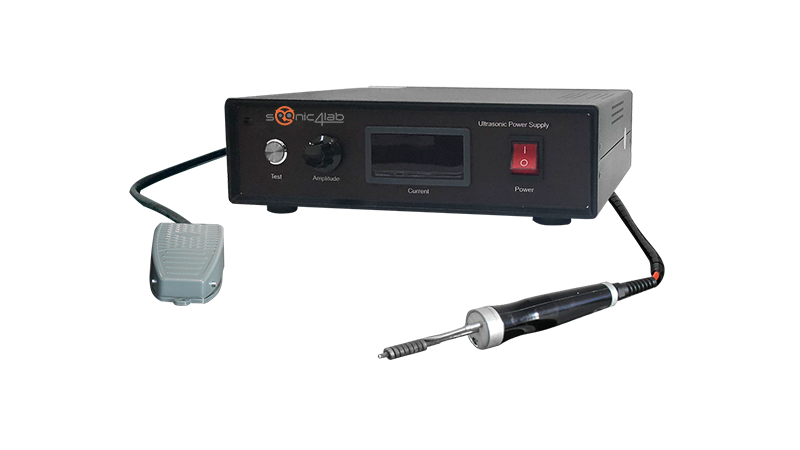
Ultrasonic vibration assisted brazing technology takes a different approach. Its process can be simply summarized as:
1. Heating and Placement: Firstly, heat the components to be connected to a temperature higher than the melting point of the brazing material but much lower than the melting point of the base material. At this point, the solid solder melts into a liquid state.
2. Apply “sonic power”: The key step is to bring a specially designed ultrasonic welding head into contact with the workpiece under a certain pressure and apply high-frequency mechanical vibration (frequency exceeding the upper limit of human hearing). This vibration is transmitted to the surface of the base material through liquid brazing material.
3. Breaking the “armor” and promoting integration: High frequency vibration can produce magical “acoustic cavitation” and “acoustic friction” effects. This force can instantly tear and break the oxide film on the surface of the base material, exposing pure metal atoms. At the same time, ultrasonic waves vigorously stir the liquid brazing material, greatly promoting its fluidity and wettability. When the pure base material surface comes into contact with the active liquid brazing material, a strong metallurgical bond can be quickly achieved.
The entire process can be completed in a normal air environment without the need for flux or protective gas, greatly simplifying the process and reducing costs.
Preliminary experiment: demonstrating strong material ‘adaptability’
Researchers have conducted preliminary experiments on various materials that are traditionally difficult to connect, and the results are encouraging:
*Welding aluminum based composite materials: These materials have high strength but are extremely difficult to weld, and traditional methods can easily damage the reinforcing particles. Experiments have shown that applying appropriate ultrasonic vibration can achieve high-strength connections at low temperatures while avoiding damage to the structure of the composite material itself.
*Connecting aluminum alloys: For conventional aluminum alloys, ultrasonic vibration can thoroughly remove the hard aluminum oxide film on their surface, obtaining dense and defect free brazed joints with excellent mechanical properties.
*Realize the “cross-border” connection between ceramics and aluminum: Ceramics and aluminum are two materials with vastly different properties. The successful experiment proves that ultrasonic vibration can activate interface reactions and achieve reliable connection between ceramics and aluminum at lower temperatures, providing new ideas for electronic packaging.
*Challenging the connection between glass and aluminum: This experiment is more groundbreaking. Ultrasonic vibration assisted brazing technology demonstrates the potential of connecting brittle materials such as glass with metals in open environments, opening up new avenues for the manufacturing of optical and vacuum devices.
Conclusion: Exploring new avenues for difficult to weld materials
Based on these preliminary experimental results, a clear conclusion appears: applying appropriate ultrasonic vibration during brazing can effectively replace the brazing agent, remove the oxide film on the surface of the base material, and significantly improve the spreading and wetting behavior of the brazing material. The ultimate result of all of this is to obtain a connection joint with uniform microstructure and excellent mechanical properties under relatively low temperature and atmospheric environment, which is a “friendly” process condition.
The maturity and promotion of this technology are expected to open up an efficient, green, and more cost-effective new path to solve the connection problems of heterogeneous materials, composite materials, and easily oxidizable materials that have long plagued the manufacturing industry. In the future, with the continuous optimization of technology, this’ connectivity master in an open environment ‘will undoubtedly play a key role in more cutting-edge manufacturing fields.
If you want to purchase equipment, please click here