
Ultrasonic Spraying Photoresist on 3D Structures
The advantages of ultrasonic spraying machine in spraying photoresist on three-dimensional structures
In advanced micro nano manufacturing fields such as MEMS, 3D IC, TSV silicon via, etc., uniform coating of photoresist on three-dimensional complex structures is the core process difficulty. The traditional spin coating method is limited by centrifugal force and is prone to defects such as edge accumulation, bottom glue deficiency, and uneven sidewall coverage at deep grooves, through holes, and steps. However, ultrasonic spraying machines, with their unique atomization and non-contact coating mechanisms, have become the optimal solution for coating three-dimensional photoresist structures and have comprehensive technical advantages.
Excellent three-dimensional structure encapsulation and step coverage
Ultrasonic spraying atomizes photoresist into uniform micro droplets of 1-50 μ m through high-frequency vibration, and gently deposits them under low-pressure carrier gas, which can cover complex morphologies from multiple angles and directions. For TSV through holes, deep grooves, V-grooves, and cantilever beam structures with high aspect ratios (>10:1), droplets can smoothly penetrate to the bottom and dead corners of the structure, with a step coverage rate of over 92%, completely solving the problems of “shadow effect” and uneven distribution of colloids in spin coating method. Spin coating relies on centrifugal force, making it difficult for the adhesive to adhere to the vertical side walls and prone to excessive accumulation at the bottom of the groove and thickening at the top edge. Ultrasonic spraying, on the other hand, can achieve uniform and consistent adhesive layers on the surface, side walls, and bottom of three-dimensional structures, without thickness differences or pinhole defects.
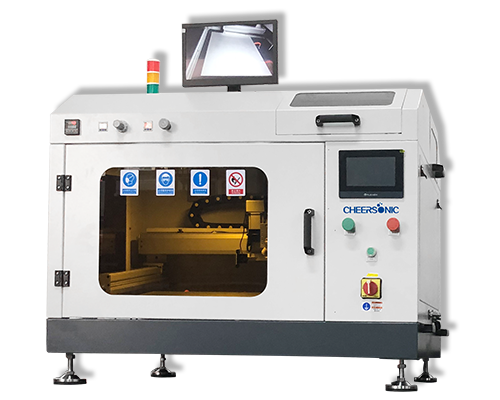
Uniformity and precise controllability of coating thickness
The coating uniformity of this technology exceeds 95%, and the film thickness error can be controlled within ± 5%. By adjusting the ultrasonic power, flow rate, nozzle speed, and spacing, it can accurately achieve a wide range of thickness control from 20nm to 100 μ m. By using layered overlay spraying technology, ultra-thin and uniform or thick film photoresist layers can be obtained on three-dimensional structures, with excellent consistency throughout the entire area, avoiding the common “coffee ring” edge effect and stripe defects in spin coating. For structured wafers with high and low fluctuations exceeding 50 μ m, the film thickness can still remain stable, providing a uniform and consistent process foundation for subsequent photolithography and etching.
Non contact processing to protect precision structures
Ultrasonic spraying is a non-contact process, with no physical contact between the nozzle and the three-dimensional structure. It does not damage fragile components such as MEMS cantilever beams, microbridges, and thin films, nor does it cause breakage of fragile substrates such as silicon wafers and glass. Compared to the structural stress and deformation risks caused by high-speed rotation of spin coating, as well as the mechanical extrusion damage caused by rolling coating, this technology can maintain the original three-dimensional structure morphology to the greatest extent possible, especially suitable for ultra-thin, irregular, and highly fragile microstructure devices.
High material utilization rate and significant cost reduction
The utilization rate of traditional spin coating photoresist is only 20% -40%, and over 80% of materials are wasted due to centrifugal separation. Ultrasonic spraying is a directional and precise deposition method, with a material utilization rate of over 95%, significantly reducing the consumption of expensive photoresist. At the same time, no large amount of waste liquid is generated, reducing environmental treatment costs. In the mass production of three-dimensional structures, the comprehensive material and process costs can be reduced by more than 60%, and the economic benefits are outstanding.
Flexible craftsmanship, adaptable to multi-dimensional three-dimensional structures
The device supports programming to control the nozzle path and can stably apply glue on flat, curved, cylindrical, spherical, and irregular three-dimensional structures. Compatible with various types of photoresist such as positive photoresist, negative photoresist, thick photoresist, thin photoresist, etc., suitable for various substrates such as silicon, glass, ceramics, metals, polymers, etc. No need to adjust the core process for different structures, only optimizing parameters can adapt to the manufacturing of multi-dimensional 3D devices such as MEMS, microfluidic chips, sensors, advanced packaging, etc., with strong process repeatability and high compatibility.
In summary, the ultrasonic spraying machine, with its core advantages of high encapsulation, high uniformity, non-contact, low loss, and high adaptability, perfectly solves the industry pain points of three-dimensional structure photoresist coating and has become a key process equipment in MEMS, 3D IC, advanced packaging and other fields, promoting the development of micro nano manufacturing towards higher precision, more complex structures, and lower costs.
About Cheersonic
Cheersonic is the leading developer and manufacturer of ultrasonic coating systems for applying precise, thin film coatings to protect, strengthen or smooth surfaces on parts and components for the microelectronics/electronics, alternative energy, medical and industrial markets, including specialized glass applications in construction and automotive.
Our coating solutions are environmentally-friendly, efficient and highly reliable, and enable dramatic reductions in overspray, savings in raw material, water and energy usage and provide improved process repeatability, transfer efficiency, high uniformity and reduced emissions.
Chinese Website: Cheersonic Provides Professional Coating Solutions