
Ultrasonic Spraying of Ru–Ir Coated Ti Electrodes
Analysis of the Technical Advantages of Ultrasonic Spraying for Ruthenium-Iridium Coated Titanium Electrodes
Ruthenium-iridium coated titanium anodes (size-stabilized anodes, DSA) are high-performance electrochemical components specifically designed for chlorine evolution environments. This product uses titanium as the substrate, with a nano-scale ruthenium-iridium oxide coating on the surface, and has wide applications in chlor-alkali industries, seawater electrolysis, disinfection systems, and water treatment. Among various preparation processes, ultrasonic spraying technology is becoming an advanced method for preparing high-performance ruthenium-iridium coated titanium electrodes due to its unique advantages.
Limitations of Traditional Preparation Processes
Traditional titanium anode coating preparation mainly uses brush coating thermal decomposition or air spraying. While brush coating is simple to operate, it suffers from problems such as uneven coating thickness, numerous pinhole defects, and easy agglomeration of oxide particles, resulting in limited electrochemical active area and unstable service life of the anode. Air spraying relies on high-pressure airflow atomization, resulting in uneven droplet size, easy generation of pinholes and bubbles, and the high-pressure impact can also damage the passivation layer of the titanium substrate. The utilization rate of precious metal materials is less than 40%, causing serious waste of valuable materials such as iridium and ruthenium. These traditional processes are insufficient to meet the stringent requirements of modern electrochemical industries for electrode performance.
Ultrasonic Spraying Technology Principle
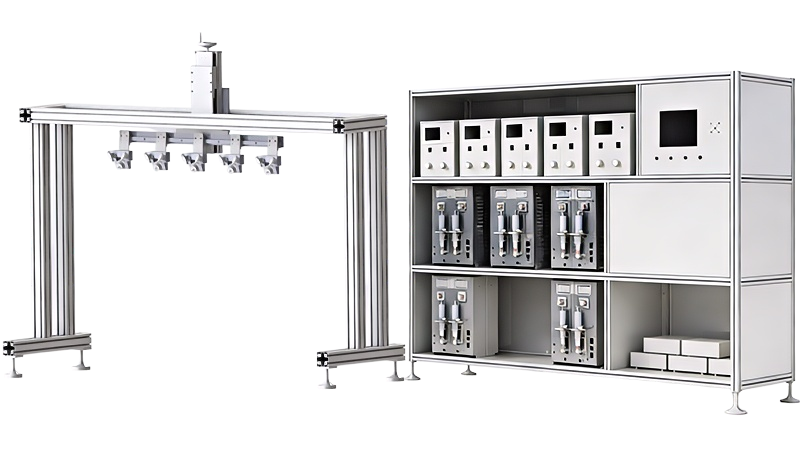
Ultrasonic spraying technology utilizes piezoelectric transducers to generate high-frequency ultrasonic waves (typically 20-120kHz). These waves are atomized through a nozzle, breaking the precursor solution into micron-sized uniform droplets. Carried by a carrier gas, these droplets are deposited on the surface of a titanium substrate, where thermal decomposition forms a metal oxide coating. This atomization process does not rely on high pressure or high-speed airflow, resulting in droplets with a highly uniform size distribution and low initial velocity.
Core Advantage 1: Significantly Improved Coating Uniformity and Precision
Ultrasonic spraying technology can atomize the precursor solution into uniform droplets with a particle size of 0.1-5 microns. Compared to brush coating, ultrasonically sprayed coatings exhibit more uniform oxide particle distribution and better consistency in crack width and depth. Coating uniformity deviation can be controlled within 5%, with no pinholes, sagging, or other defects, and a uniform distribution of active sites. Iridium and ruthenium coatings prepared by ultrasonic spraying exhibit a typical “cracked” morphology, and the crack network effectively increases the actual surface area of the electrode. Core Advantage Two: High Material Utilization, Significantly Reduced Costs
Ultrasonic spraying technology achieves a material utilization rate of 85%-95%, significantly reducing the loss of scarce precious metals such as ruthenium and iridium. Traditional air spraying achieves a utilization rate of less than 40% for precious metals, a significant difference. Furthermore, the titanium substrate is reusable; after coating failure, only the old coating needs to be removed and recoated, further reducing the total life-cycle cost.
Core Advantage Three: Significantly Enhanced Coating Adhesion and Durability
The “soft landing” characteristic of ultrasonic spraying avoids the splashing caused by high-speed droplet impact in traditional spraying, reducing pinholes and crack defects. This non-contact deposition method does not damage the titanium substrate and avoids the drawbacks of slurry splashing and material waste. The uniform and dense oxide coating effectively blocks contact between corrosive media and the titanium substrate. Experimental data shows that electrodes prepared using this technology have a coating peeling rate of less than 5% after 1000 cycles, far superior to the 15%-20% of traditional processes.
Core Advantage Four: Comprehensive Optimization of Electrochemical Performance
Electrochemical tests show that the ultrasonically sprayed anode exhibits significantly increased volt-ampere charge, reduced chlorine evolution overpotential, and superior enhanced lifespan test results. In chlor-alkali electrolysis tests, this anode demonstrates a lower chlorine overpotential and a longer enhanced electrolysis lifespan. The adhesion between the coating and the titanium substrate is enhanced, effectively inhibiting the formation of passivation films and the dissolution and loss of active components.
Conclusion
Ultrasonic spraying technology provides a high-quality, high-precision solution for the preparation of ruthenium-iridium coated titanium electrodes. This technology achieves uniform and controllable coating composition and structure by precisely controlling droplet size and the deposition process, significantly reducing precious metal consumption while improving anode electrocatalytic performance and service life. With the increasing demands for energy conservation, emission reduction, and production stability in the chlor-alkali industry, water treatment, electroplating, and other fields, the application prospects of ultrasonic spraying technology in titanium anode manufacturing will be even broader.
About Cheersonic
Cheersonic is the leading developer and manufacturer of ultrasonic coating systems for applying precise, thin film coatings to protect, strengthen or smooth surfaces on parts and components for the microelectronics/electronics, alternative energy, medical and industrial markets, including specialized glass applications in construction and automotive.
Our coating solutions are environmentally-friendly, efficient and highly reliable, and enable dramatic reductions in overspray, savings in raw material, water and energy usage and provide improved process repeatability, transfer efficiency, high uniformity and reduced emissions.
Chinese Website: Cheersonic Provides Professional Coating Solutions
