
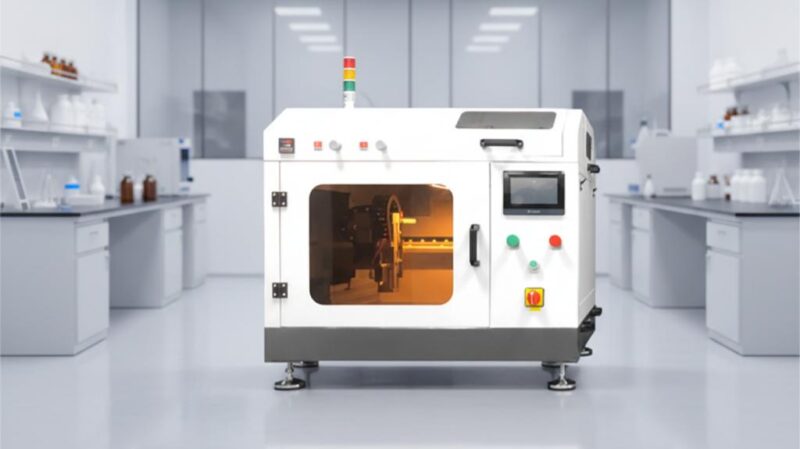
Ultrasonic Spraying Machine for SOFC Coating
Ultrasonic spraying machines can achieve ultra-thin, highly uniform coatings at the nanometer to micrometer scale in SOFC manufacturing, significantly improving material utilization (85-95%) and mass production consistency. Applications and verifications have been achieved in cathode impregnation, electrolyte films, and multifunctional composite layers.
Overview of SOFC and Ultrasonic Spraying
Solid Oxide Fuel Cell (SOFC)
- Third-generation fuel cell, all-solid-state structure, directly converts chemical energy into electrical energy at high temperatures of 600-1000°C.
- Core components: Anode (Ni-YSZ), Electrolyte (YSZ/LSGM), Cathode (LSCF/LSM)
- Advantages: High efficiency (>60%), diverse fuels, zero pollution, long lifespan

Ultrasonic Spraying Principle
- High-frequency ultrasonic vibration (25-200kHz) atomizes the liquid into uniform droplets of 5-50μm.
- After atomization, the droplets are transported by low-pressure carrier gas and precisely deposited onto the substrate.
- Non-contact spraying, achieving nanometer to micrometer-level coating thickness through parameter control.
Application of Ultrasonic Spraying in SOFC
1. Cathode Coating Preparation
- Catalyst Impregnation: Single-step ultrasonic spraying achieves 6-8wt% catalyst loading (traditionally requiring more than 4 steps).
- Materials: Perovskite oxides such as LSCF, LSCo, and PSCo.
- Case Study: 1. Single-step spraying of LSCo to LSCF cathode at 120kHz frequency, achieving a power density of 0.88 W/cm² at 800°C.
2. Electrolyte Thin Film Deposition
- Dense electrolytes: LSGM, YSZ, etc., thickness 5-20 μm
- Advantages: Coating uniformity >95%, low pinhole rate, significantly reduced ion conduction resistance
- Case Study: Ultrasonic spraying of Gd-Yb-Bi-Ce-O (GYBC) buffer layer, achieving an output power of 2.32 W/cm² at 800°C.
3. Anode Functional Layer
- NiO-YSZ composite anode: Prepared by ultrasonic spraying pyrolysis, with uniform particle dispersion and high porosity.
- Nanostructure optimization: Improves fuel contact area and anti-carbon deposition performance.
4. Other Applications
- Connector coating: Coating with Mn-based oxides to improve oxidation resistance.
- Barrier layer: Coating with Ce-based oxides to prevent element interdiffusion.
Advantages of Ultrasonic Spraying Compared to Traditional Processes
Coating Quality: Uniformity >95%, thickness error <5%, reducing local current density unevenness and improving stability.
Material Efficiency: Utilization rate 85-95%, compared to only 20-30% for traditional methods, saving over 80% on precious metal catalyst costs.
Precision Control: Thickness continuously adjustable from 20nm to tens of μm, achieving ultra-thin electrolytes and reducing ohmic losses.
Simplified Process: Single-step completion, reducing processes by over 50%, shortening manufacturing cycles, and lowering equipment investment.
Reduced Energy Consumption: 30-50% lower than CVD/sputtering, reducing production energy consumption and costs.
Typical Process Steps
1. Slurry Preparation: Dissolve/disperse metal salts/oxides (such as lanthanum nitrate, strontium nitrate, cobalt nitrate, etc.) in a solvent (water/alcohol), and add chelating agents (such as citric acid) and surfactants (such as Triton X-100).
2. Substrate Pretreatment:
- Degreasing and heat treatment of anode/cathode supports
- Surface plasma treatment to improve hydrophilicity
3. Ultrasonic Spraying:
- The nozzle scans at a speed of 5-20 cm/s, with interlayer drying/heat treatment (typically 400-600°C).
- Total thickness is precisely controlled by the number of sprays.
4. Post-treatment: High-temperature sintering (850-1000°C) to form a dense/porous functional layer.
Summary
Ultrasonic spraying, with its advantages of high precision, high uniformity, and high material utilization, has become one of the most promising coating technologies in SOFC manufacturing. It can not only significantly improve battery performance and stability but also reduce material and manufacturing costs, accelerating the commercialization of SOFCs.
- Suitable applications: High-performance SOFC single cells, large-area/mass production, ultra-thin electrolyte and precision functional layer fabrication.
- Next steps: Conduct small-batch pilot production, optimize ultrasonic frequency, slurry formulation and sintering process for specific material systems, and fully unleash the potential of this technology in SOFCs.
About Cheersonic
Cheersonic is the leading developer and manufacturer of ultrasonic coating systems for applying precise, thin film coatings to protect, strengthen or smooth surfaces on parts and components for the microelectronics/electronics, alternative energy, medical and industrial markets, including specialized glass applications in construction and automotive.
Our coating solutions are environmentally-friendly, efficient and highly reliable, and enable dramatic reductions in overspray, savings in raw material, water and energy usage and provide improved process repeatability, transfer efficiency, high uniformity and reduced emissions.
Chinese Website: Cheersonic Provides Professional Coating Solutions
