
Ultrasonic Soldering Iron for Welding Metal and Quartz Glass
When Ice Meets Fire: Unveiling the Magic of Ultrasonic Welding of Metal and Quartz Glass
In our daily impression, welding is always associated with high temperature, sparks, and molten metal. Attempting to “weld” metal and crystal clear quartz glass together sounds more like an impossible task. Metal is hard and conductive, while quartz glass is fragile and insulating. The physical properties of the two are vastly different, like trying to blend ice and fire together.
However, with the help of modern technology, a technique called ultrasonic welding cleverly circumvents the difficulties of traditional welding and achieves a firm and precise structure between metal and quartz glass.
Why is traditional welding helpless?
To understand the intricacies of this technology, one must first understand why traditional welding fails here.
1. Unequal melting point: Common metals such as copper and aluminum typically have melting points of several hundred to one thousand degrees, while high-purity quartz glass has a softening point of over 1600 ℃. If high-temperature melting of metal is used to “infiltrate” glass, before the glass is connected, the metal has already vaporized, and even quartz glass may explode due to uneven heating.
2. Mismatch in thermal expansion coefficient: The magnitude of thermal expansion of metals is much greater than that of quartz glass. Even if the connection is forced, the huge shrinkage stress during the cooling process will directly tear the joint.
3. “Non infiltration” problem: Molten metal liquid is like water droplets on a lotus leaf, unable to spread on a smooth glass surface and form effective metallurgical bonds.
Obviously, a “cold” connection method that does not rely on overall melting is needed.
The magic of ultrasound: “frictional heat generation” in the microscopic world
Ultrasonic welding technology is precisely such a “cold” connection solution. Its core principle is not to melt materials with flames, but to use the energy generated by high-frequency vibration to achieve material bonding at the microscopic level. The entire process can be summarized as “vibration, friction, diffusion, and bonding”.
Step 1: Precise pressurization and vibration
Firstly, accurately align the metal sheet (or metallized quartz glass) to be welded with the quartz glass component and apply a stable pressure to press them tightly. Then, a key component called the “welding head” will come into contact with the metal surface.
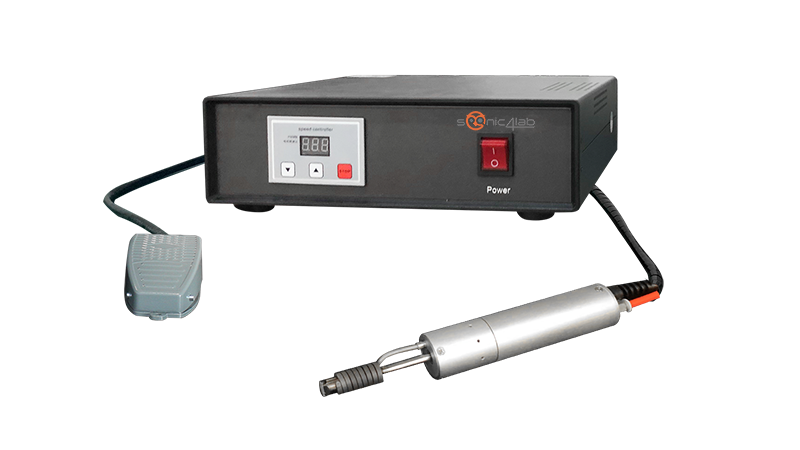
This welding head will vibrate at a frequency of tens of thousands of times per second (usually in the ultrasonic range of 20kHz to 60kHz, which is inaudible to the human ear) with high frequency and small amplitude. This vibration direction is a shear type vibration parallel to the welding interface.
Step 2: Microscopic cleaning and frictional heat generation between interfaces
The surfaces of metal and quartz glass are uneven even under a microscope, and are covered with a layer of oxide film, oil stains, and adsorbed gases. These impurities are the “roadblocks” that hinder atomic level binding.
The high-frequency vibration of ultrasound is like an invisible ‘microscopic broom’, which instantly removes these interface pollutants through intense friction. Meanwhile, friction generates concentrated heat. However, please note that this heat does not come from external heating, but is generated in an extremely small area between the two contact surfaces, so the overall workpiece is still “cold” and will not reach the melting point of the material.
Step 3: Inter atomic diffusion and solid-phase bonding
Under the combined action of pressure and frictional heat, the activity ability of metal atoms at the interface is rapidly enhanced. They will break through the original lattice constraints and diffuse and infiltrate towards the surface of quartz glass (or pre coated metal layer). Meanwhile, the intense plastic deformation also causes the pure surfaces of the two materials to approach each other infinitely in terms of atomic spacing.
Finally, a solid-phase connection layer tightly bound by interatomic forces was formed at the interface. This means that the connection is completed in a solid state without undergoing a liquid melting stage, thus perfectly avoiding issues such as thermal stress and non wetting.
Key points and magical applications of technology
To achieve reliable welding between metal and quartz glass, it is usually necessary to perform metallization pretreatment on the surface of quartz glass, which involves depositing a very thin and easy to weld metal film (such as titanium, chromium, gold, etc.) on the glass surface through special processes (such as vacuum sputtering). This layer of film serves as a transition layer with strong adhesion to the glass, and is then welded together with external metal components using ultrasonic waves.
The advantages of this technology make it indispensable in the high-end manufacturing field:
*Excellent airtightness: capable of achieving perfect vacuum sealing, used for sensor windows in aerospace vehicles and sealed casings for high-power lasers.
*No thermal damage: Protects the excellent optical properties and internal precision components of quartz glass.
*High strength: The mechanical strength of the welding point is close to that of the base metal.
Conclusion
Ultrasonic welding technology, like a highly skilled “micro forging master”, does not use flames, but uses intangible sound wave energy to complete the “handshake” between metal and quartz glass in the microscopic world. It breaks the limitations of traditional hot processing and opens a door for us to a more precise and reliable manufacturing field, allowing these materials with different properties to coexist harmoniously and jointly support the brilliant starry sky of modern technology.
If you want to purchase equipment, please click here

