
Ultrasonic Soldering and Bonding Equipment
Ultrasonic Soldering and Bonding Equipment – Sonic4Lab
What is ultrasonic soldering?
Ultrasonic Soldering and Bonding Equipment is a disruptive flux free welding technique that has been used for connecting difficult to solder materials such as aluminum since the 1950s. It is based on the cavitation effect caused by high-frequency vibration (usually 20-30 kHz), which can remove the surface oxide layer of the material without the need for chemical flux, and achieve material bonding with heat. It is considered a typical representative of environmentally friendly welding due to the absence of chemical pollution throughout the process.
Unlike common ultrasonic plastic welding, it does not rely on vibration to directly generate heat and melt the workpiece. Instead, it uses an independent heat source to melt the solder first, and then uses the molten solder as a medium to transfer vibration energy. This “melting before vibration” characteristic enables precise control of the welding process and avoids material overheating damage.
Core principle: The “cleaning magic” of vibration and cavitation
The soul of this technology lies in the cavitation effect, and its principle is similar to ultrasonic cleaning:
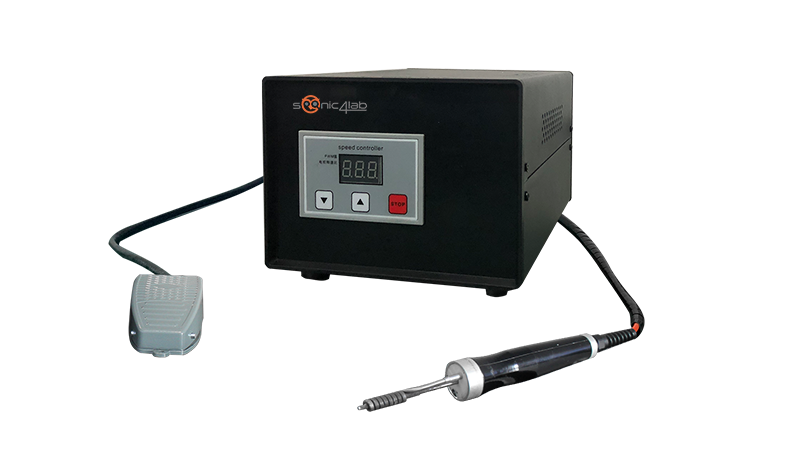
- Energy transfer: The ultrasonic generator converts electrical energy into high-frequency vibration, which is transmitted into the molten solder through the tool head;
- Birth of cavitation: Vibration causes countless tiny bubbles to form inside the solder, which rapidly expand under pressure changes;
- Powerful cleaning: The shock wave generated by the instantaneous collapse of bubbles can peel off the oxide layer on the surface of metal, glass and other substrates like a miniature “cleaning brush”, while squeezing out air and impurities in the gaps;
- Tight integration: The clean surface of the substrate allows the liquid solder to fully infiltrate, and vibration also forces the solder to penetrate into micropores, ultimately forming a dense solder joint without gaps, which can even meet the sealing requirements of high vacuum environments.
Key support: special solder that can “chemically bond”
The breakthrough in welding non-metallic materials such as glass and ceramics originated from the birth of an active solder alloy. This type of alloy is based on the conventional solder composition, with the addition of oxygen friendly elements such as zinc, titanium, and silicon. During welding, these elements react with oxygen in the air to form special oxides, which can form strong chemical bonds (RO bonds) with the silicon oxygen bonds of glass and the oxide surfaces of ceramics, achieving a “heterogeneous material marriage”.
Interestingly, this type of welding is extremely sensitive to oxygen concentration: experiments have shown that an oxygen concentration of around 2% is the critical point for bonding. If inert gases such as nitrogen are used to completely isolate oxygen, the solder will actually lose its adhesion; More specifically, the use of traditional soldering flux can disrupt this oxygen bond reaction, so this process must strictly eliminate soldering flux. Its melting point is between 155-297 ℃, suitable for the welding requirements of most precision components.
Three practical methods: from manual to assembly line
According to the scale and precision requirements of the workpiece, three core processes have been developed for ultrasonic soldering:
- Two step method (pre soldering+bonding): First, use an ultrasonic soldering iron to coat the active solder on the surface of glass, ceramic and other substrates to form a “pre soldering layer”, and then solder the metal parts to the pre soldering layer with solder – this method can obtain the highest strength joint, especially suitable for precision electronic component soldering;
- One step method (direct welding): Clamp the solder between metal and non-metal, and use a vibrating tool head to apply pressure and weld directly. Although it is efficient, the joint strength is slightly lower, making it suitable for mass production scenarios;
- Immersion method: Melt the solder in a fusion welding pot with ultrasonic vibration, and immerse the workpiece in 3-10 seconds to complete large-area coating. It is an ideal choice for industrial production of glass coating, enameled wire tin, etc.
These methods can be manually operated with handheld soldering irons or integrated into automated assembly lines, suitable for all scenarios from laboratory research and development to large-scale manufacturing.
Application Layout: Cross border Breakthrough from Glasses to Aerospace
With the advantages of “flux free and heterogeneous soldering”, it has penetrated into multiple high-precision and cutting-edge fields:
- Electronics and Optics: Making electrodes on liquid crystal glass, welding optical fibers and metal interfaces, and even accurately welding 120 μ m glass optical fibers into 0.5mm copper holes;
- Energy and environmental protection: used for welding front and rear electrodes of solar cells (monocrystalline silicon, perovskite, etc.), as well as for making metal ceramic seals for fuel cells;
- Precision manufacturing: welding of heating contacts for automotive rear windows, connection between superconductors and ceramic components, and welding of shape memory alloys in medical devices all have their presence;
- Special fields: “impossible tasks” such as welding titanium rods and sapphire substrates, and connecting niobium coils and microcrystalline glass have all achieved breakthroughs through this technology.
Advantages and Challenges: The Balance Behind Environmental Protection
Core strengths
Green and efficient: eliminating the need for flux cleaning, reducing chemical waste discharge and reducing production time by more than 30%;
Reliable joint: Welding points without bubble gaps have stronger corrosion resistance and durability, which is more than 50% higher than traditional welding;
Wide compatibility: capable of connecting more than 10 heterogeneous combinations such as metal glass, ceramic aluminum, etc., breaking through the limitations of traditional welding.
Existing challenges
Equipment cost: The initial investment is relatively high, which puts certain pressure on small and medium-sized enterprises;
Technical threshold: Parameters such as vibration frequency, temperature, and pressure need to be accurately matched, and operators require professional training;
Material limitations: The welding effect of some composite materials is limited, and it is difficult to handle ultra thick workpieces.
Conclusion
From a niche technology in the laboratory to an environmental pioneer in the industry, ultrasonic soldering has solved the century old problem of heterogeneous material welding with the innovative idea of “vibration cleaning+chemical bonding”. With the upgrading of active solder formulations and the reduction of equipment costs, it may create more possibilities in areas such as chip manufacturing and new energy in the future – after all, in the era of pursuing green and precision, this “chemical free welding magic” perfectly meets the core requirements of industrial development.
If you want to purchase equipment, please click here