
Ultrasonic PTFE Coating
Ultrasonic PTFE Coating: A High-Performance Coating Process for Precision Components
Ultrasonic coating of polytetrafluoroethylene (PTFE) is an advanced process that utilizes ultrasonic vibration energy to achieve precise and efficient PTFE coating. Through the high-frequency mechanical vibration of ultrasound, it solves the problems of uneven coating, poor adhesion, pinholes, and bubbles that easily occur in traditional coating processes (such as dip coating and spray coating) on precision components. It is particularly suitable for scenarios with stringent requirements for coating precision and performance, such as biopsy needles, miniature valves, and precision bearings. It is also an important application direction of ultrasonic technology in the field of surface engineering.
Core Process Principle
The core of ultrasonic PTFE coating is to convert electrical energy into high-frequency mechanical vibration (typically 20–60kHz) through an ultrasonic transducer and transmit the vibration to the coating head or substrate surface, enabling the PTFE coating material to achieve the entire process of “dispersion-adhesion-film formation” under the action of vibration:
1. Substrate Pretreatment: The substrate (such as stainless steel for biopsy needles, titanium alloy for industrial parts) is first degreased and roughened (e.g., by plasma treatment) to improve the adhesion between the substrate surface and PTFE.
2. Coating Material Preparation: PTFE is prepared as powder (particle size 1–50 μm) or an aqueous emulsion (containing PTFE microspheres). The material form is selected according to the required coating thickness (emulsions are suitable for ultra-thin coatings, powders for thick coatings).
3. Ultrasonic Coating Process: The coating head carries the PTFE material close to the substrate surface. High-frequency vibration uniformly disperses the PTFE particles/microspheres. Simultaneously, the micro-impact effect generated by the vibration allows PTFE molecules to physically intercalate with the substrate surface, preventing coating delamination.
4. Curing and Sintering: After coating, the substrate is placed in a high-temperature furnace for sintering (370–380℃, the melting temperature of PTFE). This melts the PTFE particles into a continuous, dense coating film, which, upon cooling, forms a stable, low-friction surface.
Core Advantages (Comparison with Traditional PTFE Coating Processes)
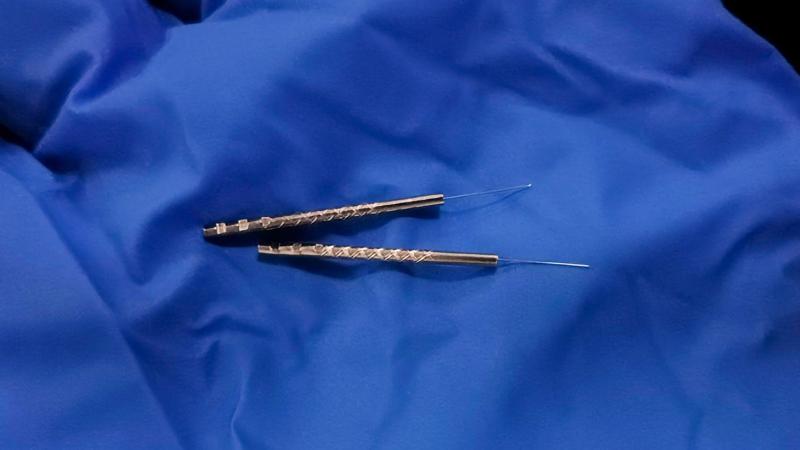
1. Dedicated Fit for Precision Components: Ultrasonic vibration can precisely target minute areas, achieving uniform coating on complex curved surfaces such as the slender body and beveled tip of biopsy needles. This eliminates dead zones and drips, and the coating thickness can be controlled between 1–50 μm, meeting the high precision requirements of lubrication coatings for medical biopsy needles.
2. Significantly Improved Coating Adhesion: In traditional coating processes, PTFE adheres primarily to the substrate through physical adsorption. However, the micro-impact effect of ultrasonic vibration embeds PTFE particles into microscopic pits on the substrate surface, forming a “mechanical anchor,” increasing adhesion by over 30%. This prevents coating detachment during biopsy needle puncture or coating failure during friction in industrial components.
3. No Pinholes, No Bubbles: The cavitation effect of ultrasound eliminates bubbles in the coating material. Simultaneously, vibration causes PTFE particles to align tightly, forming a dense coating after sintering. This prevents bodily fluids (medical) or chemical media (industrial) from penetrating and corroding the substrate through pinholes.
4. Low-Temperature Coating Compatible with Sensitive Substrates: Some ultrasonic coating processes can complete coating adhesion at room temperature, requiring only subsequent low-temperature sintering. This avoids damage to heat-sensitive substrates caused by high temperatures, expanding the application range.
Typical Application Scenarios
1. Medical Field: Interventional Devices such as Biopsy Needles
This is one of the core application scenarios for ultrasonically coated PTFE, perfectly matching the previously mentioned requirements for biopsy needle lubrication coatings:
- Coating Function: Utilizing the low-friction properties of PTFE, it reduces frictional resistance between the biopsy needle and human tissue, lowering patient pain and the risk of tissue damage; simultaneously, PTFE’s chemical inertness ensures biocompatibility, meeting medical standards.
- Process Advantages: Uniform coating can be achieved on the fine structures of biopsy needles, such as the needle tip, needle body, and graduations, avoiding problems caused by traditional processes such as graduations being covered by the coating and excessively thick coating at the needle tip affecting puncture force.
2. Industrial Field: Precision Mechanical Components
- Miniature Valves and Pumps: PTFE coating provides anti-sticking and anti-corrosion properties, suitable for micro-fluid control components in the chemical and food industries.
- Precision bearings and guide rails: Utilizing the self-lubricating properties of PTFE, friction and wear are reduced, extending component lifespan, especially suitable for enclosed equipment where continuous lubrication is not possible.
- Ultrasonic equipment accessories: Such as nozzles in ultrasonic spraying equipment and mold surfaces in ultrasonic welding equipment, coating with PTFE prevents material adhesion and facilitates cleaning.
Key Technical Points
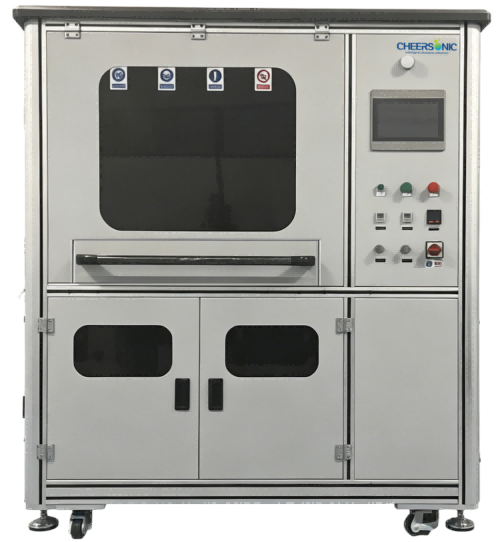
1. Ultrasonic Parameter Control: Frequency (20–40kHz suitable for precision parts, 40–60kHz suitable for ultra-thin coatings) and amplitude (10–50μm) need to be adjusted according to the substrate size and coating thickness to avoid excessive amplitude causing substrate deformation.
2. PTFE Material Selection: For medical applications, medical-grade PTFE emulsion (particle size <10μm) is preferred; for industrial applications, powder or emulsion can be selected according to requirements.
3. Substrate Pretreatment: Plasma treatment is a key step in improving adhesion, removing organic contaminants from the substrate surface and increasing surface roughness.
4. Sintering process control: The sintering temperature must be strictly controlled within the melting temperature range of PTFE to avoid excessive temperature causing PTFE decomposition and the generation of toxic gases.
About Cheersonic
Cheersonic is the leading developer and manufacturer of ultrasonic coating systems for applying precise, thin film coatings to protect, strengthen or smooth surfaces on parts and components for the microelectronics/electronics, alternative energy, medical and industrial markets, including specialized glass applications in construction and automotive.
Our coating solutions are environmentally-friendly, efficient and highly reliable, and enable dramatic reductions in overspray, savings in raw material, water and energy usage and provide improved process repeatability, transfer efficiency, high uniformity and reduced emissions.
Chinese Website: Cheersonic Provides Professional Coating Solutions
