Ultrasonic Precision Soldering Iron
In the field of consumer electronics and intelligent sensing, core devices such as MEMS sensors and silicon microphones are evolving towards micrometer level and high integration. The solder joint diameter of these devices is often less than 0.2mm, and some are even less than 0.1mm. They are often accompanied by thermal sensitive components and flexible substrates, which impose strict requirements on the welding process of “zero pollution, low heat loss, and high precision”. Ultrasonic precision soldering iron welding is the preferred solution to solve this problem.
Traditional welding techniques are often limited in the face of microdevices. The diameter of the soldering iron tip for conventional soldering is much larger than the size of micro solder joints, which can easily cause bridging between adjacent solder joints. Mechanical pressure can also cause deformation of flexible substrates, with a defect rate of over 8%; The volatile substances of the solder flux in the pre-set solder paste will remain in the sensitive area, directly affecting the detection accuracy of the device. More importantly, traditional processes rely on high-temperature conduction, which generates thermal stress that can cause small deformations in the internal structure of MEMS sensors, leading to signal drift or even failure.
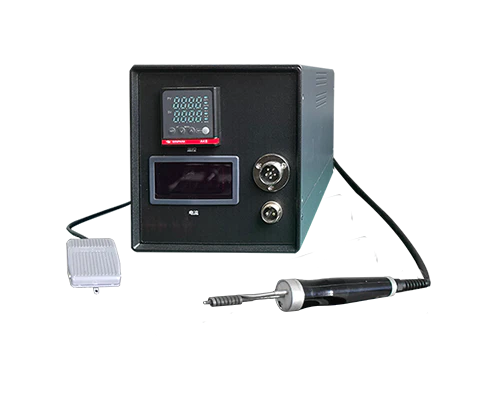
Ultrasonic precision soldering iron has broken through these bottlenecks through technological innovation. The core principle is to convert electrical energy into high-frequency mechanical vibrations of 20kHz-40kHz, generating molecular level frictional heat at the solder joint interface to achieve solid-state bonding. The welding temperature is reduced by 60% compared to traditional processes, fundamentally eliminating the risk of thermal stress damage. This “cold welding” characteristic is particularly important for thermal sensitive devices such as silicon microphones, ensuring that their acoustic performance is not affected by temperature.
In terms of pollution control, this technology has demonstrated significant advantages. It uses the cavitation effect of ultrasound to mechanically clean the welding surface, achieving reliable connections of various materials such as glass, ceramics, and metals without the need for soldering flux. This not only avoids the contamination of MEMS sensor sensitive components by chemical residues, but also eliminates the need for subsequent cleaning processes, which is both environmentally friendly and improves production efficiency. At the same time, ultrasonic vibration can squeeze out bubbles in liquid solder, making the solder joint free of pores and ensuring the stability of signal transmission.
With the continuous improvement of sensing accuracy requirements for smart devices, ultrasonic precision soldering iron has become the core supporting technology for the mass production of micro devices. With its unique advantages of pollution-free, low heat loss, and high precision, it safeguards the performance bottom line of MEMS sensors, silicon microphones, and other devices, providing a solid connection guarantee for the miniaturization wave of high-end electronic manufacturing.
About Sonic4Lab
Sonic4Lab was founded to ultrasonic instruments including ultrasonic soldering iron, ultrasonic impact treatment, ultrasonic knife and so on. Our customers are Research and Development laboratories and companies for production applications. We use state-of-the-art equipment and in-depth experience to develop accessible solutions for emerging applications.