
Ultrasonic Dispersion Transparent Ceramic Slurry
Transparent ceramics are widely used in high-end fields such as lasers, optical communications, and aerospace due to their excellent optical, mechanical, and high-temperature resistance properties. However, the preparation of high-performance transparent ceramics is difficult, and the dispersion quality of the slurry is the key. Ultrasonic dispersion technology is an important means of preparing transparent ceramic slurry.
When ultrasound propagates in liquid, it produces cavitation and mechanical vibration effects, thereby achieving dispersion of the slurry. I will first briefly explain the mechanism of cavitation effect, and then summarize the role of mechanical vibration, simplifying language expression.
The cavitation effect and mechanical vibration generated by ultrasound propagation in liquid are the key to achieving slurry dispersion. Under the cavitation effect, ultrasound propagation forms alternating compression and sparsity regions. The cavitation bubbles generated in the sparsity region collapse sharply during the compression stage, and the shock waves and microjets generated instantly can break up particle aggregates. At the same time, the mechanical vibration of ultrasound drives the periodic movement of the liquid medium, promoting particle collision and friction, further promoting the disintegration of aggregates, and improving the dispersion uniformity of the slurry.

The Effect of Ultrasonic Dispersion on the Properties of Transparent Ceramic Slurry
Particle size distribution:
The quality of ultrasonic dispersion directly affects the particle size distribution of transparent ceramic slurry. When the ultrasonic dispersion effect is good, the particle aggregates in the slurry are fully broken, and the particle size distribution will be more uniform. Uniform particle size distribution helps to reduce the generation of pores and defects during subsequent molding and sintering processes, and improve the density and optical properties of transparent ceramics. Related experimental studies have shown that after ultrasonic dispersion treatment with appropriate parameters, the particle size distribution range of transparent ceramic slurry particles is significantly narrowed, and the number of large particle aggregates is significantly reduced.
Viscosity:
The viscosity of the slurry is an important parameter that affects its formability. Ultrasonic dispersion can effectively reduce the viscosity of transparent ceramic slurry. This is because ultrasonic dispersion breaks the agglomeration structure between particles, reduces the interaction force between particles, and improves the fluidity of the slurry. Moderate viscosity is beneficial for the filling and leveling of the slurry during the forming process, ensuring the uniformity and integrity of the formed body.
Stability:
The stability of transparent ceramic slurry is crucial for subsequent storage and processing. After ultrasonic dispersion treatment, the slurry has uniform particle dispersion and enhanced repulsive force between particles, which can effectively prevent particle re aggregation and settling, thereby improving the stability of the slurry. Experimental data shows that transparent ceramic slurry treated with ultrasonic dispersion has a significantly reduced settling rate and can maintain a stable state for a longer period of time.
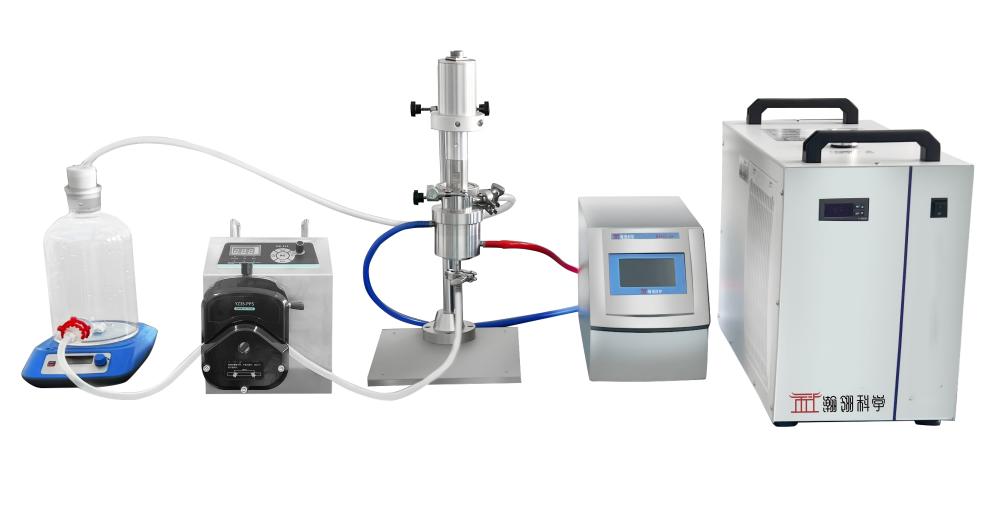
Ultrasonic dispersion technology has significant advantages in the preparation of transparent ceramic slurry, which can improve the dispersion quality and ceramic properties. In the future, with the continuous development of technology, ultrasonic dispersion technology will be continuously improved and optimized. On the one hand, by conducting in-depth research on the mechanism of ultrasonic dispersion, further optimizing ultrasonic parameters, and improving the stability and reliability of dispersion effects; On the other hand, combining ultrasonic dispersion technology with other dispersion techniques can form a synergistic effect to meet the preparation needs of different types of transparent ceramic slurries.
I believe that in the near future, ultrasonic dispersion technology will play a more important role in the preparation of transparent ceramic slurries, providing strong technical support for the research and production of high-performance transparent ceramics.
Chemisonic specializes in ultrasonic liquid processing technology. For decades, we have dedicated to designing, developing, and manufacturing ultrasonic liquid processors independently, from laboratory application to industrial level. Cutting-edge ultrasonic technology, high quality device and easy-to-use operating system are the fundamentals for our company to achieve continued business growth.
