
Ultrasonic Dispersion of Titanium Dioxide Nanoparticles
Titanium dioxide nanoparticles are widely used in various fields due to their unique advantages such as photocatalytic degradation of pollutants, improvement of coating performance, and realization of sunscreen for cosmetics. However, due to its high surface energy, it is prone to aggregation, resulting in reduced specific surface area, decreased catalytic activity, and decreased coating quality. In contrast, ultrasonic dispersion has become an effective method for solving the agglomeration of titanium dioxide nanoparticles.
The principle of ultrasonic dispersion
Ultrasonic dispersion mainly utilizes the cavitation effect and mechanical vibration generated by the propagation of ultrasonic waves in a medium to break down the aggregates of titanium dioxide nanoparticles.
The cavitation effect is the core mechanism of ultrasonic dispersion. When ultrasound propagates in a liquid medium, alternating compression and stretching zones are generated. In the stretching zone, tiny bubbles in the liquid will rapidly expand, while in the compression zone, these bubbles will rapidly rupture. At the moment of bubble rupture, a huge impact force and local high temperature and high pressure environment are generated. This powerful force can overcome the van der Waals forces and other attractive forces between nanoparticles, dispersing the agglomerated particles.
At the same time, the mechanical vibration of ultrasound can also produce shear effects on particles, further promoting the fragmentation and dispersion of aggregates, allowing titanium dioxide nanoparticles to be uniformly dispersed in the medium.

Advantages of Ultrasonic Dispersion
Compared with other dispersion methods, ultrasonic dispersion has the following significant advantages:
- High efficiency: Ultrasonic waves can have a strong effect on nanoparticles in a short period of time, quickly achieving dispersion and greatly reducing dispersion time.
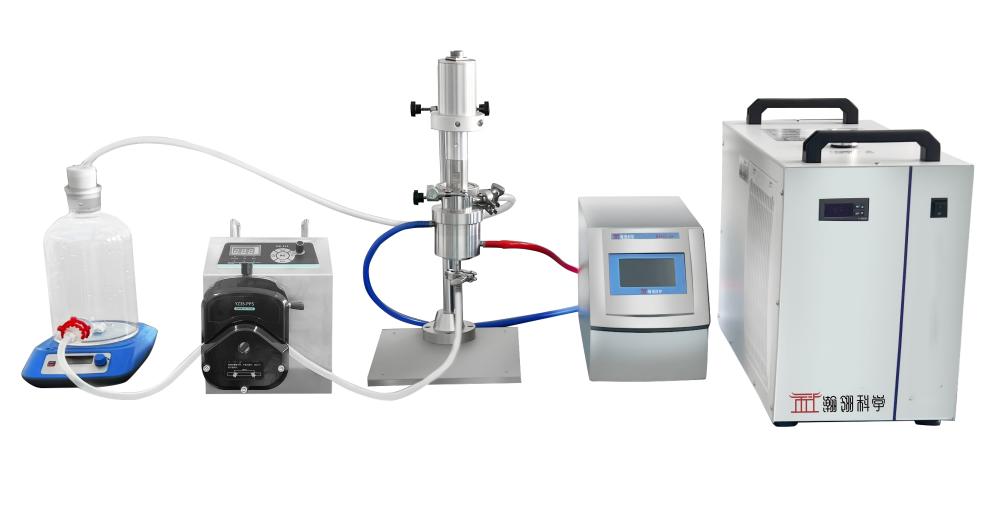
- Easy to operate: Simply place the probe or container of the ultrasonic device into a suspension containing titanium dioxide nanoparticles, set the relevant parameters, and perform dispersion operation without complex process flow.
- Less damage to particles: Compared to some mechanical stirring methods, ultrasonic dispersion does not cause significant damage to the structure of titanium dioxide nanoparticles and can better maintain their original properties.
- Good dispersion effect: It can effectively break the agglomerates of nanoparticles, making the particles more evenly dispersed and improving the stability of the suspension.
Factors affecting dispersion effect
- Ultrasonic power: When the power is too low, the cavitation effect and mechanical vibration intensity generated are insufficient, making it difficult to effectively disperse aggregates; Excessive power may cause liquid overheating, even damage the structure of nanoparticles, and increase energy consumption. Therefore, it is necessary to choose an appropriate ultrasonic power.
- Processing time: Within a certain range, as the processing time increases, the dispersion effect will gradually improve. But after a certain period of time, the dispersion effect tends to stabilize. Continuing to extend the time will not only not improve the dispersion effect, but may also cause energy waste.
- Solution concentration: When the solution concentration is too high, the distance between nanoparticles is close, which can easily cause agglomeration and affect the dispersion effect; If the concentration is too low, it will reduce dispersion efficiency and increase costs.
- Temperature: Temperature has a significant impact on cavitation effects. When the temperature is too high, the vapor pressure of the liquid increases, making it difficult for bubbles to form and burst, and the cavitation effect weakens; If the temperature is too low, it may lead to an increase in the viscosity of the solution, which is not conducive to the propagation of ultrasound and the dispersion of particles.
Application Fields
- Materials Science: In the preparation of composite materials, adding titanium dioxide nanoparticles dispersed by ultrasound to the polymer matrix can improve the mechanical properties, thermal stability, and antibacterial properties of the composite material. For example, adding evenly dispersed titanium dioxide nanoparticles to plastics can enhance their strength and aging resistance.
- Environmental engineering: In wastewater treatment, the use of titanium dioxide nanoparticles dispersed by ultrasound as photocatalysts can improve their degradation efficiency of organic pollutants in wastewater. Uniformly dispersed particles can come into full contact with pollutants, enhancing the effectiveness of photocatalytic reactions.
- Biomedical: In the field of drug delivery, encapsulating drugs on the surface of titanium dioxide nanoparticles dispersed by ultrasound can improve the stability and bioavailability of drugs. Uniformly dispersed particles facilitate the transportation and release of drugs in the body.
With the continuous advancement of technology, ultrasonic dispersion technology will play a more important role in the dispersion application of titanium dioxide nanoparticles, promoting the further development and application of titanium dioxide nanomaterials in various fields.
Chemisonic specializes in ultrasonic liquid processing technology. For decades, we have dedicated to designing, developing, and manufacturing ultrasonic liquid processors independently, from laboratory application to industrial level. Cutting-edge ultrasonic technology, high quality device and easy-to-use operating system are the fundamentals for our company to achieve continued business growth.
