Ultrasonic Dispersion of Platinum Alloy Catalyst
Ultrasonic Dispersion of Platinum Alloy Catalyst – Chemisonic
Platinum alloy catalysts occupy a core position in fields such as fuel cells and chemical synthesis due to their high catalytic activity and good stability. Its catalytic performance is highly dependent on dispersibility, and agglomerated particles can lead to insufficient exposure of active sites and reduced mass transfer efficiency. Ultrasonic dispersion technology, with its unique physical mechanism, has become an efficient means to solve the agglomeration problem of platinum alloy catalysts, providing key support for improving catalyst performance.
The core mechanism of ultrasonic dispersion
The core principle of ultrasonic dispersion is the “cavitation effect”, which means that when ultrasonic waves propagate in liquid media, they cause periodic changes in the density of the medium, forming a large number of tiny bubbles. These bubbles expand during the negative pressure stage of sound waves and rapidly collapse during the positive pressure stage, releasing extremely strong energy in the process. In the dispersed system of platinum alloy catalysts, the instantaneous local high temperature (up to thousands of Kelvin), high pressure (hundreds of atmospheres), and high-speed microjet (flow rate exceeding 100m/s) generated by cavitation effect can effectively break the van der Waals forces, hydrogen bonds, and other binding forces between catalyst particles, and dissociate the agglomerated block particles into nanoscale dispersed units.
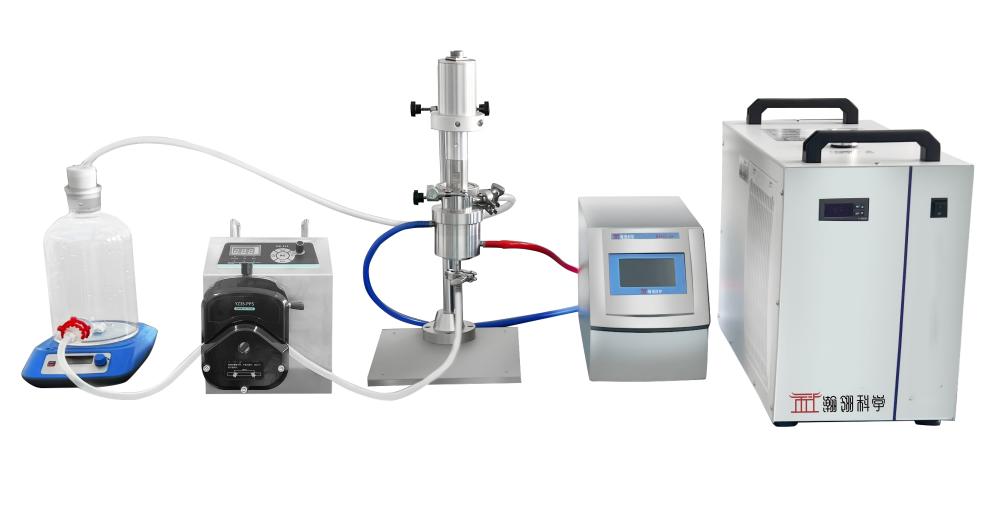
At the same time, the mechanical vibration effect of ultrasound can cause violent turbulent motion in the dispersed medium, further enhancing the dispersion and suspension stability of particles, and avoiding the re aggregation of small particles after dissociation. Compared with traditional dispersion methods such as mechanical stirring and ball milling, ultrasonic dispersion does not require direct contact with particles, which can reduce the damage to the catalyst crystal structure caused by mechanical wear and maximize its intrinsic catalytic activity.
Enhancement of Platinum Alloy Catalyst Performance by Ultrasonic Dispersion
Good dispersibility directly determines the performance of platinum alloy catalysts. After ultrasonic dispersion, the platinum alloy particles have uniform particle size and narrow distribution range, significantly increasing the number of exposed active sites. Taking the platinum ruthenium alloy catalyst commonly used in fuel cells as an example, the exposure rate of active sites of agglomerated particles before dispersion is less than 30%, while after ultrasonic dispersion, the exposure rate can be increased to over 70%, which increases the catalytic current density of the catalyst for methanol oxidation by 2-3 times.
In addition, uniformly dispersed platinum alloy particles can optimize the pore structure of the catalyst layer and reduce the mass transfer resistance between reactants and products. In proton exchange membrane fuel cells, the use of platinum alloy catalyst dispersed by ultrasound to construct the catalytic layer can increase the peak power density of the cell by 15% -20%, while reducing the amount of platinum used and lowering the manufacturing cost of the cell. Ultrasonic dispersion can also improve the bonding stability between catalyst and carrier, reduce particle detachment and migration during the reaction process, and extend the service life of the catalyst.
Key parameters and optimization directions in applications
The ultrasonic dispersion effect is influenced by multiple parameters and needs to be precisely controlled according to the composition, particle size, and dispersion medium characteristics of platinum alloy catalysts. Ultrasonic power is the core parameter: too low power cannot effectively break aggregates, while too high power may lead to excessive particle fragmentation and an increase in crystal structure defects. For platinum palladium alloys with particle sizes of 50-100nm, a power range of 200-400W is usually used for optimal dispersion effect.
The dispersion time also needs to be reasonably controlled. Generally, stable dispersion can be achieved within 10-30 minutes. Extending the time not only fails to improve the effect, but also increases energy consumption and particle oxidation risk. The selection of dispersion medium is equally important. Polar media such as water and ethanol can enhance the propagation efficiency of ultrasonic waves. When combined with appropriate dispersants (such as polyvinylpyrrolidone), the dispersion stability can be further improved through electrostatic repulsion and steric hindrance effects.
Conclusion and Development Prospects
Ultrasonic dispersion technology, with its advantages of high efficiency, mildness, and controllability, has become an indispensable key link in the preparation process of platinum alloy catalysts. It fundamentally enhances catalytic activity, stability, and mass transfer efficiency by improving the dispersibility of the catalyst, laying the foundation for the widespread application of platinum alloy catalysts in energy, chemical, and other fields. In the future, with the precise upgrading of ultrasonic equipment and in-depth research on dispersion mechanisms, this technology will be more closely integrated with catalyst preparation processes, achieving the integration of “dispersion synthesis loading”, further promoting the development of platinum alloy catalysts towards high activity, low platformization, and long lifespan, and providing strong support for the green and efficient upgrading of related industries.
If you want to purchase equipment, please click here.