
Ultrasonic Dispersion Magnetic Ceramic Slurry
In the preparation and processing of magnetic ceramic materials, the dispersibility of the slurry directly affects the performance of the final product. Magnetic ceramic slurries are often composed of magnetic powders, dispersing media, and various additives. If the dispersion is uneven, particle agglomeration is prone to occur, leading to a significant decrease in the magnetic and mechanical properties of the material. Ultrasonic dispersion technology, with its unique mechanism of action, has become an effective means to solve the dispersion problem of magnetic ceramic slurry, and has shown broad application prospects in fields such as electronics, energy, aerospace, etc.
The core principle of ultrasonic dispersion of magnetic ceramic slurry is derived from the cavitation effect. When ultrasound propagates in the slurry, alternating compression and sparsity regions are generated. In the sparse stage, a large number of tiny bubbles are formed in the slurry; During the compression stage, these bubbles rapidly collapse, producing instant high temperature, high pressure, as well as strong micro jets and shock waves. This extreme physical environment can effectively break the van der Waals forces, hydrogen bonds, and other interactions between magnetic ceramic particles, dispersing the aggregated particles into smaller monomers or uniform aggregates, thereby achieving uniform dispersion of the slurry. Meanwhile, the vibration effect of ultrasound can also promote the adsorption of dispersants on the surface of particles, further stabilizing the dispersion system and preventing particle agglomeration again.
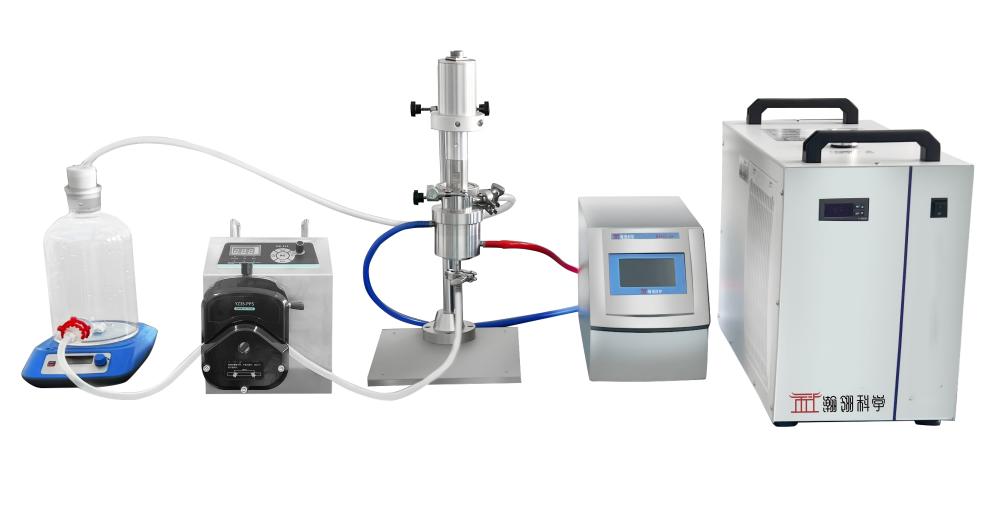
Compared with traditional dispersion methods such as mechanical stirring and ball milling, ultrasonic dispersion of magnetic ceramic slurry has many significant advantages. Firstly, the dispersion efficiency is higher. The cavitation effect of ultrasound can directly act on the interior of particle aggregates, achieving good dispersion effect in a short period of time and greatly shortening the dispersion time. Secondly, the dispersion effect is more uniform. Mechanical stirring and other methods are prone to local uneven dispersion, while ultrasound can act uniformly throughout the entire slurry system, ensuring a narrower particle size distribution and improving the stability of the slurry. In addition, it causes minimal damage to particles. The traditional ball milling method may cause particle structure damage or introduce impurities due to the collision between the grinding medium and particles, while ultrasonic dispersion mainly relies on the physical effect of cavitation, which can maximize the preservation of the original structure and properties of magnetic ceramic particles. Finally, the operation is convenient and flexible. Ultrasonic dispersion equipment has a relatively small volume and is easy to integrate into production lines. By adjusting parameters such as ultrasonic power, frequency, and processing time, the dispersion effect can be flexibly controlled to meet different process requirements.
The application field of ultrasonic dispersed magnetic ceramic slurry is very wide. In electronic device manufacturing, such as magnetic sensors, magnetic cores, etc., it is required that magnetic ceramic materials have a uniform microstructure and excellent magnetic properties. The green body prepared by ultrasonic dispersion slurry has uniform density, stable performance after sintering, and can significantly improve the accuracy and reliability of the device. In the field of energy, magnetic ceramic materials can be used for energy storage devices, magnetohydrodynamic generators, etc. Ultrasonic dispersion technology helps to improve the energy conversion efficiency and service life of materials. In addition, in the biomedical field, when magnetic ceramic microspheres are used as drug carriers or contrast agents, their dispersibility directly affects biocompatibility and targeting. Ultrasonic dispersion can ensure the uniformity of microspheres, providing guarantees for related applications.
Of course, the technology of ultrasonic dispersion magnetic ceramic slurry also faces some challenges. For example, for high concentration and high viscosity slurries, the energy transfer efficiency of ultrasound will decrease, and the dispersion effect will be affected; Long term ultrasonic treatment may lead to an increase in slurry temperature, affecting the stability of dispersants or the magnetic properties of particles. To this end, researchers are solving the problem by optimizing ultrasound parameters (such as using pulsed ultrasound), developing new dispersants, and combining other dispersion methods (such as mechanical stirring and ultrasound synergy).
With the continuous development of materials science and ultrasonic technology, the technology of ultrasonic dispersed magnetic ceramic slurry will become more mature and perfect, and its application in various fields will also become more in-depth, providing strong technical support for the preparation of high-performance magnetic ceramic materials.
Chemisonic specializes in ultrasonic liquid processing technology. For decades, we have dedicated to designing, developing, and manufacturing ultrasonic liquid processors independently, from laboratory application to industrial level. Cutting-edge ultrasonic technology, high quality device and easy-to-use operating system are the fundamentals for our company to achieve continued business growth.
