
Ultrasonic Cutting Full Tray Sandwich
Application of Ultrasonic Cutting Technology in Efficient Production of Full Tray Sandwich
In the modern food processing industry, sandwiches are loved by consumers worldwide as a convenient, nutritious, and versatile food. Especially in the fields of catering delivery, convenience stores, airline catering, and large-scale event catering, mass production of sandwich products with uniform specifications and stable quality has become a core requirement for many food enterprises. Among them, the production mode of full tray sandwiches is gradually becoming one of the mainstream solutions for industrial production due to its efficient molding and cutting processes.

The demand for large-scale production of full pallet sandwiches
The so-called full tray sandwich refers to laying all the ingredients such as bread, sauce, vegetables, meat, cheese, etc. layer by layer in a standard sized baking tray or pallet, forming a huge complete sandwich “brick”. The common tray size is 26 inches by 18 inches (approximately 66 centimeters by 46 centimeters). After stacking and pressing, the entire large-sized sandwich is divided into several small parts by cutting equipment and finally packaged for sale.
The advantage of this production method is that: firstly, a single molding can simultaneously process a large amount of raw materials, significantly improving the output per unit time; Secondly, the layered structure ensures that the internal components of each small sandwich are evenly distributed, avoiding filling deviations caused by manual production of each sandwich; Thirdly, it facilitates the integration of automated assembly lines and reduces labor costs.
For terminal sales, the ideal size for a single sandwich is usually around 4.5 inches square. Cutting according to this specification, a 26 × 18 inch full tray sandwich can be divided into approximately 24 small squares. This requires cutting equipment to have the ability to be efficient, precise, clean, and not damage the sandwich structure.
Limitations of traditional cutting methods
In the past, food factories often used circular rotating blades, band saws, or stamping molds to cut large-sized sandwiches. However, these methods have obvious drawbacks: ordinary metal blades are prone to sticking sauce, mayonnaise, or cheese during repeated cutting processes, resulting in dirty and trailing cut surfaces, and even pulling the filling out of the interlayer; Cutting with a band saw generates a large amount of debris, which not only wastes raw materials but may also contaminate the product; In addition, mechanical pressure can flatten the soft bread embryo, affecting the appearance and taste of the sandwich. More importantly, traditional cutting methods are difficult to ensure that the size error of each piece is controlled within the allowable range, especially during continuous high-speed production, where blade wear will further exacerbate quality fluctuations.
The principle and advantages of ultrasonic cutting technology
Ultrasonic cutting technology provides an ideal solution to solve the above problems. The core principle is to use piezoelectric transducers to convert electrical energy into high-frequency mechanical vibrations (usually 20kHz to 40kHz), causing the blade to vibrate with small amplitudes at a frequency of tens of thousands of times per second while moving along the cutting direction. This high-frequency vibration endows the blade with unique cutting characteristics:
Firstly, extremely low cutting resistance. The friction coefficient between the blade and the food is significantly reduced, and the cutting process is like “melting” through the material instead of squeezing and tearing. Therefore, the soft structure of the bread is fully preserved and will not deform or collapse.
Secondly, the cleaning effect of the cut surface. High frequency vibration ensures that the blade surface hardly adheres to any sauce, butter, or moist filling. Under a one size fits all approach, the cut surface is clean and sharp, the interlayer is clearly visible, and there will be no situation where the filling is dragged out or applied to the edge of the bread. This is crucial for multi-layered sandwich structures.
Thirdly, high precision and repeatability. Ultrasonic cutting systems are usually paired with CNC positioning mechanisms, which can complete longitudinal and transverse cutting with precise millimeter level repeat positioning accuracy. Whether cutting 24 pieces or more, the size of each sandwich is strictly consistent, making it easy for subsequent packaging and standardized pricing.
Fourth, reduce debris and loss. Due to the absence of crushing and tearing during the cutting process, there are almost no bread crumbs or scattered fillings, and the utilization rate of raw materials can reach over 98%. At the same time, it also avoids the risk of debris contaminating the production line or mixing into the finished product packaging.
Fifth, the blade has a long lifespan and is easy to clean. Ultrasonic vibration itself has a self-cleaning effect, and the blade is less likely to leave food residue, reducing the need for frequent shutdown cleaning. The blade is made of high-strength alloy material, and the wear rate is much lower than that of traditional metal cutting tools.
Integrated application in actual production process
In actual production lines, the ultrasonic cutting system for 26 × 18 inch full pallet sandwiches usually works according to the following process:
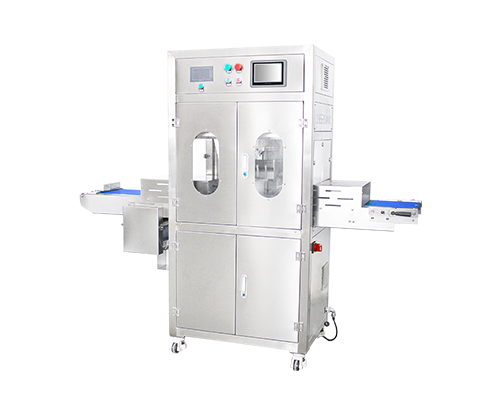
Firstly, the entire sandwich plate that has been stacked and pressed is transported by a conveyor belt to the cutting station, where the tray is precisely positioned. The operator or visual system confirms the bread edge baseline. Subsequently, the ultrasonic cutting knife performs horizontal cutting according to the preset program – for example, dividing the 26 inch long edge into 4 equal parts, each about 6.5 inches long; Perform longitudinal cutting again – divide the 18 inch wide edge into 6 equal parts, each 3 inches long. By combining several knives vertically and horizontally, 24 small squares arranged in a 4×6 or similar pattern are ultimately formed. Each time cutting, the blade quickly cuts in at a vertical or appropriate tilt angle, and the blade vibration instantly cuts through the layers of bread, vegetables, meat slices, and cheese. After completion, it automatically lifts and moves to the next cutting line.
The entire process can be completed in seconds to tens of seconds, depending on the product thickness and equipment configuration. After cutting is completed, the robotic arm or sorting device transfers 24 small sandwiches one by one onto the packaging conveyor belt for boxing, wrapping, or sealing.
For production lines that require higher output, dual blade synchronous cutting or multi station turntable structure can be configured to match the cutting cycle with the preceding and succeeding processes, achieving continuous non-stop production.
Economic and Quality Value Enhancement
Although the initial equipment investment for ultrasonic cutting technology is higher than that of traditional mechanical cutting tools, it has significant advantages in terms of overall operating costs. Firstly, the improvement in product yield usually results in raw material savings of 3% to 5% or more. For factories with a daily production of tens of thousands of parts, significant raw material costs can be saved annually. Secondly, products with beautiful cross-sections and uniform sizes can support higher terminal pricing or enhance brand competitiveness, especially for high-end convenience stores, hotels, and airline catering channels. Furthermore, reducing the risk of foreign object complaints and returns caused by debris contamination has lowered the cost of quality management. In addition, ultrasonic cutting does not require frequent blade replacement, reducing downtime for maintenance and improving overall equipment efficiency.
Future Development Trends
With the continuous improvement of consumers’ requirements for the quality of prefabricated food and the upgrading of food factories towards automation and intelligence, the application scope of ultrasonic cutting technology will continue to expand. At present, there are devices that integrate online weighing, AI visual inspection, and adaptive cutting parameter adjustment functions, which can automatically optimize vibration frequency and cutting speed based on the differences in hardness and thickness of different batches of raw materials. For full tray sandwiches, personalized size customization can even be achieved in the future – cutting different sizes of blocks on the same tray at the same time to meet the needs of multi-channel and multi specification orders.
Conclusion
From 26 inch x 18 inch full trays to exquisite 4.5-inch square portions, ultrasonic cutting technology, with its unique advantages of low resistance, high precision, and clean cutting surfaces, perfectly solves the cutting difficulties in industrial sandwich production. It not only significantly improves production efficiency and raw material utilization, but also ensures the visual beauty and taste integrity of each sandwich. For modern food enterprises that pursue both scale and quality, this technology has undoubtedly become a key link in the production line of full pallet sandwiches, bringing consumers a consistently high-quality experience from the first bite to the last bite.
About Cheersonic
Cheersonic manufactures the leading portioning equipment for bakeries producing fresh and frozen desserts. Since 1998 bakers have used Cheersonic machines to cut, slice and portion cheesecake, pie, layer cake, loaves, butter, cheese, pizza, sandwichs, and more. Cheersonic offers ultrasonic cutting solutions that support start-up bakeries and high production commercial facilities alike. Small standalone machines can be used in manual baking facilities and large inline robotic solutions aid in high speed production.
Cheersonic offers many ultrasonic slicing models, both inline and offline applications, with production speeds of 80 to 1,500 cakes or pies per hour.
Cheersonic’ latest offline introductions include ultrasonic cutting with or without divider inserts between each slice. This improves the quality of the cut and makes for a much better product presentation for the customer. In addition, robotic arm improves the speed, efficiency, and accuracy of the cutting process, producing professional looking products every time.