
Ultrasonic Cutter for Frozen Desserts
Ultrasonic Cutter for Frozen Desserts | Baking, Dairy Products, and Frozen Dessert Processing Applications in the Dessert Workshop
In modern dessert production systems, baked goods, dairy-based desserts, and frozen desserts often exhibit processing characteristics such as soft, sticky textures, tendency to harden at low temperatures, and structural deformation. Traditional mechanical cutting methods commonly result in rough cut surfaces, ingredient adhesion, high product damage rates, and numerous hygiene risks, making them unsuitable for precise, standardized mass production. As a novel precision food processing technology, ultrasonic cutting relies on high-frequency micro-vibration to achieve clean, smooth cuts, perfectly adapting to the diverse cutting requirements of various dessert ingredients. It has gradually become a core processing equipment for improving quality, efficiency, and finished product appearance in dessert manufacturing facilities. This article comprehensively analyzes the practical value of this technology in dessert processing from perspectives including technical principles, application scenarios, key advantages, and implementation considerations.
Core Working Principle of Ultrasonic Cutting
Unlike conventional cutting methods that rely on compression or sawing with blades, ultrasonic cutting converts electrical energy into mechanical energy efficiently, enabling precise, low-friction, pressure-free cutting operations with stable and controllable processes. The entire system operates through coordinated action of its core components to achieve fine material separation: first, an ultrasonic generator converts standard power frequency AC electricity into a high-frequency electrical signal ranging from 20 kHz to 40 kHz. This signal is then precisely transformed by a transducer into corresponding microscopic mechanical vibrations of the same frequency. After being amplified by a horn, these stable high-frequency micro-vibrations are transmitted to the food-grade cutting blade.
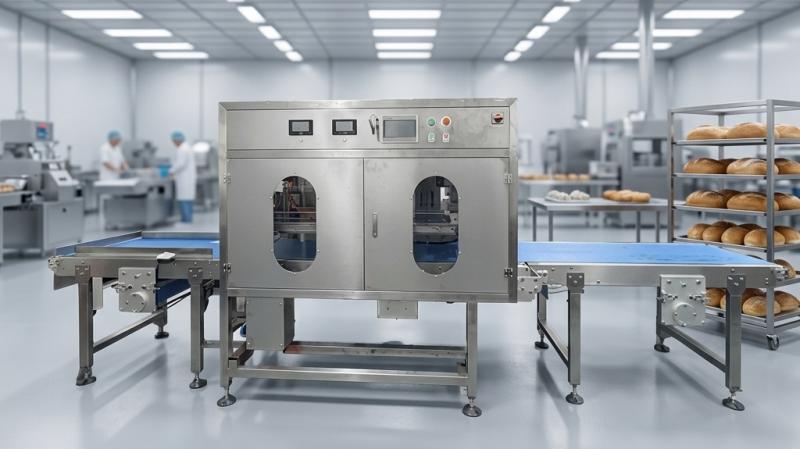
During cutting, the blade vibrates at tens of thousands of times per second, creating a nearly frictionless interface between the blade and the ingredient. Simultaneously, localized micro-vibrations temporarily soften the molecular structure of the ingredient’s surface, allowing rapid severance of molecular chains. The entire process requires no external compressive force—only high-frequency vibration is needed to separate the material. This fundamentally resolves the key challenges associated with traditional cutting techniques and enables effective processing of soft, sticky, and cold-hardened dessert ingredients.
Scenario Adaptability Analysis Across Multiple Dessert Categories
Dessert production involves a wide variety of products, each differing significantly in physical properties and requiring distinct standards for cutting flatness, integrity, and hygiene. Ultrasonic cutting technology demonstrates exceptional adaptability across three major dessert categories: baked goods, dairy products, and frozen desserts.
1. Baked Desserts Processing
Baked desserts such as cakes, pastries, flaky pastries, and nougat typically have light, porous structures with fragile surfaces prone to crumbling under pressure. Conventional blade cutting easily compresses and collapses the internal structure, resulting in uneven edges, excessive debris, and inconsistent appearance. This not only affects visual uniformity but also increases ingredient waste. With ultrasonic cutting, high-frequency micro-vibrations smoothly penetrate the delicate texture without compression or pulling, producing clean, smooth cuts free from crumbling or deformation. This enables precise operations such as whole-cake slicing, portioning, and shape-cutting, ensuring consistent presentation for every baked dessert.
2. Dairy-Based Desserts Processing
Dairy desserts like cheese, cream-filled confections, and custards are highly viscous and soft, posing significant challenges for traditional cutting methods. Conventional blades tend to stick to the surface of sticky ingredients, causing糊化 (blurring) of cut surfaces and inconsistent thickness. Frequent machine stoppages are required for blade cleaning, disrupting production continuity. Moreover, repeated residue buildup promotes microbial growth, creating potential food safety hazards. The low-friction interface of ultrasonic cutting completely eliminates ingredient adhesion, eliminating the need for frequent cleaning. The resulting cut surfaces are clean and neat, with no residual cream or cheese clinging to the blade. This ensures superior product quality while significantly enhancing continuous production efficiency.
3. Frozen Desserts Processing
Frozen mousse, frozen cakes, ice skin desserts, and other low-temperature frozen desserts become hard and brittle under cold conditions. Traditional rigid cutting tools often cause chipping, cracking, or delamination during slicing, resulting in high waste rates. Additionally, low-temperature ingredients tend to frost and harden, increasing cutting resistance and reducing precision with conventional methods. Ultrasonic high-frequency vibration weakens internal structural stresses within frozen ingredients, significantly lowering cutting resistance. This enables stable, precise cutting even at low temperatures, effectively preventing defects such as chipping, flaking, and layer separation, while ensuring accurate dimensional control—making it ideal for large-scale production of frozen desserts.
Core Advantages of Ultrasonic Cutting Technology in Dessert Production Lines
1. Enhancing Product Quality and Reducing Ingredient Waste
Leveraging the non-compressive, high-frequency micro-vibration cutting feature, this technology delivers mirror-smooth cut surfaces across all dessert types—free from deformation, smudging, debris, or chipping—greatly improving product appearance and market competitiveness. Precise cutting control also minimizes ingredient waste. Compared to traditional methods, material loss is significantly reduced, making it especially suitable for standardized production of premium and portion-controlled desserts, supporting lean manufacturing in production facilities.
2. Optimizing Production Efficiency for Mass Production
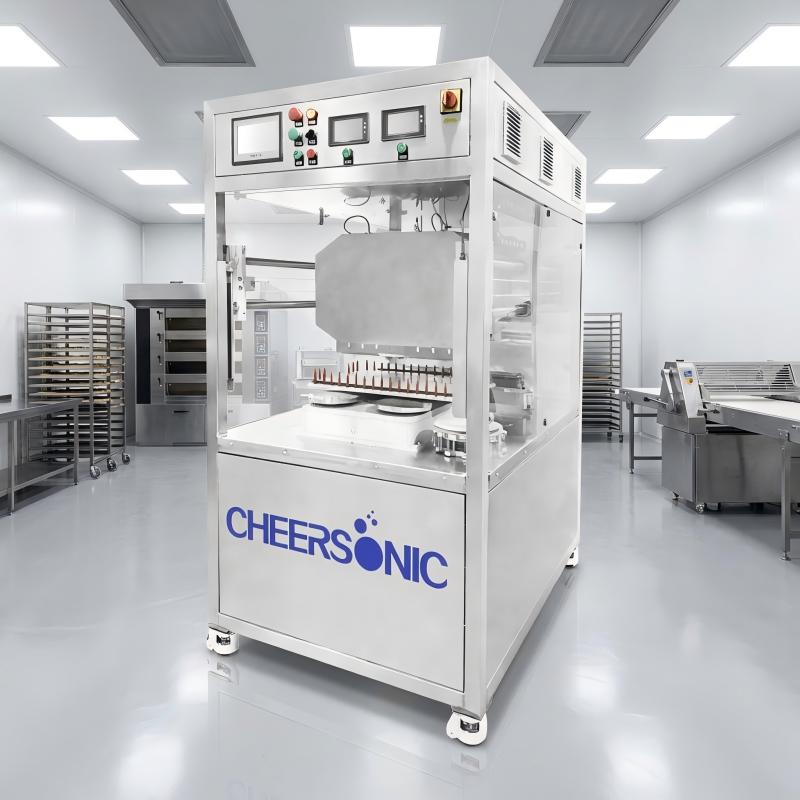
Traditional cutting processes suffer from frequent interruptions due to ingredient adhesion, surface imperfections, and equipment jamming, leading to inconsistent production rhythms and high labor costs for manual finishing. Ultrasonic cutting equipment enables high-speed continuous operation without frequent shutdowns for cleaning or adjustments. With stable cutting speed and consistent precision, it seamlessly integrates into automated dessert production lines, meeting the demands of large-volume, standardized mass production, reducing labor intervention, and improving overall production throughput.
3. Meeting Food Safety Standards and Reducing Risks
The cutting blades are made of food-grade materials with smooth surfaces that resist residue buildup. The high-frequency vibration provides self-cleaning effects, greatly reducing bacterial growth. The non-compressive, residue-free cutting process eliminates cross-contamination risks associated with ingredient retention and repeated contact in traditional methods. This fully complies with strict food safety regulations in dessert production environments and is well-suited for processing highly hygienic food categories such as baked goods and dairy products.
4. Supporting Flexible, Multi-Product Manufacturing
This technology requires no complex mold changes—only minor parameter adjustments are needed to handle soft, sticky, or low-temperature-hardened dessert ingredients. It covers full-range processing of baked goods, dairy products, and frozen desserts, enabling flexible, small-batch, multi-product production in dessert workshops. This significantly increases equipment utilization, reduces procurement and maintenance costs.
Key Points for Implementation and Maintenance
To ensure long-term, stable operation and consistent high-quality output of ultrasonic cutting equipment in dessert production lines, implementation and daily maintenance must follow food processing industry standards and focus on critical details. During installation, the equipment should be properly matched to the workshop’s dust-free, temperature-controlled, and low-temperature environment, with adequate vibration damping and secure mounting to maintain cutting accuracy. During production setup, parameters such as vibration frequency, cutting speed, and spacing must be precisely adjusted according to the texture, hardness, and viscosity of different desserts to achieve optimal cutting results.
For routine maintenance, after each production run, blades and contact components must be cleaned using food-safe methods to remove any residual ingredients and prevent bacterial growth. Regular checks on the stability of the ultrasonic vibration system and calibration of cutting precision are essential to prevent parameter drift over time. Standardized operating procedures must be strictly followed to avoid improper use that could lead to blade wear or accuracy deviations, thereby extending equipment lifespan. Moreover, the equipment features a simple design with no complex transmission parts, minimizing maintenance complexity and enabling seamless integration into high-intensity, routine production cycles.
Summary and Industry Outlook
Compared to traditional cutting methods, ultrasonic cutting technology fundamentally addresses numerous challenges in dessert production, including baking, dairy processing, and frozen dessert manufacturing. It offers significant advantages in product quality, production efficiency, food safety, and flexible manufacturing, perfectly aligning with the modern trends of standardization, precision, and automation in dessert processing.
As the food processing industry accelerates its quality improvement efforts, end markets are increasingly demanding consistent appearance, texture, and specifications for desserts. Ultrasonic cutting technology is poised to become a standard core process in dessert production facilities. In the future, integrated with automated control systems and intelligent parameter adaptation systems, this technology will enable smart switching across multiple product types, automatic precision calibration, and real-time production data monitoring, driving the dessert industry toward intelligent and lean transformation.
About Cheersonic
Cheersonic manufactures the leading portioning equipment for bakeries producing fresh and frozen desserts. Since 1998 bakers have used Cheersonic machines to cut, slice and portion cheesecake, pie, layer cake, loaves, butter, cheese, pizza, sandwichs, and more. Cheersonic offers ultrasonic cutting solutions that support start-up bakeries and high production commercial facilities alike. Small standalone machines can be used in manual baking facilities and large inline robotic solutions aid in high speed production.
Cheersonic offers many ultrasonic slicing models, both inline and offline applications, with production speeds of 80 to 1,500 cakes or pies per hour.
Cheersonic’ latest offline introductions include ultrasonic cutting with or without divider inserts between each slice. This improves the quality of the cut and makes for a much better product presentation for the customer. In addition, robotic arm improves the speed, efficiency, and accuracy of the cutting process, producing professional looking products every time.