
Ultrasonic Coating Non-metallic Catalyst
Ultrasonic Coating Non-metallic Catalyst: Empowering precise electrocatalytic conversion of CO ₂ to methanol
Under the guidance of the “dual carbon” goal, the electrocatalytic conversion of CO ₂ into high-value methanol has become one of the core pathways for carbon recycling. The efficiency bottleneck of this process has long been constrained by the coating accuracy and activity control of catalysts, and the combination of ultrasonic spraying technology and non-metallic catalysts is providing a new solution to break through this dilemma and achieve “precise” conversion of CO ₂ to methanol.

Traditional catalyst coating techniques such as scraping and dipping often lead to agglomeration of non-metallic catalyst particles and uneven coating thickness, which not only wastes materials but also masks active sites and hinders mass transfer channels. Ultrasonic spraying technology atomizes catalyst slurry into uniform droplets of 10-50 microns through high-frequency vibration, and with precise parameter control, constructs a catalytic layer with controllable thickness and uniform distribution. Experiments have shown that when nitrogen doped carbon based catalysts are sprayed at a frequency of 80Hz and a flow rate of 0.3mL/s, the coating uniformity can reach over 95%, which is 25 percentage points higher than the scraping coating technology. This microscopic uniformity lays the structural foundation for the full exposure of active sites.
The “precise” catalytic performance of non-metallic catalysts is maximized with the assistance of ultrasonic coating technology. Taking boron nitrogen co doped carbon nanomaterials as an example, their activity originates from the electron imbalance structure formed by heteroatoms and carbon skeleton, while the porous coating structure formed by ultrasonic spraying enables CO ₂ molecules to quickly contact the active sites. Meanwhile, during the spraying process, the coating porosity can be controlled by adjusting the droplet size. When the droplet diameter stabilizes at 15 microns, the coating porosity is optimized to 40%, and the CO ₂ diffusion rate is increased by three times, effectively avoiding side reactions caused by volume accumulation during the reaction. Related studies have shown that non-metallic catalysts coated with ultrasonic waves can achieve a methanol Faraday efficiency of 92%, far higher than the 65% achieved by traditional coating methods.
The controllability of ultrasonic coating parameters provides technical support for precise regulation of catalytic reaction pathways. By adjusting the ultrasonic frequency, the catalyst loading density can be changed. The thin layer catalyst (thickness<10 microns) formed by high-frequency spraying can reduce electron transport resistance, and the current density can reach 3.89A cm ² at 1.5V voltage. Optimizing the liquid flow rate can construct a gradient coating to achieve layered catalysis in the reaction zone – non-metallic catalysts with rich oxygen vacancies on the surface are used for CO ₂ adsorption and dissociation, and the bottom layer enhances conductivity to promote electron transfer. This structured design highly matches each stage of the catalytic process, significantly improving the selectivity of methanol generation.
Stability is a key indicator for measuring the practical value of catalytic systems. The catalytic layer formed by ultrasonic spraying has stronger adhesion with the electrode substrate, and through the dual effects of mechanical anchoring and chemical adsorption, it can effectively suppress catalyst detachment. In a continuous 180 hour electrolysis test, the boron carbon composite catalyst coated with ultrasonic waves still maintained over 90% of its initial activity without significant carbon deposition, while the traditional coated catalyst showed a 40% decrease in activity after 60 hours. This excellent stability has cleared important obstacles for the industrial application of technology.
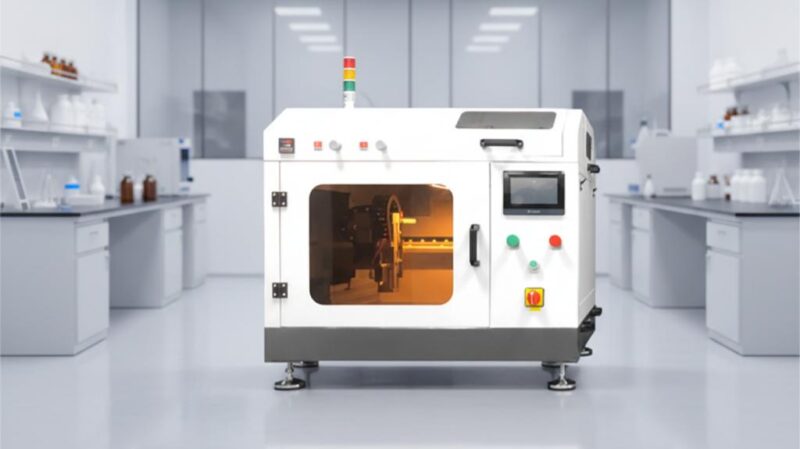
Currently, ultrasonic coating technology is developing towards multi parameter collaborative optimization. By coupling parameters such as frequency, flow rate, and drying temperature, customized design of the microstructure of the catalytic layer can be achieved. In the future, with the deep integration of this technology with non-metallic catalyst synthesis processes, it is expected to break through the efficiency and cost bottlenecks of CO ₂ electrocatalytic conversion, promote the commercialization of the “carbon capture conversion utilization” closed loop, and provide solid technical support for achieving carbon neutrality goals.
About Cheersonic
Cheersonic is the leading developer and manufacturer of ultrasonic coating systems for applying precise, thin film coatings to protect, strengthen or smooth surfaces on parts and components for the microelectronics/electronics, alternative energy, medical and industrial markets, including specialized glass applications in construction and automotive.
Our coating solutions are environmentally-friendly, efficient and highly reliable, and enable dramatic reductions in overspray, savings in raw material, water and energy usage and provide improved process repeatability, transfer efficiency, high uniformity and reduced emissions.
Chinese Website: Cheersonic Provides Professional Coating Solutions