
Ultrasonic Bread Cutter Makes Slicing Bread
Say Goodbye to Crumbs and Collapse! This Ultrasonic Bread Cutter Makes Slicing Bread as Easy as Slicing Tofu
A Must-Read for Bakery Owners: Use this “black technology” to slice bread without it sticking to the blade or crumbling, saving you hundreds of thousands a year!
Still bread flattened and crumbling when you slice it? Switch to an ultrasonic cutter for mirror-like cuts that will have customers wanting to place orders!
150 cuts per minute, 2mm precision! How amazing is the ultrasonic bread cutter? You’ll understand after reading this!
A revolution in the baking industry! No flattening, no sticking, no heat—the ultrasonic cutter perfectly solves your bread-slicing problems.
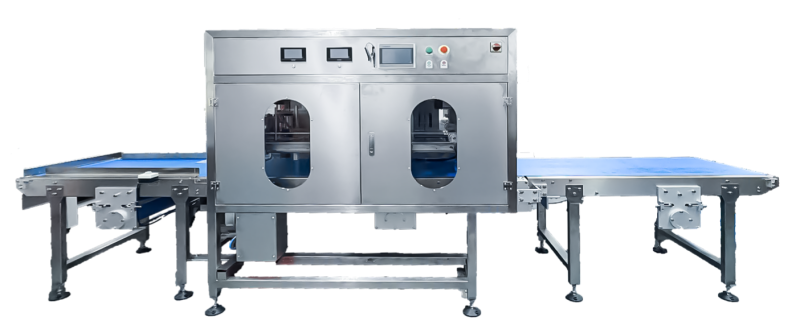
Core Principle: Vibration Instead of Pressure
The ultrasonic bread cutter doesn’t “cut” bread with a sharp blade, but rather achieves separation through high-frequency vibration. The entire process is as follows:
1. Energy Conversion: The built-in ultrasonic generator converts electrical energy into a high-frequency electrical signal.
2. Vibration Generation: The transducer converts the high-frequency electrical signal into millions of mechanical vibrations per minute.
3. Energy Amplification: The amplitude transformer amplifies the vibration amplitude and transmits it to the cutting head.
4. Cutting Completion: The cutting head (usually made of hygienic and durable titanium alloy) “bites” into the food with a micron-level amplitude, loosening its molecular structure and completing the separation.
The vibration frequency is typically in the range of 20kHz to 40kHz. In simple terms, it’s like a dull knife vibrating at a very small amplitude at a speed invisible to the naked eye – that’s its working state.
Key Advantages: Precision and Efficiency Combined
Compared to traditional cutting methods (such as ordinary knife cutting or wire cutting), ultrasonic bread cutters have significant advantages in food processing:
– Perfect Cuts, Reduced Waste: The cut surface is smooth and even, solving the problems of sticking to the blade and crumbling, especially suitable for processing multi-layered fillings, cream, or filled baked goods.
– Preserving Shape, Enhancing Appearance: The low cutting pressure prevents the bread from being flattened or torn, preserving its original shape and improving its overall appearance.
– Cold processing, ensuring quality: This “cold cutting” process generates minimal heat, preserving the bread’s flavor, texture, and nutritional components. It’s especially suitable for temperature-sensitive frozen or high-fat products.
– Hygienic and easy to maintain: The high-frequency vibration has a self-cleaning function, preventing food residue from sticking to the blades, reducing the risk of bacterial growth, and making cleaning easier.
– Flexible and efficient, compatible with automated lines: It can easily handle various types of bread, cakes, cheese, etc. Some machines can cut at speeds up to 150 cuts per minute with a precision of 2mm. It can also be integrated into automated production lines for large-scale production.
Potential disadvantages: Several points to consider
Despite its significant advantages, the following two points should be considered when making a decision:
1. Higher initial investment: Due to the high technical content and the cost of key components (such as titanium alloy blades), the equipment price is usually higher than traditional cutting tools.
2. Special material requirements: Not suitable for all ingredients. For very hard (such as hard-shell baguettes) or overly chewy ingredients, the cutting effect may be less than expected, or even impossible to complete. Main Application Scenarios: From Kitchen to Production Line
From independent bakeries to large food factories, ultrasonic bread cutters are used in the following scenarios:
– Baking Enterprises: Used for batch cutting and slicing various breads, cakes, etc., ensuring uniform size for each product.
– Central Kitchens & Pre-packaged Foods: Efficiently and hygienically completes the batch cutting and shaping of sandwiches, hamburgers, and other products.
– Frozen Food Production: Specifically designed for cutting frozen dough, ice cream cakes, etc., without melting or deforming during cutting.
– Handmade and Fine Baking: Some small or handheld devices help bakers precisely handle handmade bread, achieving complex layers or shapes.
Purchasing and Selection Considerations
– Equipment Type: Select according to business volume; handheld, benchtop, and automated production line types are available.
– Frequency and Power: 20kHz models are widely used for cutting bread, pizza, and other foods. Power is typically between 500W and 2000W and must be matched to actual production capacity.
– Blade and Material: Titanium alloy blades are preferred, as they meet food hygiene standards and are durable. It is necessary to confirm whether the blade shape (straight blade, round blade, etc.) meets the product requirements.
– Price Reference:
– Handheld devices: Relatively inexpensive, starting at approximately 800 RMB per unit.
– Industrial/Automatic devices: Higher priced, typically ranging from 20,000 to 50,000 RMB, or even higher.
Summary
Ultrasonic bread cutters achieve precise, clean, and efficient cutting results through high-frequency vibration technology. This not only solves the pain points of traditional processes but also facilitates standardized production of baked goods. Although the initial investment is high, it is a worthwhile technological investment for large-scale production aiming for high quality and high output.
About Cheersonic
Cheersonic manufactures the leading portioning equipment for bakeries producing fresh and frozen desserts. Since 1998 bakers have used Cheersonic machines to cut, slice and portion cheesecake, pie, layer cake, loaves, butter, cheese, pizza, sandwichs, and more. Cheersonic offers ultrasonic cutting solutions that support start-up bakeries and high production commercial facilities alike. Small standalone machines can be used in manual baking facilities and large inline robotic solutions aid in high speed production.
Cheersonic offers many ultrasonic slicing models, both inline and offline applications, with production speeds of 80 to 1,500 cakes or pies per hour.
Cheersonic’ latest offline introductions include ultrasonic cutting with or without divider inserts between each slice. This improves the quality of the cut and makes for a much better product presentation for the customer. In addition, robotic arm improves the speed, efficiency, and accuracy of the cutting process, producing professional looking products every time.