
Toast Cutting
Ultrasonic Automated Cutting Machine: Reshaping Efficiency and Precision in Toast Cutting
In the toast production industry, the cutting process is a crucial step determining product quality and production efficiency. Traditional cutting methods generally suffer from problems such as toast breakage, uneven thickness, and low efficiency. The emergence of the ultrasonic automated cutting machine has completely changed this situation. As a highly efficient piece of equipment in the food processing field, it demonstrates significant advantages in toast cutting scenarios due to its unique cutting principle, especially in terms of increasing production capacity, making it a core piece of equipment for large-scale toast production.
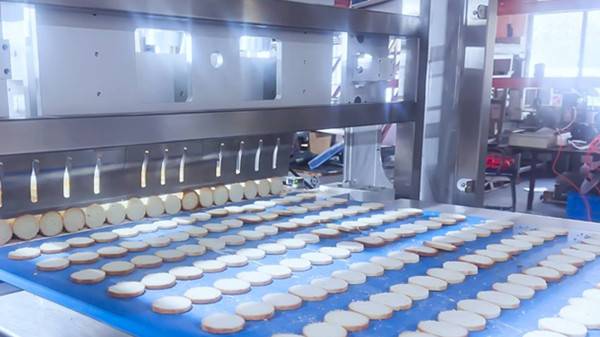
The core advantage of the ultrasonic automated cutting machine stems from its innovative working principle, which is completely different from the traditional mechanical cutting method that relies on sharp blades and mechanical pressure. This equipment uses an ultrasonic generator to convert standard electrical energy into a high-frequency electrical signal of 20-40 kHz. This signal is then converted into mechanical vibration by a piezoelectric transducer, and the amplitude is amplified by an amplifier before being transmitted to the cutting blade. The blade performs cutting with a high-frequency longitudinal vibration of 20,000 to 40,000 times per second. This vibration, invisible to the naked eye, ensures minimal contact between the blade and the toast during the cutting process, instead penetrating the material through a “vibration” motion, fundamentally solving many problems associated with traditional cutting.
For crisp and fragile foods like toast, the precision of ultrasonic cutting is particularly crucial. Traditional mechanical cutting often results in toast crumbling and producing numerous fragments due to the pressure of the blade, reducing yield and increasing material waste. The high-frequency vibration of the ultrasonic automated cutting machine significantly reduces cutting resistance, applying extremely low pressure to the toast during the cutting process, virtually eliminating deformation and resulting in smooth, clean cuts free of burrs and debris. Whether it’s a paper-thin soup toast or a moderately thick crispy toast, uniform cutting is achieved, ensuring consistent product specifications and effectively improving product appearance and market competitiveness.
In terms of production efficiency, the ultrasonic automated cutting machine demonstrates exceptional large-scale production capabilities, with an hourly output far exceeding that of traditional cutting equipment and manual operation. Depending on the toast’s dimensions and production requirements, this equipment can achieve a stable output of 12,000 to 36,000 pieces per hour, with some high-speed models reaching even higher capacities. This capacity stems from the equipment’s fully automated production line design. From toast conveying and positioning to cutting and unloading, the entire process requires no manual intervention, enabling continuous, uninterrupted operation. In contrast, manual cutting can only complete a few dozen pieces per hour. While traditional mechanical cutting offers improvements, its capacity is typically less than one-third of that of ultrasonic equipment due to its cutting principle, and it requires frequent shutdowns to clean toast debris adhering to the blades, further impacting production continuity.
Besides high efficiency and precision, the ultrasonic production line cutting machine also boasts excellent hygiene and safety, as well as ease of maintenance, meeting stringent food production standards. The high-frequency vibrating blades have a self-cleaning effect, effectively preventing toast debris from adhering, reducing cleaning downtime, and lowering the risk of microbial growth. The equipment uses food-grade contact materials, complying with food processing hygiene regulations, while automated operation reduces human intervention, minimizing the possibility of human contamination. In terms of maintenance costs, due to minimal friction during the cutting process, the blade wears slowly, resulting in a lifespan far exceeding that of traditional blades. This significantly reduces the frequency of blade replacement and maintenance expenses, leading to a substantial reduction in overall production costs over the long term.
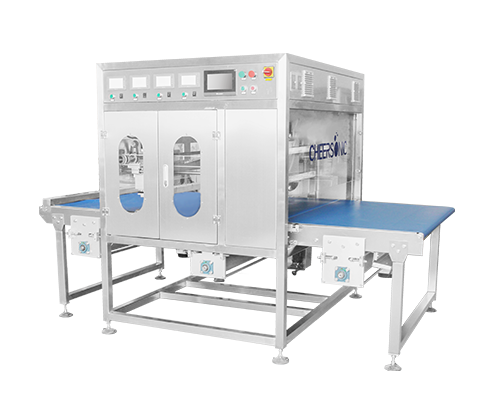
In large-scale toast production scenarios, the application value of ultrasonic automated cutting machines lies not only in increased capacity but also in driving the upgrade of production models. It can seamlessly integrate with subsequent drying and packaging equipment to build a complete automated production chain, achieving efficient operation from raw materials to finished products. For manufacturers, this not only means a significant increase in production efficiency but also a substantial improvement in profit margins by reducing raw material waste, increasing product qualification rates, and lowering labor costs. Simultaneously, standardized product specifications help companies establish a standardized production system, enhancing brand reputation and market competitiveness.
With the continuous improvement of automation levels in the food industry, ultrasonic automated cutting machines are increasingly widely used in toast production. With a capacity exceeding a thousand units per hour, combined with features such as precise cutting, hygiene and safety, and low-cost maintenance, it completely solves the pain points of traditional toast cutting, becoming a core piece of equipment for modern toast production companies. In the future, with continuous technological optimization, these devices will achieve greater breakthroughs in capacity enhancement and functional expansion, injecting stronger momentum into the efficient and standardized development of the food processing industry.
About Cheersonic
Cheersonic manufactures the leading portioning equipment for bakeries producing fresh and frozen desserts. Since 1998 bakers have used Cheersonic machines to cut, slice and portion cheesecake, pie, layer cake, loaves, butter, cheese, pizza, sandwichs, and more. Cheersonic offers ultrasonic cutting solutions that support start-up bakeries and high production commercial facilities alike. Small standalone machines can be used in manual baking facilities and large inline robotic solutions aid in high speed production.
Cheersonic offers many ultrasonic slicing models, both inline and offline applications, with production speeds of 80 to 1,500 cakes or pies per hour.
Cheersonic’ latest offline introductions include ultrasonic cutting with or without divider inserts between each slice. This improves the quality of the cut and makes for a much better product presentation for the customer. In addition, robotic arm improves the speed, efficiency, and accuracy of the cutting process, producing professional looking products every time.
