
Preparation of Large-Area Carbon Felt Substrate Catalyst Layer
Application of Ultrasonic Spraying Technology in the Preparation of Catalyst Layers on Large-Area Carbon Felt Substrates
Background and Needs
In fuel cells and similar electrochemical devices, the uniform preparation of the catalyst layer is a key factor determining performance. This solution addresses the specific needs of preparing platinum-carbon catalyst layers on carbon felt substrates by proposing an ultrasonic spraying technology-based solution. This solution must meet the following core parameters: single-sided coating, catalyst loading controlled within the range of 0.05-0.1 mg/cm², coating size reaching a large format of 2.1 m × 2.1 m, substrate being a carbon felt with a certain degree of flexibility (it can be folded once, but the process design should avoid folding as much as possible), and an annual processing capacity of approximately 20,000 square meters.
Principles and Advantages of Ultrasonic Spraying Technology
Ultrasonic spraying technology utilizes piezoelectric transducers to convert electrical energy into high-frequency mechanical vibrations (typically operating in the 20-120 kHz frequency band). This causes the liquid to undergo a “standing wave effect” and “surface tension wave breaking” process at the nozzle tip, forming micron-sized droplets. Compared to traditional two-fluid spraying or pneumatic spraying, ultrasonic atomization offers the following significant advantages: concentrated droplet size distribution (typically 10-50 micrometers), low droplet velocity (avoiding bounce and splashing), high transmission efficiency (up to 80%-95%), and the atomization process does not rely on compressed air, avoiding airflow disturbance to the thin-layer substrate.

For platinum-carbon catalyst inks (typically composed of platinum-carbon powder, ionomer solution, alcohol solvent, and deionized water), ultrasonic spraying can generate a uniform mist that is guided by a carrier gas to deposit on the carbon felt surface. Since the carbon felt has a three-dimensional porous structure, the droplet penetration depth needs to be controlled to avoid excessive catalyst intrusion into the bulk phase, resulting in waste. The low-momentum droplets of ultrasonic spraying can precisely achieve “surface enrichment” coating, meeting the design intent of single-sided catalysis.
System Overall Architecture
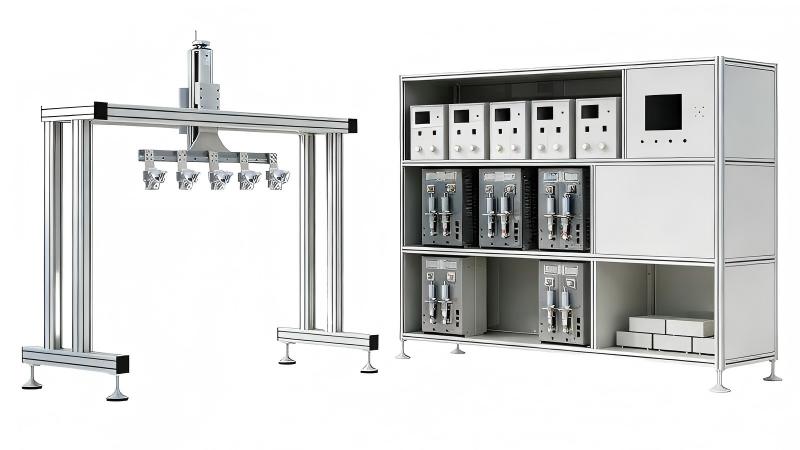
For large-format coating requirements of 2.1m × 2.1m, a “gantry-type motion platform + linear array nozzle” architecture is recommended. The overall system includes: a substrate transport and positioning module, an ultrasonic spraying module, an ink supply and circulation module, a carrier gas and negative pressure adsorption module, and an environmental control and waste gas treatment module.
Substrate Transport and Positioning Module: Due to the flexibility of the carbon felt but to avoid folding, a flat, continuous or step-by-step transport scheme should be adopted. A 2.3-meter wide stainless steel mesh belt conveyor system is designed, with the carbon felt laid flat and fixed by electrostatic adsorption or micro-negative pressure. The transport direction is set to the long side (one side of the 2.1-meter belt), completing one single-sided scan coating within the coating area. With an annual processing capacity of 20,000 square meters, calculated based on an 8-hour shift and 300 working days per year, a production capacity of approximately 8.3 square meters per hour is required. Considering the process cycle time, the nozzle movement speed is set to 50-100 mm/s, with a single scan width of 50 mm, and round-trip coating. Coating time for a single 2.1×2.1 meter (4.41 square meters) sheet within 30 minutes is feasible.
Ultrasonic Spraying Module: Since a single nozzle width cannot meet the efficiency requirements for large-format applications, a multi-nozzle linear array should be used. Arrange 8-12 ultrasonic nozzles at equal intervals laterally (perpendicular to the conveying direction), each nozzle handling a strip approximately 180-260 mm wide, covering a total width of 2.1 meters. Each nozzle has independent flow control and start/stop, with a precise flow distributor ensuring consistent output from all nozzles. The vertical distance between the nozzle and the substrate should be controlled at 40-60 mm. This distance ensures partial solvent evaporation during droplet flight (avoiding over-wetting) while maintaining sufficient deposition accuracy.
Key Process Parameter Control
Ink Preparation and Supply: The recommended ink concentration for platinum-carbon catalyst ink is 0.5-2 mg (precious metal)/mL to accommodate low-load coating (0.05-0.1 mg/cm²). The surface tension of the solvent needs to be adjusted to 35-45 dyn/cm, achieved by adding isopropanol or n-propanol. A circulating ink supply system should be used to prevent particle settling. The liquid supply rate is controlled at 0.5-2 mL/min per nozzle, adjusted in real time according to the target load.
Spraying trajectory strategy: A “two-way cross-spraying” mode is adopted, i.e., the first pass is sprayed from left to right, and the second pass is sprayed from right to left, offset by half a nozzle spacing. This strategy can effectively eliminate splicing marks and control the surface load uniformity within ±5%. Due to the certain undulations on the carbon felt surface (flexible substrate), a laser displacement sensor is required to detect changes in the substrate surface height in real time and dynamically adjust the nozzle height to maintain a constant deposition distance.
Temperature and drying management: To ensure a dense catalyst layer structure and prevent cracking, it is recommended to use a combination of substrate heating and hot air-assisted drying. An infrared heating plate is installed under the conveyor belt to maintain the carbon felt temperature at 40-60℃; at the same time, a 30-40℃ micro-hot air is blown above the spraying area to promote rapid solvent evaporation and prevent excessive spread of droplets on the carbon felt surface. Multiple thin-layer alternating spraying (e.g., 10-20 thin layers) is superior to single thick coating, with each layer thickness controlled at 1-2 micrometers of dry film.
Substrate Processing Strategies to Avoid Folding
While the carbon felt substrate can be folded once, the process should avoid folding. This means that substrate storage, transportation, and loading should utilize roll-to-roll or large-size sheet flat laying methods. It is recommended that upstream suppliers cut the carbon felt into 2.2m x 2.2m sheets, or manufacture it into rolls 2.3m wide and 50-100m long. For roll solutions, a continuous production line of unwinding-tension control-coating-drying-rewinding is used, keeping the substrate flat throughout the process without any folding. For sheet solutions, vacuum suction cup robots are used to load sheets one by one onto the conveyor belt, again eliminating the need for folding.
Summary
The ultrasonic spraying technology proposed in this solution can meet the requirements for single-sided, low-load, and uniform coating of platinum-carbon catalyst layers on 2.1m x 2.1m large-format carbon felt substrates. Key technologies include: wide-area coverage achieved by a multi-nozzle linear array, selective surface deposition using low-momentum droplets, closed-loop flow control to ensure load accuracy, and a non-folded, flat-lay transport strategy. This solution caters to small- to medium-scale production needs of 20,000 square meters per year, featuring moderate equipment investment, high process flexibility, and excellent material utilization, providing a reliable technical path for the large-area fabrication of fuel cell-like electrodes.
About Cheersonic
Cheersonic is the leading developer and manufacturer of ultrasonic coating systems for applying precise, thin film coatings to protect, strengthen or smooth surfaces on parts and components for the microelectronics/electronics, alternative energy, medical and industrial markets, including specialized glass applications in construction and automotive.
Our coating solutions are environmentally-friendly, efficient and highly reliable, and enable dramatic reductions in overspray, savings in raw material, water and energy usage and provide improved process repeatability, transfer efficiency, high uniformity and reduced emissions.
Chinese Website: Cheersonic Provides Professional Coating Solutions