
Project Description
Solid Oxide Fuel Cell Coating Spray
Protective coating based on manganese–copper oxide for solid oxide fuel cell interconnects: Ultrasonic spray coating and performance evaluation
Solid Oxide Fuel Cell (SOFC) is one of the most promising high-efficiency renewable energy power generation technologies in the new energy research field, widely adopted in university laboratory scientific research and new energy enterprise R&D projects for clean energy conversion and electrochemical performance research. A high-performance SOFC stack relies on durable metallic interconnects to electrically connect single unit cells and isolate fuel and oxidant gases, which is the core component to ensure stable and long-term operation of fuel cell systems.
However, during long-term intermediate-temperature SOFC operation, dense chromia scales are continuously generated on the surface of traditional Crofer 22 APU metallic interconnects. This inevitable defect will sharply increase the interfacial contact resistance of the cell stack, while volatile gaseous Cr species released from chromia scales will trigger cathode degradation, seriously reducing electrochemical stability and long-term durability of SOFC devices, becoming a key bottleneck restricting the industrialization and laboratory research progress of solid oxide fuel cells.
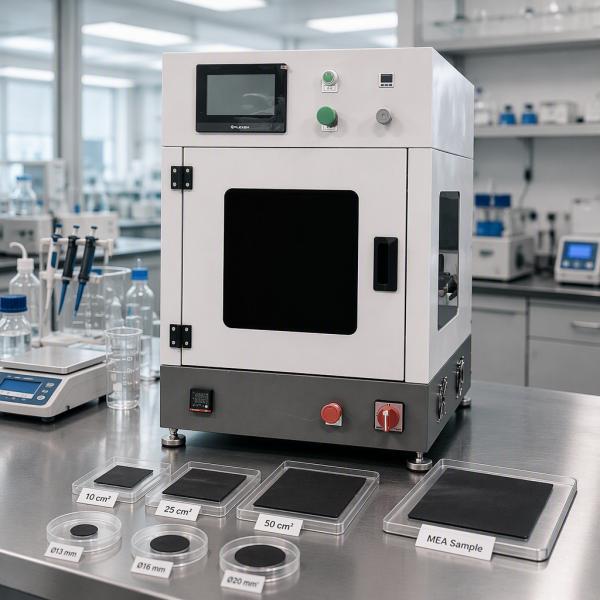
To solve the common technical pain points of chromium poisoning and interfacial resistance rise in SOFC interconnect research, this study innovatively prepares high-quality Mn2CuO4 composite protective coatings on Crofer 22 APU metallic interconnect substrates using the advanced ultrasonic spray coating technology — a mainstream precision coating process widely used in new energy material research and fuel cell component modification. Our professional Ultrasonic spray coating Solid Oxide Fuel Cell solution is specially optimized for academic laboratory research and scientific research enterprise customized experiments, perfectly matching the experimental demands of SOFC material modification, component performance optimization and fuel cell durability research.
Different from traditional coating preparation processes such as screen printing and plasma spraying, the ultrasonic spray coating technique realizes uniform and precise direct spray deposition of molten Mn2CuO4 functional materials on interconnect substrates. This efficient preparation method successfully forms high-density, low-porosity and high-adhesion functional coatings without subsequent high-temperature post-heat-treatment, effectively avoiding secondary damage to metal substrates and performance attenuation of functional layers. Experimental verification shows that the core performance indicators of PS-Mn2CuO4 coatings are precisely adjustable by optimizing key process parameters, including spray frequency, liquid precursor viscosity and substrate temperature, meeting the customized experimental parameter research needs of different university laboratories and scientific research teams.
The optimized PS-Mn2CuO4 coating presents excellent comprehensive performance for SOFC interconnect protection. It has complete gas barrier impermeability, which effectively isolates oxygen and fuel gas erosion, and possesses ultra-high bonding strength with Crofer 22 APU substrate, avoiding coating peeling and failure during long-term cell operation. Most importantly, the optimized ultrasonic spray coating process completely inhibits the formation of resistive chromia scales at the coating-substrate interface, fundamentally solving the core problem of chromium-induced performance degradation of SOFC stacks and significantly improving the power generation efficiency and service life of solid oxide fuel cells.
This ultrasonic spray coating-based Mn2CuO4 protective coating scheme provides a reliable, low-cost and high-repeatability technical path for next-generation high-stability SOFC component optimization, which is suitable for undergraduate and graduate laboratory teaching experiments, university scientific research projects and new energy enterprise product R&D verification. If you are engaged in SOFC new energy research, fuel cell material modification or electrochemical performance testing, and want to obtain customized ultrasonic spray coating process parameters, sample test solutions or in-depth technical consultation for solid oxide fuel cell interconnect coatings, please feel free to contact our professional technical team. We support one-on-one experimental scheme customization and technical guidance for scientific research institutions and university laboratories worldwide.
