Portable Ultrasonic Homogenizer
Portable ultrasonic homogenizer: an efficient biological sample processing tool empowered by titanium probes
In modern scientific research and experimental fields, portable ultrasonic homogenizers have become important equipment in molecular biology, materials science, and other fields due to their flexible application scenarios and efficient sample processing capabilities. This type of equipment uses ultrasonic energy as its core driving force and is equipped with specialized probe components to achieve fine processing of samples. The probe version made of titanium material, with its material characteristics and technological advantages, demonstrates unique value in complex biological sample processing, especially suitable for tearing operations of hard and structurally dense samples such as bone tissue, providing key support for molecular biology research.
From the perspective of core technical principles, the working logic of portable ultrasonic homogenizers revolves around the “ultrasonic cavitation effect”. After the device is powered on, the internal transducer converts electrical energy into high-frequency mechanical vibration, which is transmitted to the sample solution through the probe, causing a large number of tiny bubbles to be generated inside the liquid. These bubbles rapidly generate, expand, and rupture under high-frequency vibration, releasing strong shock waves and shear forces during the process. It is precisely this energy effect that can break the physical structure of the sample, achieving goals such as homogenization, fragmentation, or extraction. Compared to traditional mechanical grinding equipment, it does not require complex preprocessing steps and can adapt to different hardness and type of sample requirements by adjusting vibration frequency and power. Its flexibility far exceeds that of fixed equipment.
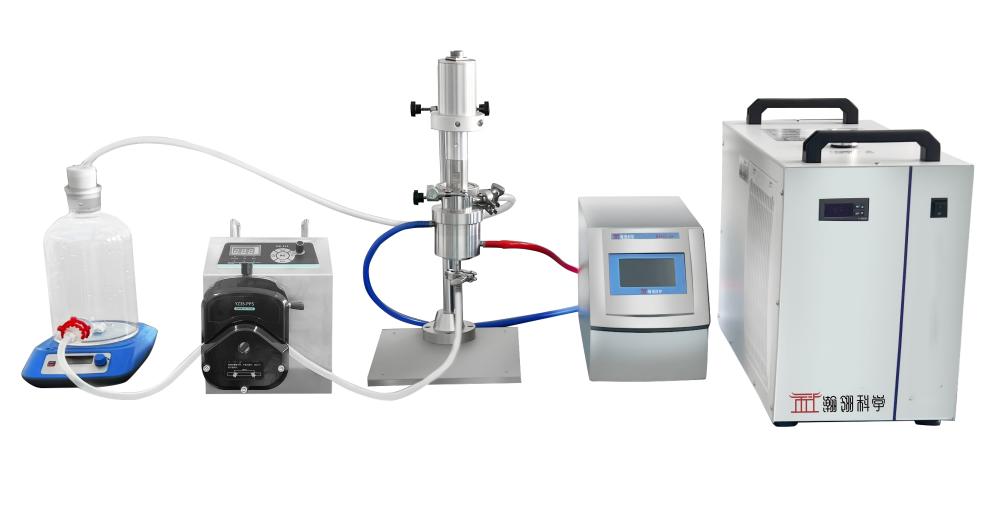
As the core executing component of the device, titanium probes are the key to adapting to bone tissue processing. Titanium material itself has three core advantages: firstly, a balance between hardness and toughness. Bone tissue contains a large amount of hydroxyapatite, which is hard and brittle. Ordinary metal probes are prone to wear or deformation under high-frequency vibration, while titanium probes can maintain structural stability while withstanding impact, avoiding probe debris contamination of the sample; Secondly, it has excellent biocompatibility, and molecular biology experiments require extremely high sample purity. Titanium material will not react with nucleic acids, proteins, or chemical reagents in the sample, nor will it release metal ions, ensuring the accuracy of subsequent detection results (such as PCR, Western Blot); Thirdly, it has strong corrosion resistance, and chemical reagents such as buffer solutions and cracking solutions are often used in experiments. Titanium probes can withstand the erosion of such liquids for a long time, extending the service life of the equipment and reducing maintenance costs.
The application value of this device is particularly prominent in the field of bone tissue research in molecular biology. The molecular extraction of bone tissue has always been a research difficulty – its dense mineralized structure wraps around cells, collagen, and various biomolecules. Traditional grinding methods are not only inefficient, but may also generate heat due to mechanical friction, which can damage the activity of nucleic acids or proteins. The portable ultrasonic homogenizer, through the cavitation effect transmitted by the titanium probe, can accurately act on bone tissue samples: first, it breaks the block shaped bone tissue into micrometer sized fragments, and then further tears the extracellular matrix and cell membrane, allowing the internal RNA, DNA, or protein to be fully released into the extraction solution. The entire process does not require high temperature, and impurities caused by excessive crushing can be avoided by controlling the processing time (usually 1-5 minutes) and power. In addition, its portability allows it to adapt to different experimental environments, whether it is routine sample processing in the laboratory or real-time sample pretreatment after field collection, it can be quickly put into use, reducing the degradation risk during sample transportation and providing reliable sample pretreatment support for research on bone development and exploration of bone disease mechanisms (such as osteoporosis and bone tumors).
In addition to bone tissue, this device can also be extended to more fields: in food testing, it is used to break down plant cell walls and extract active ingredients; In environmental monitoring, processing soil samples to extract microbial nucleic acid; In medical research, homogenize animal tissue to prepare protein homogenates. Its versatility and reliability make it a “universal tool” for interdisciplinary experiments, and the existence of titanium probes provides technical support for high demand and high difficulty sample processing scenarios, promoting researchers to explore the molecular mysteries of the microscopic world more efficiently.
If you want to purchase equipment, please click here.