Laboratory Ultrasonic Dispersion Photovoltaic Conductive Paste
Ultrasonic dispersion technology: a key laboratory process for solving the dispersion problem of photovoltaic conductive paste
In the rapid development of the photovoltaic industry, the efficiency and cost of solar cells have always been the core competitive focus. As a key material for forming battery electrodes, the performance of photovoltaic conductive paste directly determines the conductivity of the battery cell and the final photoelectric conversion efficiency. In the preparation and development process of slurry, dispersion technology is a crucial step, and laboratory ultrasonic dispersion technology, with its unique advantages, has become an indispensable means of optimizing slurry performance.
Photovoltaic conductive paste: the lifeline of solar cells
Photovoltaic conductive paste is a complex solid-liquid mixture composed of conductive phases (such as silver powder, aluminum powder), glass oxides, organic carriers (resins, solvents, additives), etc. Its main function is to form fine electrode grid lines on the battery cell through screen printing technology, collecting and transmitting photocurrent.
*Silver paste: Used for the front electrode, it requires extremely high conductivity and fine grid lines, which is the key factor affecting battery efficiency.
*Aluminum paste: used for back electrode and back field, mainly for forming back field, conducting and reflecting light.

The quality core of the slurry lies in the uniformity and stability of the dispersion of conductive phase particles in the organic carrier. The ideal state is that every micron or nanometer sized conductive particle can be fully wetted, separated, and evenly distributed, thereby forming a dense and highly conductive electrode film layer after sintering.
The shackles of uneven dispersion: performance bottlenecks from laboratory to production
During the storage or initial mixing stage of the slurry, high surface area conductive particles are prone to agglomeration due to van der Waals forces. If these aggregates cannot be effectively opened in subsequent processes, they will bring a series of serious impacts:
1. Impairment of conductivity: Aggregates cannot form a continuous conductive network after sintering, resulting in an increase in electrode resistance and series resistance (Rs), directly lowering the fill factor (FF) and conversion efficiency of the battery cell.
2. Impact on printing performance: Large agglomerates can block the mesh holes of the screen, causing problems such as wire breakage and false printing during printing, damaging the integrity and aspect ratio of the grid lines, and affecting current collection.
3. Deterioration of stability: unevenly dispersed slurry is more prone to settling and clumping during storage and transportation, resulting in unstable slurry performance, poor batch consistency, and affecting product quality control.
4. Increase raw material loss: In order to achieve the desired electrical performance, it may be necessary to increase the silver content or silver powder particle size, which significantly increases the cost of expensive raw materials.
Therefore, in the laboratory research and quality control stage, how to efficiently and thoroughly solve the problem of particle agglomeration is the primary task to improve the performance of the slurry.
Ultrasonic dispersion: the ‘energy blade’ in the laboratory
Compared to traditional dispersion methods such as mechanical stirring and high-speed shearing, ultrasonic dispersion technology provides a more efficient and refined solution. Its core advantage stems from the unique cavitation effect.
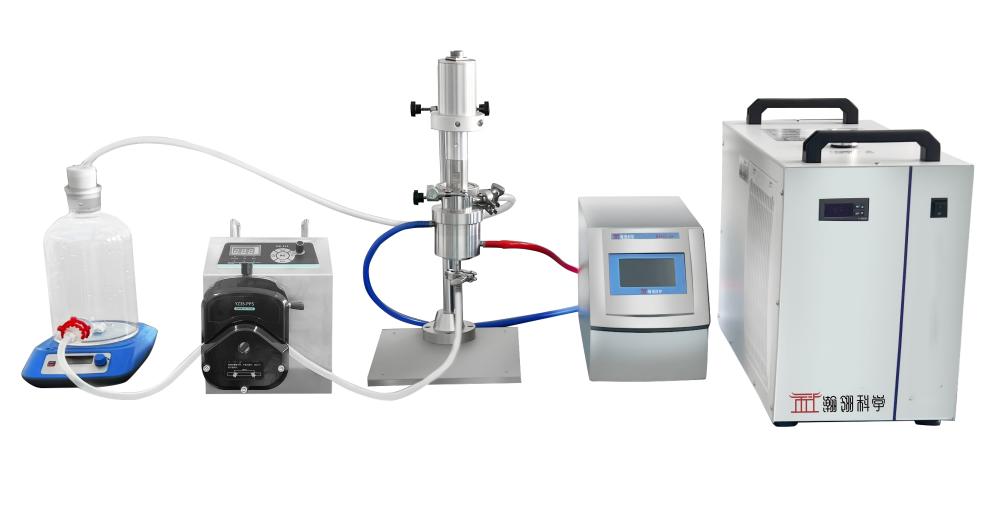
Working principle: The ultrasonic generator generates high-frequency electrical signals, which are transmitted to the slurry through the transducer and amplitude rod (probe) to transfer energy. This high-frequency vibration forms countless tiny vacuum bubbles in liquid media and instantly ruptures them, producing extreme high temperatures (about 5000K), high pressures (about 1000atm), as well as strong shock waves and microjets. These enormous forces are like countless miniature “energy blades” that can efficiently impact, peel off, and break hard particle aggregates, thereby achieving uniform dispersion at the nanoscale.
The significant advantages of ultrasonic dispersion:
1. Excellent dispersion efficiency: The energy density generated by cavitation effect is much higher than traditional methods, which can effectively handle high viscosity slurries and solve tough agglomeration structures. The dispersion fineness can reach the micrometer or even nanometer level, which is difficult to achieve by mechanical stirring.
2. Improve the overall performance of the product:
*Conductivity: The particles are more evenly dispersed, the conductive film formed after sintering is denser, the resistance is significantly reduced, and the battery efficiency is directly improved.
*Printability: The flowability of the slurry is better, the rheological properties are more stable, and the printing lines are clearer and more uniform.
*Stability: After the particles are evenly dispersed, the settling speed slows down, and the storage stability of the slurry is greatly improved.
3. Strong repeatability and controllability of the process: Laboratory ultrasound equipment parameters (power, time, pulse mode) can be accurately set and repeated, facilitating scientific experimental design (DOE) and systematically studying the structure-activity relationship between dispersion processes and slurry properties, providing reliable data support for large-scale production.
4. High efficiency and easy operation: For small batch samples in the laboratory (tens of grams to several kilograms), ultrasonic dispersion can achieve ideal results in a few minutes, greatly shortening the research and development cycle.
Conclusion and Prospect
Under the eternal theme of pursuing cost reduction and efficiency improvement in the photovoltaic industry, optimizing the performance of conductive paste is a crucial aspect. As the source of technological innovation, the laboratory has effectively solved the core pain point of uneven dispersion of slurry by using ultrasonic dispersion technology. It is not only a key process to ensure product quality and improve battery efficiency, but also an indispensable research and development tool for developing a new generation of low-cost and high-performance slurry (such as lower silver content and finer line width).
With the continuous advancement of ultrasonic technology and in-depth research on the dispersion mechanism of slurry, this “energy blade” will continue to play an irreplaceable role in photovoltaic laboratories, providing core driving force for promoting technological iteration and cost reduction in the photovoltaic industry.