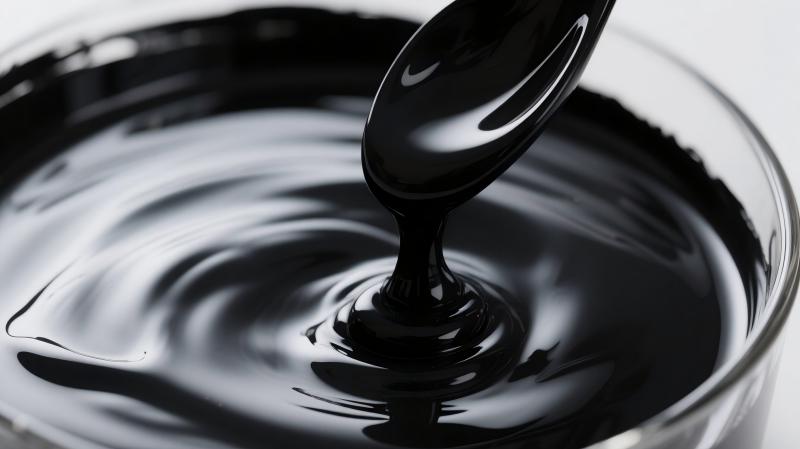
Laboratory Ultrasonic Dispersion of Carbon Black
The use of laboratory ultrasonic dispersion equipment to disperse carbon black is a very common and effective application. Carbon black is difficult to disperse uniformly in liquid media due to its extremely high specific surface area and strong tendency to agglomerate. The cavitation effect of ultrasound can generate extremely strong shear forces, effectively breaking down these aggregates.
Below, I will provide you with a detailed and systematic operation guide and principle explanation.
Introduction to the principle of ultrasonic dispersion
The core of ultrasonic dispersion is the “cavitation effect”. The ultrasonic generator (ultrasonic probe) converts high-frequency electrical signals into high-frequency mechanical vibrations and transmits them to the liquid through the amplitude rod (probe tip).
*Generate negative pressure zone: When sound waves propagate in a liquid, they form a sparse and dense zone. In the sparse zone (negative pressure zone), the liquid is torn apart, producing tiny vacuum bubbles (cavitation bubbles).
*Bubble growth and collapse: These cavitation bubbles rapidly grow and then violently collapse in the positive pressure zone, producing instantaneous extreme high temperatures (about 5000K), high pressures (about 1000atm), and microjets up to 1000km/s in a very small space (near the probe tip).
*Crushing aggregates: These enormous energies directly act on the aggregates of carbon black, breaking down the solid aggregates into original primary particles or smaller aggregates through strong shear forces, impact forces, and microjets, thereby achieving uniform dispersion at the nanometer or micrometer level.
Required equipment and materials
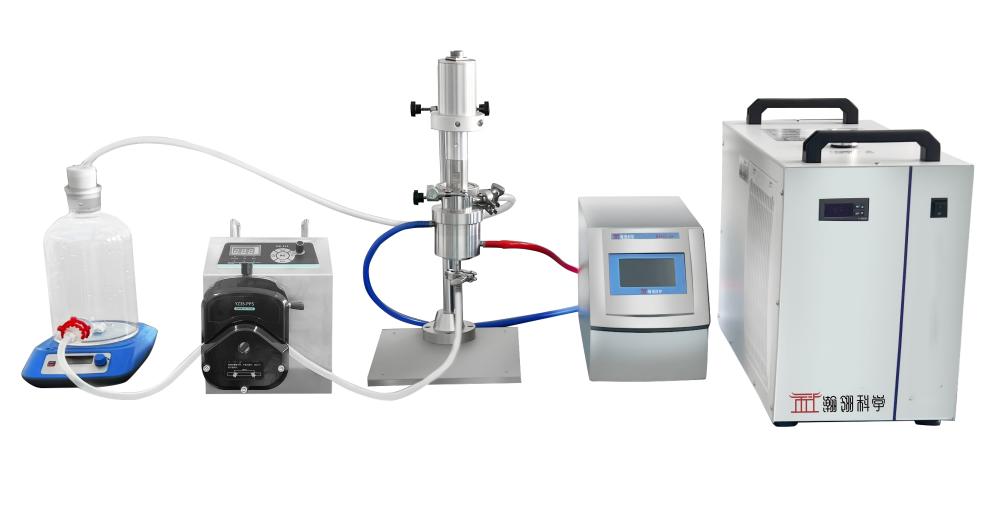
1. Laboratory ultrasonic cell grinder/disperser: The core equipment typically includes a generator, transducer, and titanium alloy probe (amplitude rod).
*Power selection: Depending on the processing capacity, common options include 200W, 400W, 600W, 1000W, etc. For samples below 50mL, 200-400W is sufficient; For 100-500mL, it is recommended to use 600W or more.
2. Titanium alloy probe (amplitude rod): The part directly inserted into the sample has different diameters (such as Φ 3, Φ 6, Φ 10, etc.) to adapt to samples of different volumes. The smaller the probe diameter, the higher the energy density, making it suitable for small volume samples.
3. Sample container: It is best to use a slender beaker or test tube (such as a 50mL/100mL beaker), which helps to concentrate energy and reduce waste. Avoid using wide mouthed beakers.
4. Carbon black powder
5. Dispersion medium (solvent/resin): water, ethanol, NMP (N-methylpyrrolidone), acetone or various resin matrices, etc., choose according to your final application.
6. Surfactant/dispersant (optional but strongly recommended): For carbon black, adding a dispersant can adsorb onto the surface of newly formed particles, preventing them from re aggregating and achieving long-term stable dispersion. For example, PVP (polyvinylpyrrolidone), SDS (sodium dodecyl sulfate), various non-ionic surfactants, or carbon black specific dispersants.
7. Ice water bath device (very important!): Ultrasonic energy can be quickly converted into thermal energy, causing a sharp increase in sample temperature, which may cause solvent boiling, carbon black degradation, or re aggregation.
8. Personal protective equipment (PPE): goggles, lab coats, gloves. Ultrasonic operation produces high decibel noise, it is recommended to wear noise cancelling earplugs.
Standard operating procedures
Step 1: Pre treatment – Preliminary Wetting
1. Weighing: Accurately weigh the required mass of carbon black powder and dispersion medium.
2. Pre mixing: Slowly add the carbon black powder into the dispersion medium without turning on the ultrasonic wave. Use a magnetic or mechanical stirrer to stir at low speed, allowing the powder to initially wet and form a rough, dry powder free suspension. This step can greatly reduce the total time for subsequent ultrasonic treatment and prevent dry powder splashing.
Step 2: Ultrasonic dispersion
1. Device setup: Install the ultrasound probe onto the generator. Set parameters:
*Power: usually set to 40% -70% of the total power. For example, a 600W instrument can be initially set to 300W (50%). Never use 100% power at the beginning to prevent sample splashing or probe damage.
*Mode: Select intermittent mode, for example, work for 2 seconds and stop for 1 second. This helps to control temperature rise, allowing time for energy transfer, resulting in better and safer performance.
2. Insert the probe: Place the beaker containing the preliminary mixed sample into an ice water bath. Immerse the ultrasound probe 1-2 centimeters below the sample liquid level and ensure that the probe is in the center of the container. Never touch the bottom and walls of the container, otherwise it will damage the probe and cause energy reflection.
3. Start dispersion: Start the ultrasonic equipment. You will see severe fluctuations in the liquid level, which may be accompanied by white mist like aerosols (it is recommended to operate in a fume hood).
4. Processing time: The processing time depends on the sample size, target particle size, and carbon black type. Usually, for 10-100mL samples, it takes 5-20 minutes. The optimal time can be determined by sampling and measuring particle size (see below).
Step 3: Post processing and Cleaning
1. Stop and sample: After reaching the predetermined time, turn off the ultrasound first, and then remove the probe.
2. Clean the probe: Immediately clean the probe tip with ethanol or acetone and water to prevent carbon black particles from adhering and sintering, which may affect subsequent efficiency and lifespan.
Key influencing factors and optimization techniques
*Energy input: The dispersion effect is directly related to the total energy input. Total energy=power x time. But energy density (power/sample volume) is more important. Use a fine probe for small samples and a coarse probe for large samples.
*Temperature control (ice water bath!): This is the key to the success or failure of the experiment. Excessive temperature can cause solvent evaporation, dispersant failure, and particle re aggregation (Ostwald ripening). The sample container must always be placed in an ice water bath for ultrasound.
*Dispersant: The use of dispersants is a necessary condition for obtaining stable dispersions. The type and dosage need to be optimized through experiments (by measuring Zeta potential or observing sedimentation stability).
*Ultrasound time: The longer the time, the better. There exists an optimal time point beyond which particle fragmentation or re aggregation may occur due to temperature accumulation and excessive ultrasound. Regular sampling is required, and particle size changes should be monitored using a particle size analyzer or microscope.
Dispersion effect evaluation method
1. Laser particle size analyzer: The most direct method to measure the particle size distribution (D50, D90, etc.) of particles. Observe the changes in particle size distribution before and after ultrasound.
2. Settlement experiment: Observe the dispersed liquid and record the time when obvious stratification or settlement occurs. The better the stability, the slower the settlement.
3. Optical microscope/SEM: Sampling and sectioning, directly observing the size and quantity of aggregates under a microscope.
4. Viscosity testing: Well dispersed carbon black slurries typically have lower viscosity and better rheology.
5. Application performance testing: The ultimate test is to use it for your target application (such as making electrodes to measure conductivity, adding it to coatings to measure blackness or corrosion resistance).
Safety Warning
*High temperature: The probe tip and sample will be very hot, be careful when touching.
*Noise: Prolonged exposure to harmful hearing is recommended. It is suggested to wear protective equipment.
*Aerosols: Aerosols containing nanoparticles will be generated during the process, so it is necessary to operate in a fume hood to avoid inhalation.
*Flammable solvents: If organic solvents are used, ultrasonic waves may produce sparks and pose a risk of explosion. Special caution is required.
By following the above steps and precautions, you should be able to successfully prepare a uniformly dispersed and highly stable carbon black dispersion using laboratory ultrasound equipment.