Laboratory Carbon Black Dispersion
The problem of carbon black dispersion in lithium battery positive electrode slurry and its solutions
In the field of lithium-ion battery material research and development, the commonly used lithium-ion button type battery in the laboratory is a core tool for quickly verifying the electrochemical performance of new positive electrode materials, negative electrode materials, and electrolytes/additives. Its standardized structure (such as a diameter of 20mm and a thickness of 3.2mm), low-cost preparation, and rapid testing characteristics greatly accelerate the screening and iteration process of battery materials. However, during the preparation stage of the positive electrode slurry for button type batteries, conductive carbon black (such as conventional conductive carbon black, acetylene black, etc.) becomes a typical pain point for small-scale laboratory pulping due to its large specific surface area (usually 50-150m ²/g) and high surface energy, making it easy to form difficult to disperse aggregates. This agglomeration not only leads to unevenness in the slurry system, but also causes “breakpoints” in the electrode conductive network, ultimately resulting in a 15% -30% decrease in electrode conductivity and weakened mechanical strength (such as an increase in electrode powder loss rate), directly affecting the charging and discharging efficiency and cycling stability of button batteries. The following analysis is conducted from two aspects: core reasons and targeted solutions, combined with laboratory ultrasonic lithium battery positive electrode slurry carbon black dispersion technology:
The core reason for poor dispersion of carbon black in laboratory positive electrode slurry
1. Inherent constraints on the physical and chemical properties of carbon black itself
The particle size of carbon black is mostly in the nanometer range (20-50nm), and its huge specific surface area makes its surface energy significantly higher than that of conventional powders. The strong van der Waals forces between particles easily promote the formation of “grape clusters” of primary aggregates, which further aggregate into dense hard aggregates (secondary structure). Most carbon black surfaces exhibit hydrophobic properties and have poor compatibility with commonly used polar solvents in the laboratory, such as NMP. The solvents are difficult to fully wet the surface of carbon black, resulting in insufficient particle suspension and easy settling and aggregation. More importantly, the laboratory pulp batch size is small (usually 10-100mL), and the amount of carbon black used is only a few milligrams to tens of milligrams. A small amount of agglomeration can significantly affect the overall uniformity of the pulp, and hard aggregates are more difficult to break by mechanical force in small-scale mixing.
2. The chain effect of improper solvent control
NMP, as a commonly used solvent for positive electrode slurries, has strong hygroscopicity. However, in laboratory operations, it is prone to exceeding the solvent moisture limit due to the following issues: firstly, insufficient sealing of solvent storage containers (such as repeatedly opened reagent bottles), resulting in environmental water vapor infiltration; The second is open operation in the pulp making process (such as mixing the beaker without covering it), especially in laboratory environments with humidity greater than 30% RH, where the moisture absorption rate of NMP is significantly accelerated. Excessive moisture can cause multiple problems: on the one hand, it leads to the hydrolysis of NMP to produce organic amines, changing the pH value of the slurry (usually raising the pH from 6-7 to 8-9), and damaging the solubility of PVDF binder; On the other hand, a “water film” is formed on the hydrophobic surface of carbon black, which hinders solvent wetting and enhances capillary forces between particles, intensifying agglomeration. In addition, low boiling point impurities remaining in the solvent (such as incompletely distilled small molecule organic compounds) can also adsorb onto the surface of carbon black, interfering with the dispersion process.
3. Adhesive compatibility and dissolution process defects
PVDF, as the core binder of positive electrode slurry, if selected improperly or dissolved insufficiently, will directly exacerbate the problem of carbon black dispersion. Firstly, if the molecular weight or concentration of PVDF is too high, the viscosity of the gel will be too high (>5000mPa · s), and the shear force transmission efficiency will decrease when carbon black is added later, making it difficult to break the agglomeration; Second, the laboratory dissolution operation was not standardized (such as unheated or insufficient mixing time), PVDF was not completely dissolved to form micro gel, which was easy to wrap carbon black particles to form “fish eye” agglomeration; The third issue is that PVDF molecular chains excessively adsorb onto the surface of carbon black, forming a dense adsorption layer that hinders further fusion between carbon black particles and solvents.
4. Operational blind spots in laboratory pulping process
(1) Unreasonable feeding sequence and method
In small-scale laboratory pulping, incorrect feeding sequence is the main cause of dispersion failure: for example, adding positive electrode active materials (such as LFP, NCM) and carbon black to the solvent at the same time, the micrometer sized particles of the active material will “wrap” the carbon black, making it unable to be exposed to shear force and forming agglomeration cores; Or pour the carbon black powder into a high viscosity adhesive solution at once, causing a sudden increase in local concentration and instantly forming hard lumps that are difficult to disperse.
(2) Insufficient shear force and dispersion time
The small mixing equipment commonly used in the laboratory, such as magnetic stirrers and simple paddle mixers, has limited shear strength (with a speed of less than 3000r/min), making it difficult to provide sufficient energy to break the hard agglomeration of carbon black; Moreover, due to the small batch size, researchers tend to shorten the dispersion time (such as only stirring for 10-15 minutes), resulting in incomplete fragmentation of aggregates before entering subsequent processes.
(3) Lack of temperature control
During the dispersion process, mechanical shearing generates heat. If laboratory equipment does not have temperature control function, the slurry temperature is prone to rise above 40 ℃, causing NMP volatilization (boiling point 202 ℃, but the volatilization rate increases at high temperatures) and PVDF local denaturation; When PVDF is dissolved, if the temperature is insufficient (such as room temperature dissolution), the dissolution time will be prolonged, and the probability of micro gel generation will be increased.
5. Insufficient equipment selection and environmental control
Laboratory pulping equipment is mostly of a universal type, such as simple paddle mixers that cannot generate strong shear flow and have mixing dead corners (such as the bottom and side walls of beakers), resulting in local carbon black agglomeration; Some laboratories do not strictly control the humidity of the pulp making environment (such as not equipped with dehumidifiers), especially during the rainy season when the environmental humidity can easily exceed 40% RH, accelerating NMP moisture absorption; At the same time, incomplete equipment cleaning (such as residual dry pulp from the previous pulping) can also become a new agglomeration core.
Targeted solutions to the problem of carbon black dispersion in laboratory positive electrode slurry
1. Carbon black pretreatment: reduce agglomeration basis
Prioritize the use of surface modified conductive carbon black (such as carbon black modified with hydroxyl and carboxyl groups), which enhances surface polarity and significantly improves compatibility with NMP; Before pulping, the carbon black is subjected to vacuum drying treatment (temperature 80-120 ℃, time 2-4 hours) to remove the adsorbed moisture and gas on the particle surface in a vacuum environment, thereby reducing the agglomeration driving force. A small vacuum drying oven can be used in laboratory operations, and after drying, it can be quickly transferred to a sealed container for cooling to avoid secondary moisture absorption.
2. Fine solvent control
Select high-purity NMP (purity ≥ 99.9%), and before use, dehydrate it through 3A molecular sieve (soak for more than 24 hours) or vacuum distillation (temperature 120-130 ℃, vacuum degree ≤ -0.09MPa) to further reduce the moisture content (control moisture content ≤ 50ppm); The pulp making process uses sealed containers (such as three necked flasks with lids) and is protected by inert gases (such as argon and nitrogen) to reduce contact with environmental water vapor; At the same time, the humidity in the laboratory pulping area is strictly controlled at<30% RH, which can be monitored in real time through dehumidifiers and temperature and humidity recorders.
3. Optimization of Adhesive Dissolution Process
Choose medium to low molecular weight PVDF (with a viscosity average molecular weight of 300000 to 500000) to reduce the viscosity of the adhesive solution; When dissolving, a combination of “heating+stirring” process is used: PVDF and NMP are mixed in a mass ratio of 1:8-1:10, placed in a constant temperature water bath at 50-60 ℃, and stirred with a magnetic stirrer (speed 800-1200r/min) for 2-3 hours until a uniform and transparent gel is formed. By visual observation, there are no obvious particles or layers. The laboratory can detect the viscosity of the adhesive liquid through a viscometer (controlled at 1000-3000mPa · s) to ensure the feasibility of subsequent dispersion.
4. Optimization of pulp making process: introduction of laboratory ultrasonic dispersion technology
(1) Optimize the feeding sequence
Adopting the “three-step feeding method”: ① Preparation of adhesive solution: First, mix 70% -80% NMP with PVDF, and prepare a uniform adhesive solution according to the above process; ② Pre dispersion of carbon black: Mix carbon black with the remaining 20% -30% NMP and stir with a glass rod to form a low solid content (solid content 5% -10%) carbon black slurry, avoiding direct addition of dry powder; ③ Step by step mixing: Under high-speed stirring (speed 2000-3000r/min, using a small dispersing disc stirrer), slowly drip the carbon black slurry into the glue solution, control the drip time at 5-10 minutes, and continue high-speed stirring for 30-40 minutes after dripping.
(2) Introduction of Laboratory Ultrasonic Lithium Battery Positive Electrode Slurry Carbon Black Dispersion Technology
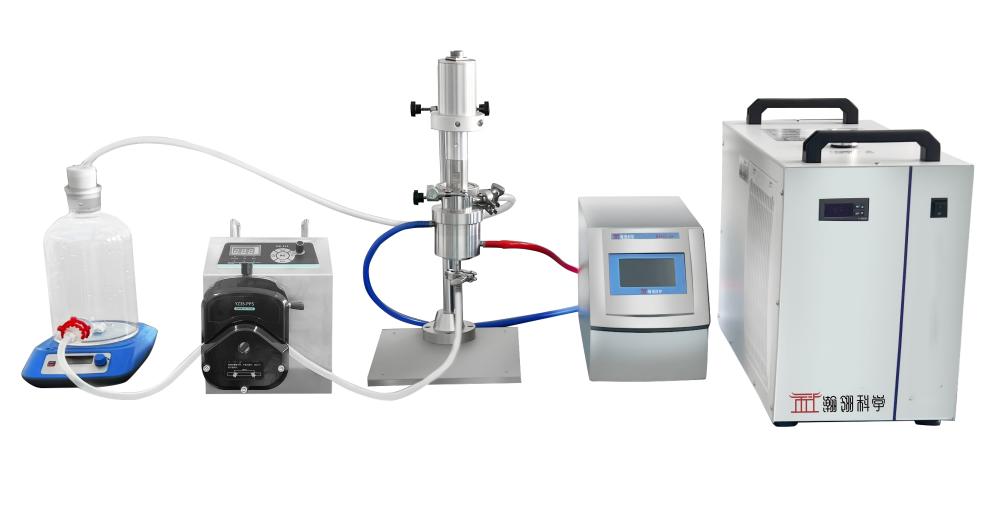
For the hard agglomeration of carbon black that is difficult to break by mechanical shearing, a probe type ultrasonic disperser (power 50-200W, frequency 20-40kHz) is used for auxiliary dispersion: the pre stirred carbon black gel mixture system is placed in an ice water bath (temperature controlled at 25-35 ℃ to avoid PVDF denaturation caused by ultrasonic thermal effects), a 6-10mm diameter probe (suitable for 10-100mL slurry) is selected, and the probe is inserted into the middle of the slurry (1-2cm from the bottom of the container to avoid cavitation damage to the container), with an ultrasonic power of 80-150W and an ultrasonic time of 10-25 minutes (using a pulse mode of “ultrasonic 3s intermittent 2s” to reduce local overheating). During the ultrasonic process, low-speed stirring (300-500r/min) can be used to ensure the uniformity of the macroscopic system and avoid excessive dispersion of carbon black in the ultrasonic area while other areas still aggregate. This technology can generate instantaneous high temperature (≥ 5000K) and microjet through cavitation effect, efficiently tearing apart hard agglomerates of carbon black, reducing the Span value of carbon black particle size distribution from 1.8 to below 0.9.
(3) Subsequent addition of active substances and viscosity adjustment
After confirming that the carbon black is evenly dispersed (with no obvious lumps observed by visual inspection), reduce the stirring speed to 500-800r/min, and add the positive electrode active material in batches (with each addition not exceeding 1/3 of the total mass), stirring for 15-20 minutes after each batch is added; Finally, according to the coating requirements, add a small amount of reserved NMP to adjust the viscosity of the slurry (controlled at 5000-8000mPa · s), and stir at low speed (200-300r/min) for 10-15 minutes to remove bubbles.
5. Equipment selection and environmental optimization
Priority should be given to using a small dual planetary mixer (with a revolution speed of 200-500r/min and a rotation speed of 1000-2000r/min), which has no mixing dead corners, uniform shear force, and is suitable for laboratory pulp production of 10-500mL batches; Combined with a probe type ultrasonic disperser (such as the commonly used 200W level equipment in the laboratory), a composite dispersion scheme of “mechanical shearing+ultrasonic assistance” is formed; Thoroughly clean the equipment (including stirring blades, containers, and ultrasonic probes) with NMP before and after pulping, and dry them for later use; Install dehumidifiers and inert gas protection devices in the pulp making area to ensure stable environmental humidity and oxygen content.
Testing and Verification of Laboratory Carbon Black Dispersion Effect
1. Basic performance testing
Fineness testing: Use a scraper fineness meter (range 0-50 μ m) to evenly scrape a small amount of slurry and observe the maximum particle size. The qualified slurry fineness should be ≤ 20 μ m;
Viscosity and rheological testing: Use a rotary viscometer (shear rate 10-100s ⁻¹) to measure the viscosity of the slurry. The viscosity fluctuation of well dispersed slurry is ≤ 5%, and the rheological curve shows pseudoplastic fluid characteristics (viscosity decreases with increasing shear rate);
Electrical resistivity detection: Coat the slurry on a glass substrate (thickness 50-100 μ m), dry it, and use a four probe resistance meter to detect the surface resistivity. The resistivity of well dispersed slurry is usually ≤ 50 Ω· cm, and the value is stable.
2. Microscopic and electrochemical verification
Microscopic morphology observation: After drying a small amount of slurry, observe the distribution of carbon black through scanning electron microscopy (SEM). In well dispersed samples, the carbon black uniformly wraps around the surface of the active substance without obvious agglomerates; Alternatively, by observing the particle size of carbon black through transmission electron microscopy (TEM), the exposure rate of primary particles of carbon black after ultrasonic treatment is increased by more than 40%;
Button type battery performance testing: Assemble the prepared positive electrode sheet into a CR2032 button type battery, test its first charge and discharge efficiency (the first efficiency of well dispersed batteries is usually ≥ 90%) and cycle performance (100 cycle capacity retention rate ≥ 85%), and verify the actual impact of carbon black dispersion on battery performance.
Summary
The solution to the problem of carbon black dispersion in the positive electrode slurry of laboratory lithium batteries requires “fine control+technical collaboration” as the core: laying the dispersion foundation through carbon black pretreatment, solvent dehydration, and binder optimization, constructing a basic dispersion system through “three-step feeding method+mechanical shearing”, and introducing laboratory ultrasonic lithium battery positive electrode slurry carbon black dispersion technology to break the bottleneck of hard agglomeration. At the same time, with equipment selection and environmental control, a full process solution is formed. In laboratory settings, ultrasonic dispersion technology, with its efficient crushing ability for nanoscale agglomerates, can compensate for the insufficient shear force of small equipment without the need for additional dispersants, avoiding the introduction of impurities. Through the above measures, the problem of poor dispersion of carbon black in laboratory positive electrode slurry can be effectively solved, providing uniform and stable electrode materials for button type battery performance testing, and accelerating the research and development process of new materials for lithium-ion batteries.