
Engineering Composite Membrane Architecture via Ultrasonic Spray
Engineering composite membrane architecture via ultrasonic spray coating: Interlayered organosilica structures for efficient molecular separation
The loose nanofiltration membrane has a moderate range of molecular weight retention and low operating pressure, and has broad application prospects in the field of dye wastewater resource utilization. The separation performance core depends on the surface functional separation layer.

Bridged organic silicon, with its adjustable pore size, good hydrophilicity, and excellent hydrothermal stability, is a highly promising nanofiltration membrane functional material. Among them, the silicon oxygen network prepared by BTESE precursor has a narrow pore size distribution and outstanding molecular sieving ability, and can still operate stably for more than a thousand days under long-term high temperature conditions. However, the existing preparation process is difficult to prepare ultra-thin, defect free, and uniformly thick organic silicon separation layers on porous substrates, which restricts their large-scale application.
Ultrasonic atomization spraying is a new thin film preparation technology, which has uniform droplet size, high material utilization rate, and smooth film formation. Compared with traditional pneumatic spraying, it can avoid overspray and uneven coating problems. Existing research has utilized this technology to prepare organic silicon separation membranes, but when directly spraying the sol onto a porous fiber substrate, the sol is prone to penetrate the substrate pores, causing membrane defects and limiting the separation effect. Graphene oxide (GO) is rich in active functional groups such as hydroxyl and carboxyl groups, and its two-dimensional layered structure is suitable as an intermediate layer in membranes. However, there have been no reports on its use in ultrasonic spraying of organic silicon interlayer membranes.
This article proposes the preparation of BTESE/GO/PAN composite loose nanofiltration membrane using GO as the functional interlayer and ultrasonic atomization spraying process. GO interlayer has a dual function: firstly, it blocks the pores of PAN nanofiber substrate and prevents sol penetration; The second is to regulate the microstructure of organosilicon through the interaction between surface functional groups and BTESE precursors. The experiment used various solvents such as DMF and n-propanol to prepare BTESE sol. Dynamic light scattering tests showed that the particle size of the sol remained stable at 1.35-2.2 nm, and the solvent evaporation rate directly affected the membrane density. Low volatility n-propanol was more conducive to forming a complete and defect free separation layer.
Research system optimization of GO coating amount, ultrasonic spraying parameters, and sol solvent system, successfully constructing ultra-thin continuous organic silicon selective layer under mild preparation conditions. The dye separation test results show that the optimal composite membrane has a retention rate of over 96% for organic dyes, stable permeate flux, and no significant attenuation during continuous operation, demonstrating excellent long-term operational stability.
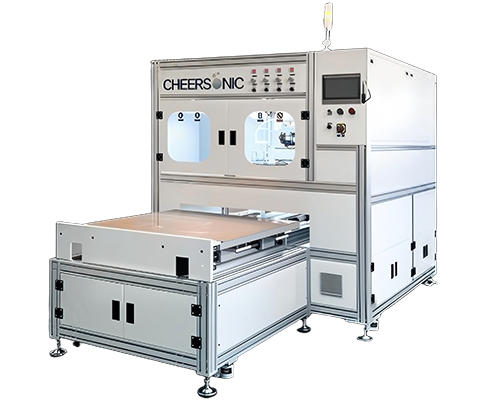
This work establishes a simple and controllable ultrasonic spraying preparation process to solve the industry problem of porous substrate ultra-thin organic silicon membranes being prone to permeability and multiple defects. It provides new ideas for the mass production of high-quality bridging organic silicon composite nanofiltration membranes and theoretical references for the interface sandwich structure design of high-performance screening membrane materials. It has guiding value for the development of membrane materials in fields such as dye wastewater treatment and small molecule fine separation.
About Cheersonic
Cheersonic is the leading developer and manufacturer of ultrasonic coating systems for applying precise, thin film coatings to protect, strengthen or smooth surfaces on parts and components for the microelectronics/electronics, alternative energy, medical and industrial markets, including specialized glass applications in construction and automotive.
Our coating solutions are environmentally-friendly, efficient and highly reliable, and enable dramatic reductions in overspray, savings in raw material, water and energy usage and provide improved process repeatability, transfer efficiency, high uniformity and reduced emissions.
Chinese Website: Cheersonic Provides Professional Coating Solutions