
Details of Bread Processing Process
Details of Bread Processing Process: detailed explanation of demolding, cooling, slicing, and packaging steps after baking
After the bread is fully matured by high-temperature baking, the mold still retains high temperatures. If the bread is left in the mold, the residual heat may cause excessive coking of the edges of the bread, and also prevent the internal moisture from dissipating properly, making the taste solid and sticky. Therefore, it is necessary to immediately use tools such as heat-resistant gloves or bread clips to carefully remove the bread from the mold and quickly transfer it to a dedicated cooling rack for natural cooling. The cooling rack adopts a hollow grid design, which allows air to circulate from the bottom and sides of the bread in all directions, avoiding the accumulation of water vapor at the bottom of the bread due to prolonged contact with the flat surface, resulting in the bottom becoming soft and damp; At the same time, the circulating air can also help the hot air inside the bread to dissipate evenly, avoiding excessive temperature differences between the inside and outside that can cause skin shrinkage and cracking.

The texture of freshly baked hot bread is particularly soft, filled with small pores generated during the fermentation process. At this time, the starch has not yet fully regenerated and formed, and the gluten structure is also in a relaxed state. If directly cut with a knife at this time, external pressure will instantly destroy the unstable pore structure, causing the bread to collapse significantly. Not only will the shape after slicing be irregular, but it will also cause the taste to lose its expected soft and fluffy texture, and even result in “serious slagging”. The cooling process needs to be adjusted according to the size and thickness of the bread: small toast usually takes 30-40 minutes, while large square bread takes 1-1.5 hours, until the center temperature of the bread drops to room temperature of 25-28 ℃. When lightly pressing the surface of the bread with your hand, it can quickly rebound, and there is no obvious depression at the pressing point, indicating that the internal structure is completely stable and can proceed to the next step of processing.
After the bread is completely cooled, it will be smoothly transported by the conveyor belt to the ultrasonic automatic slicer. This device is different from traditional cutting tools. It achieves “pressure free cutting” through high-frequency vibration, which can not only avoid the production of a large amount of bread crumbs due to squeezing during traditional cutting tools, reduce raw material waste, but also accurately control the slice thickness – strictly controlling the error within ± 0.5mm, ensuring that the thickness of each slice of bread is uniform and consistent. Whether it is stacking during subsequent packaging, or consumers applying sauce or matching ingredients, it can maintain good consistency.
After slicing is completed, the bread slices will continue to be transported to the packaging station via the conveyor belt. Firstly, a brief foreign object detection process will be carried out to check for bread crumbs and impurities mixed in through optical detection equipment, ensuring the cleanliness of each piece of bread; Subsequently, it enters the automatic packaging machine and uses breathable and moisture-proof composite film as the packaging material – this material can block the invasion of moisture in the air, prevent the bread from becoming soft and damp during storage, and retain an appropriate amount of breathability to avoid condensation inside the packaging, which can cause the bread slices to mold and deteriorate. During the packaging process, the machine will automatically adjust the packaging size based on the number of bread slices. After the packaging is completed, a quality inspection of the sealing will be conducted to check whether the sealing is tight, whether there is any air leakage or wrinkling, to prevent packaging damage during transportation and storage, ensuring that the bread can be delivered to consumers in good condition, and ultimately completing the entire processing flow.
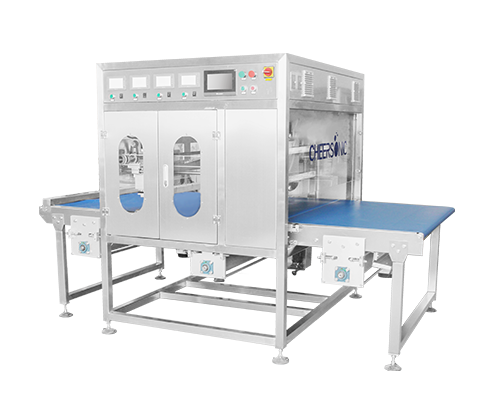
Ultrasonic slicer is not suitable for all types of bread, and its advantages are particularly prominent in soft, high moisture, and porous bread. The core applicable categories include:
Toast category: white toast, whole wheat toast, and mixed grain toast (the most common application scenario, almost standard in industrial toast production lines);
Soft bread: meal bread, conditioning bread (such as cream bread, red bean bread, which can prevent the filling from overflowing due to squeezing);
Cake categories: Sponge cake, Qi Feng cake (with a softer texture and ultrasonic cutting to reduce the risk of “crushing”).
Note: For bread with a hard texture and high density (such as European style hard bread and baguettes), ultrasonic cutting efficiency is lower due to the hard skin, large and compact internal pores, making it more suitable for specialized hard bread slicers.
About Cheersonic
Cheersonic manufactures the leading portioning equipment for bakeries producing fresh and frozen desserts. Since 1998 bakers have used Cheersonic machines to cut, slice and portion cheesecake, pie, layer cake, loaves, butter, cheese, pizza, sandwichs, and more. Cheersonic offers ultrasonic cutting solutions that support start-up bakeries and high production commercial facilities alike. Small standalone machines can be used in manual baking facilities and large inline robotic solutions aid in high speed production.
Cheersonic offers many ultrasonic slicing models, both inline and offline applications, with production speeds of 80 to 1,500 cakes or pies per hour.
Cheersonic’ latest offline introductions include ultrasonic cutting with or without divider inserts between each slice. This improves the quality of the cut and makes for a much better product presentation for the customer. In addition, robotic arm improves the speed, efficiency, and accuracy of the cutting process, producing professional looking products every time.
Chinese Website: Cheersonic Provides Professional Ultrasonic Cutting Solutions
