
Coating Mini/Micro LED Glass Substrates
Application of Ultrasonic Spraying Thermal Decomposition Equipment in Mini/Micro LED Glass Substrate Coating
In the wave of display technology iteration towards high density, high brightness, and low power consumption, Mini/Micro LEDs, with their superior optical performance, have become a core solution in high-end displays, automotive displays, VR/AR, and other fields. As the core substrate supporting Mini/Micro LED devices, the surface coating quality of the glass substrate directly determines the device’s luminous efficiency, color consistency, and lifespan. Ultrasonic spraying thermal decomposition technology, with its precise and controllable coating advantages, is gradually replacing traditional coating processes and becoming a key technological path for Mini/Micro LED glass substrate coating.

The core principle of ultrasonic spraying thermal decomposition technology is to atomize the coating material into nanoscale uniform droplets through ultrasonic vibration, which are then precisely deposited onto the glass substrate surface under gas-driven conditions. Subsequently, heating the substrate achieves thermal decomposition of the droplets and film formation. Compared with traditional spraying and evaporation processes, this technology solves the pain points of uneven thickness, material waste, and high defect rates in the coating process from the source. Its atomized particle diameter can be controlled within 1-10 micrometers, with a droplet distribution uniformity error of less than ±5%, perfectly adapting to the technological trend of continuously shrinking pixel pitch in Mini/Micro LEDs—whether it’s the 100-500 micrometer pixel pitch of Mini LEDs or the 10-100 micrometer ultra-fine pitch of Micro LEDs, it can achieve uniform coating without dead angles or overlaps.
In Mini/Micro LED glass substrate coating, ultrasonic spraying thermal decomposition equipment exhibits three core advantages. First, outstanding coating precision and consistency. The equipment can digitally adjust parameters such as ultrasonic frequency, spraying pressure, and substrate temperature to control coating thickness at the nanometer to micrometer level, with a thickness error within ±2%, meeting the precise requirements of different functional coatings such as conductive layers, insulating layers, and phosphor conversion layers. For complex substrates requiring multi-layer coating, the equipment supports multi-channel material switching and interlayer temperature closed-loop control, ensuring the adhesion and interface compatibility of each coating layer and avoiding interlayer peeling or performance degradation.
Second, it combines high material utilization with environmentally friendly processes. Traditional coating processes typically achieve material utilization rates of 30%-50%, while ultrasonic spraying technology, with its directional atomization and precise deposition design, can increase material utilization to over 85%, significantly reducing the cost of high-end coating materials such as precious metals and specialty resins. Simultaneously, the process requires no high-temperature or high-pressure environment, generates no volatile harmful gases, and the droplet atomization process produces no secondary pollution, aligning with the green production development philosophy of the display industry.
Thirdly, it boasts strong process adaptability and scalability. The equipment can flexibly adapt to substrates ranging from 100mm×100mm laboratory-grade small sizes to 1800mm×2400mm mass-production-grade large sizes, supporting continuous production lines and intermittent customized production. For different functional requirements, the equipment is compatible with various coating systems such as metal oxides, phosphors, conductive pastes, and insulating materials. Whether it’s the high conductivity requirements of the electrode layer, the high insulation performance of the passivation layer, or the high transmittance requirements of the phosphor layer, precise matching can be achieved through process parameter optimization.
In practical applications, ultrasonic spraying pyrolysis equipment effectively addresses key pain points in Mini/Micro LED glass substrate coating through end-to-end digital control. For example, in the substrate pretreatment stage before Micro LED chip transfer, the equipment can coat a uniform adhesive layer, ensuring the chip’s fixation strength and conductivity stability after transfer. In phosphor conversion layer coating, precise control of coating thickness and phosphor distribution density achieves accurate color reproduction and improved brightness uniformity in the display. Furthermore, the integrated online detection module monitors key indicators such as coating thickness and defect distribution in real time, automatically adjusting process parameters through a closed-loop control system, increasing product yield to over 98%, providing a reliable guarantee for the large-scale mass production of Mini/Micro LEDs.
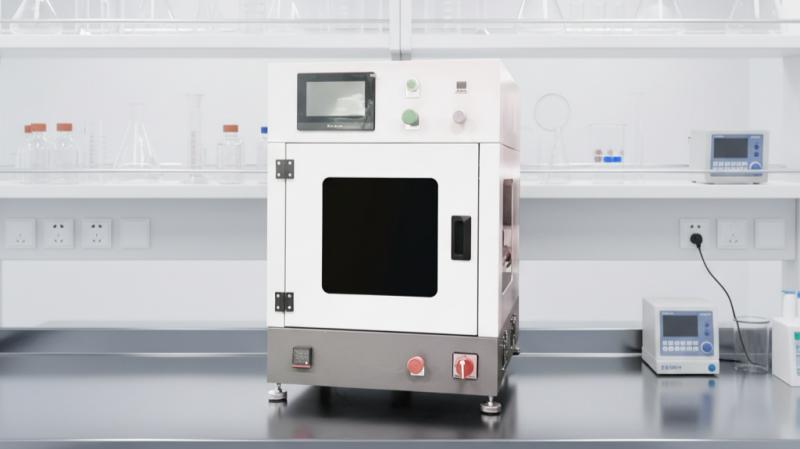
As Mini/Micro LED technology develops towards higher pixel density, larger size, and lower cost, ultrasonic spraying pyrolysis equipment is continuously iterating and upgrading. In the future, through deep integration with AI algorithms, machine vision, and other technologies, the equipment will achieve adaptive optimization of the coating process and intelligent fault prediction. In terms of material compatibility, it will further expand its compatibility with novel nanocomposite materials and flexible coating materials, providing broader process space for innovative breakthroughs in display technology. As a key piece of equipment in the Mini/Micro LED industry chain, ultrasonic spraying thermal decomposition equipment not only promotes technological innovation in glass substrate coating processes, but also helps the display industry move towards high image quality, low power consumption, and green environmental protection, injecting core momentum into the upgrading of global display technology.
About Cheersonic
Cheersonic is the leading developer and manufacturer of ultrasonic coating systems for applying precise, thin film coatings to protect, strengthen or smooth surfaces on parts and components for the microelectronics/electronics, alternative energy, medical and industrial markets, including specialized glass applications in construction and automotive.
Our coating solutions are environmentally-friendly, efficient and highly reliable, and enable dramatic reductions in overspray, savings in raw material, water and energy usage and provide improved process repeatability, transfer efficiency, high uniformity and reduced emissions.
If you have any technical questions, customization demands, or procurement inquiries about ultrasonic atomization nozzles, feel free to contact our professional sales and technical team for detailed parameters, customized solutions, and industry application support.
Email: market2@cheersonic.com