
Carbon Paper Catalyst Spraying
In the research and laboratory preparation of fuel cell membrane electrodes, the uniformity, loading accuracy and compactness of catalyst coatings are core factors that determine the electrochemical performance, stability and service life of fuel cells. Traditional coating methods such as dipping, blade coating and ordinary air spraying have long plagued laboratory research due to uncontrollable catalyst loading, uneven coating thickness, blocked carbon paper pores and serious material waste, which cannot meet the high-precision experimental standards of modern hydrogen energy fuel cell research. The professional fuel cell catalytic spray coating system perfectly solves the above process pain points and has become essential laboratory equipment for fuel cell electrode research and development.
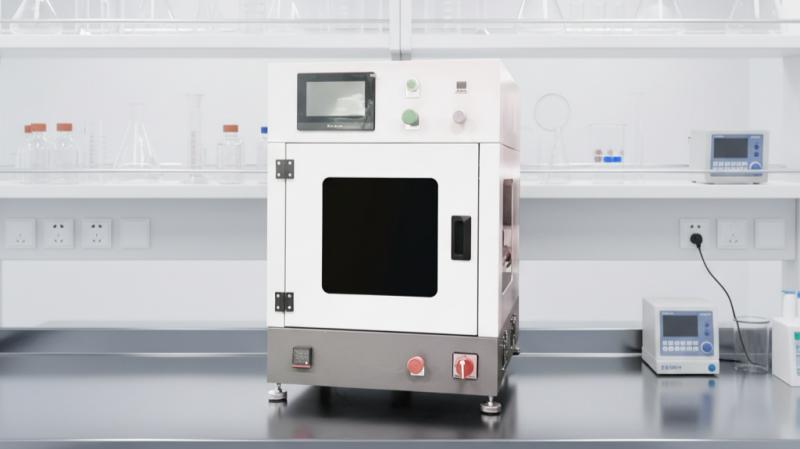
This laboratory-specific catalytic spray coating system is professionally optimized for carbon paper substrate coating, supporting mainstream laboratory sample specifications ranging from 1×1cm to 3×3cm. It achieves precise and stable catalyst loading control of 1~3mg/cm² on carbon paper surfaces with extremely low loading error and excellent coating uniformity. The system effectively avoids common defects such as local coating accumulation, missing coating and uneven substrate penetration, ensuring high consistency and repeatability of experimental data, which is crucial for fuel cell material testing and process iteration.
The system is compatible with two high-precision spraying modules to adapt to diverse laboratory research needs, including quantitative precision spraying equipment and ultrasonic spraying equipment. Adopting high-frequency atomization technology, the ultrasonic spraying module disperses catalyst ink into uniform micron-sized droplets, which are evenly deposited on carbon paper through low-pressure carrier gas. This soft spraying method protects the porous structure of carbon paper without fiber damage or pore blockage, maintaining the original gas transmission and conductivity of the substrate. Meanwhile, it greatly reduces the waste of expensive catalyst materials and lowers laboratory research costs.
The quantitative precision spraying module features adjustable spraying parameters including flow rate, atomization pressure and spraying distance, adapting to various precious metal and non-precious metal catalyst slurries. With modular and compact design, the whole system is suitable for laboratory desktop installation with simple operation and rapid startup, no complicated professional debugging is required.
Equipped with this catalytic spray coating system, laboratories can achieve standardized and high-precision preparation of fuel cell gas diffusion electrodes. The optimized coating process reduces electrode interface resistance, improves catalytic reaction efficiency and enhances the overall stability of fuel cell components. Widely applied in university and research institute laboratories, the system provides reliable technical support for fuel cell new material research, process optimization and performance upgrading.
About Cheersonic
Cheersonic is the leading developer and manufacturer of ultrasonic coating systems for applying precise, thin film coatings to protect, strengthen or smooth surfaces on parts and components for the microelectronics/electronics, alternative energy, medical and industrial markets, including specialized glass applications in construction and automotive.
Our coating solutions are environmentally-friendly, efficient and highly reliable, and enable dramatic reductions in overspray, savings in raw material, water and energy usage and provide improved process repeatability, transfer efficiency, high uniformity and reduced emissions.
If you have any technical questions, customization demands, or procurement inquiries about ultrasonic atomization nozzles, feel free to contact our professional sales and technical team for detailed parameters, customized solutions, and industry application support.
Email: market2@cheersonic.com