
Bonding Technology Between Glass and Metal
Connection technology between glass and metal: ultrasonic assisted brazing technology
In our daily lives, behind high-end products such as LED lights, solar cells, and aerospace equipment, there is a key challenge – how to make glass and metal stably “hold hands”. Glass (such as SiO ₂ glass and quartz glass) has become the top choice for optical windows and packaging shells due to its excellent optical properties and corrosion resistance; Metals (such as aluminum, copper, tin alloys) play an important role in heat dissipation and conductivity due to their good electrical and thermal conductivity. However, achieving a reliable connection between these two materials with vastly different properties is not an easy task, and the emergence of ultrasonic assisted brazing (UAS) technology has finally broken this deadlock.
The “Three Difficulties” of Connecting Glass and Metal
To achieve a tight bond between glass and metal, three core challenges must be overcome first:
Unfamiliar surface: poor wettability
The surface of glass has a stable Si-O covalent bond structure, just like the wax layer on the surface of lotus leaves. Molten solder (the “adhesive” that connects the two materials) drips onto it and rolls like water droplets, making it difficult to spread and attach, and unable to form an effective connection.
‘Non synchronous thermal expansion and contraction’: mismatched coefficient of thermal expansion
The thermal expansion coefficient of glass is extremely low (such as SiO ₂ glass only 0.55 × 10 ⁻⁶/° C), while metals (such as aluminum reaching 23 × 10 ⁻⁶/° C) are prone to “weight gain” when heated and “shrinkage” is more pronounced when cooled. After connection, temperature changes occur, and the degree of expansion and contraction of the two is different, which will generate huge internal stress and lead to joint cracking.
Difficult to react interface: insufficient metallurgical bonding
During conventional brazing, it is difficult for chemical reactions to occur between glass and solder, making it impossible to form a “molecular level” strong bond, and the connection strength is far from meeting the requirements of high-end devices.
The ‘inadequacy’ of traditional connection methods
To solve the above problems, people in the past mainly relied on two methods, but both have obvious shortcomings:
Active brazing: high cost and complex process
It is necessary to use brazing materials containing active elements such as titanium (Ti) and zirconium (Zr), and operate them in a high-temperature vacuum environment. Not only is the equipment cost high and the process cumbersome, but high temperature will further exacerbate the thermal stress contradiction between glass and metal, increasing the risk of cracking.
Adhesive bonding: short lifespan, low reliability
Although using glue for pasting is simple to operate, the glue is prone to aging, losing its stickiness in high temperature and humid environments, and has poor airtightness, which cannot meet the sealing performance requirements of LED heat dissipation substrates, vacuum heat collection tubes, etc.
Just when traditional methods were at a bottleneck, ultrasonic assisted brazing technology became a new focus in the industry due to its advantages of “low temperature, high efficiency, and low cost”.
Ultrasonic brazing: turning “water fire incompatibility” into “close interdependence”
The core of ultrasonic assisted brazing is to “buff” the molten brazing material – through high-frequency mechanical vibration of 20-60kHz, two magical effects are generated in the brazing material, making it easy to overcome connection problems.
1. Cavitation effect: “micro explosion” in brazing materials
When ultrasound propagates in liquid brazing materials, periodic “pressure fluctuations” occur: during the negative pressure stage, tiny bubbles in the brazing material rapidly expand into “cavitation bubbles”; During the positive pressure stage, these bubbles will collapse instantly, like countless’ micro explosions’. This process only takes nanoseconds, but can generate high temperatures of 5000K (about 4727 ℃), high pressures of 100MPa, as well as strong shock waves and microjets locally.
For metals: Micro jets can act like a “high-pressure water gun” to flush away oxide films on metal surfaces (such as Al ₂ O3 on aluminum surfaces), exposing pure metal surfaces and allowing brazing materials to “intimately contact” the metal.
For glass: High temperature and pressure will break the Si-O bonds on the surface of the glass, creating “unsaturated bonds” and creating conditions for subsequent reactions with brazing materials.
Simply put, the cavitation effect is like a “cleaner+catalyst”, allowing interfaces that were previously difficult to react to efficiently combine even at low temperatures.
2. Acoustic flow effect: the “stirrer” in brazing materials
Ultrasonic waves can also generate directional “sound flow” in liquid solder, like an invisible “stirrer”, bringing three major benefits:
Make the composition of the brazing material more uniform and quickly deliver active elements such as Ti and Zn to the interface reaction zone;
Like “skimming foam”, it discharges gases and impurities from the interface, reducing defects such as pores and shrinkage;
Accelerate the diffusion of elements to make the reaction between glass and solder more complete.
Triple guarantee of interface integration
Ultrasonic brazing can achieve high-strength connections through the combined action of three mechanisms, forming a “triple guarantee”:
1. Mechanical anchoring: Lock like a “hook”
If there are small pits or cracks on the surface of the glass, the molten solder will penetrate these gaps under the action of ultrasound, and after solidification, form a “mechanical interlocking structure”, just like a hook hooking an object, significantly improving the connection strength. When the surface roughness (Ra value) of the glass reaches 0.26 μ m, the separation of the joint can reach its peak, which is much better than the connection effect of smooth glass.
2. Chemical bonding: a molecular level “strong adhesive”
This is the core source of connection strength. Through X-ray photoelectron spectroscopy (XPS) analysis, scientists have found that:
When Sn Zn is used to solder glass, Zn, O, and Si atoms at the interface will form Zn-O-Si-chemical bonds, like molecular level “glue”, firmly adhering the two;
Solder materials containing Ti (such as Sn Ag Ti) have stronger effects, and Ti has a high affinity for oxygen, forming a TiO ₂ transition layer at the interface to achieve metallurgical bonding.
3. Acoustic oxidation: “nano bridges” at low temperatures
This is a unique mechanism of ultrasonic brazing. The extreme environment generated by cavitation effect can also lead to the formation of nanoscale oxide layers at the interface:
When connecting aluminum and brazing material, a 13.9nm thick α – Al ₂ O3 layer will be formed;
When connecting glass and solder, a 16.2nm thick TiO ₂ layer will be formed.
These nano layers are like “bridges”, perfectly connecting glass and metal to achieve high-strength bonding.
Process parameters: Find the “optimal balance point”
The quality of ultrasonic brazing cannot be achieved without precise control of four key parameters, and all of them must follow the principle of “too much is not enough”:
Ultrasonic power and amplitude: The power is too low, the cavitation effect is insufficient, and the interface cannot be cleaned; Excessive power can cause solder splatter and damage to glass.
Ultrasound exposure time: too short, insufficient response; If the time is too long, the metal will dissolve excessively, which will actually reduce its strength.
Brazing temperature: If the temperature is too low, the flowability of the brazing material will be poor; Excessive temperature can exacerbate thermal stress and oxidation. Fortunately, ultrasonic brazing can operate at temperatures lower than conventional brazing, effectively alleviating thermal stress issues.
Solder composition: Sn based solder materials (such as Sn Zn, Sn Bi) are the mainstream choice due to their low melting point; Adding active elements such as Zn and Ti can improve wettability, but the content needs to be moderate, otherwise it will make the solder brittle.
For example, Sn Zn solder can easily achieve the connection between glass and metal, while Sn Ag Cu solder without active elements cannot wet glass even under the same ultrasonic conditions, indicating the importance of solder composition.
In the future, this technology will continue to develop towards greater intelligence (automated processes, online monitoring), higher efficiency (research and development of new brazing materials), and wider application (in sapphire and microcrystalline glass), providing support for innovation in more high-end products.
From the traditional method of “insufficient strength” to the “breakthrough” of ultrasonic brazing, there is finally an efficient solution to the problem of connecting glass and metal. This technology, which integrates acoustics, materials science, and technology, not only showcases the charm of science, but also marks a significant milestone in promoting industrial upgrading.
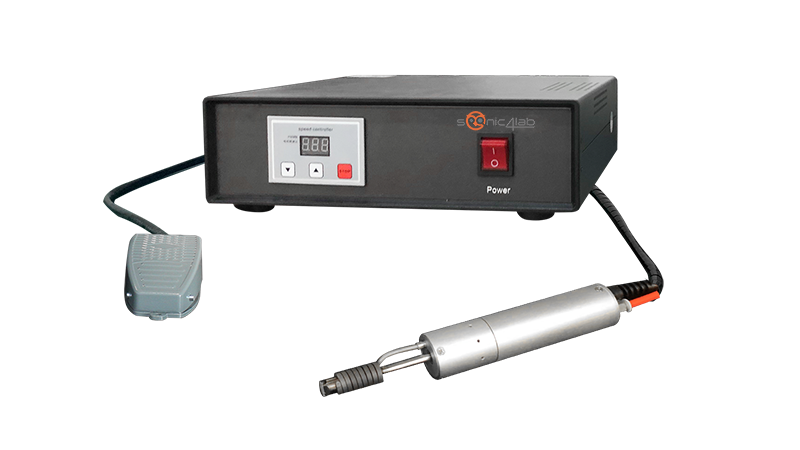
If you want to purchase equipment, please click here