
Analysis of Sprayed Organic Thin Films
Analysis of Sprayed Organic Thin Films – Ultrasonic Coating – Cheersonic
1. Definition and Principle
Definition: Sprayed organic thin film is a process in which organic materials, in liquid form, are uniformly deposited onto a substrate surface using spraying equipment to form a thin organic film. These organic materials can be polymers, small organic molecules, or mixtures thereof, and the film thickness is typically in the nanometer to micrometer range.
Principle: The spraying process is primarily based on fluid dynamics and physicochemical processes. Organic materials are dissolved or dispersed in a suitable solvent to form a spray liquid. This liquid is atomized into tiny droplets using a spray gun or other spraying device, utilizing compressed air or other power sources. These droplets collide, spread, and fuse on the substrate surface. As the solvent evaporates, the organic material gradually solidifies to form a thin film. For example, when spraying polymethyl methacrylate film, PMMA is dissolved in an organic solvent such as toluene. When the atomized droplets reach the substrate, the toluene evaporates, and the PMMA molecules aggregate to form a continuous film.
2. Types of Sprayed Materials
Polymer Materials: This is the most common material for sprayed organic thin films. For example, polyvinyl alcohol can be used to prepare thin films with good hydrophilicity and biocompatibility, and can be applied in fields such as drug delivery carriers and biosensors; polystyrene has good optical and processing properties and is often used to prepare optical thin films and insulating layers for electronic devices.
Organic small molecule materials: Some organic small molecules can form thin films through self-assembly. For example, some organic dye molecules can form thin films with specific optical properties on the substrate surface under suitable conditions, and are used in display devices, photochemical sensors, etc.
Composite materials: Combining different organic materials or organic and inorganic materials can produce thin films with multiple properties. For example, spraying carbon nanotubes combined with polymers can improve the electrical and mechanical properties of the thin film, and can be used to prepare flexible electronic devices.
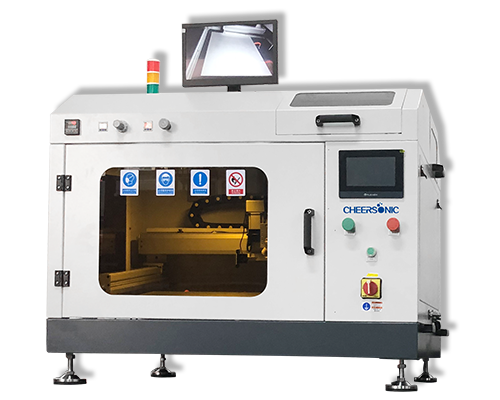
Ultrasonic spraying machine for spraying organic thin films
Ultrasonic spraying machine, with high-frequency ultrasonic atomization technology, has become the core equipment for precise preparation of organic thin films, widely used in fields such as photovoltaics, electronics, flexible displays, etc. It can efficiently spray organic photovoltaic polymers, organic semiconductors and other materials to prepare uniform and dense functional thin films.
The core of its work is to utilize the cavitation effect of high-frequency ultrasound to atomize organic solutions into small particles with a diameter of only a few micrometers. Under the guidance of low-pressure carrier gas, they are uniformly deposited on the surface of the substrate, and after drying and annealing, organic thin films are formed. Compared with traditional spraying processes, this technology atomizes particles more uniformly, achieves nanometer level thickness control, and maintains an error stability of ± 3 nanometers, effectively avoiding defects such as pinholes and flow hanging.
The spraying process requires precise control of key parameters: the ultrasonic frequency is selected between 80-120kHz based on the characteristics of the organic solution to ensure droplet refinement; The solution flow rate is controlled at 0.1-0.5mL/min, combined with 2-5W ultrasonic power to avoid substrate damage; Maintain a vertical distance of 4-6cm between the nozzle and the substrate to ensure even deposition. The substrate needs to be pre treated in advance to remove impurities and oxide layers, and to regulate surface energy to enhance film adhesion.
This process has significant advantages, with a material utilization rate exceeding 90% and a significant reduction in organic material loss; No high pressure impact, compatible with flexible substrates, avoiding mechanical damage; The coating uniformity reaches over 95%, ensuring stable optoelectronic performance of the thin film. At present, it has been widely used in the preparation of active layers for organic solar cells and functional layers for OLED panels, providing a reliable solution for the large-scale and high-precision production of organic thin films.
About Cheersonic
Cheersonic is the leading developer and manufacturer of ultrasonic coating systems for applying precise, thin film coatings to protect, strengthen or smooth surfaces on parts and components for the microelectronics/electronics, alternative energy, medical and industrial markets, including specialized glass applications in construction and automotive.
Our coating solutions are environmentally-friendly, efficient and highly reliable, and enable dramatic reductions in overspray, savings in raw material, water and energy usage and provide improved process repeatability, transfer efficiency, high uniformity and reduced emissions.
Chinese Website: Cheersonic Provides Professional Coating Solutions