
Spray Catalyst Ink onto PEMs or GDLs
Application and Advantages of Ultrasonic Spraying Technology in Catalyst Layer Preparation
In the manufacturing of new energy devices, especially core components related to hydrogen energy, the preparation of the catalyst layer is one of the key processes determining its performance and lifespan. Ultrasonic spraying technology, as an advanced precision coating process, plays an indispensable role in this field. Its core lies in the uniform and controllable spraying of a precisely formulated slurry containing highly active catalytic materials (e.g., platinum-carbon materials) onto key substrates such as proton exchange membranes or gas diffusion layers, thereby forming a high-performance catalyst coating film. The precision of this process directly affects the energy density, efficiency, and durability of the final energy conversion device.
Technical Principle: Precision Conversion from Liquid to Uniform Thin Film
Unlike traditional spraying technologies that rely on high-pressure gas atomization, the core of ultrasonic spraying machines lies in their unique atomization mechanism. The equipment uses electrical energy to drive a piezoelectric transducer, generating high-frequency mechanical vibrations of tens of thousands of times per second. This high-frequency vibration is transmitted to the nozzle tip, instantly tearing the catalytic slurry flowing through it into extremely fine and uniform atomized droplets, typically at the micrometer level.
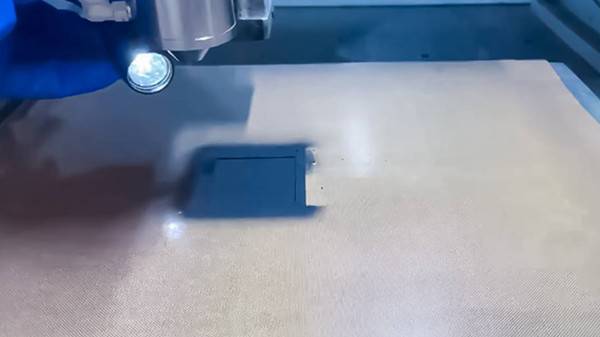
This “gentle” atomization method offers several advantages. First, it does not rely on high-speed airflow, thus avoiding the risk of damage or agglomeration of valuable catalytic particles in the slurry due to excessive shear force, ensuring stable catalytic activity. Second, the resulting droplet atomization has a narrow particle size distribution and low axial velocity, meaning they can reach the substrate surface in a gentler and more controllable manner. Operators can achieve micrometer-level control over the thickness, width, and shape of the wet film by precisely adjusting the equipment’s vibration frequency, slurry flow rate, and the relative movement speed between the spray head and the substrate, laying the foundation for preparing ultrathin, uniform, and defect-free catalytic layers.
Process Advantages: Superior Characteristics Surpassing Traditional Methods
Compared to traditional processes such as blade coating and screen printing, ultrasonic spraying technology exhibits significant technical and economic advantages in catalytic layer preparation.
1. Exceptional Uniformity and Consistency: The uniformity of the catalyst layer, especially the distribution of noble metals, is crucial to the efficiency of electrochemical reactions. Ultrasonic spraying achieves near-perfect material distribution, ensuring the consistency of active sites per unit area. This effectively improves the utilization of the reaction interface, reduces local overload or reaction dead zones, and is essential for enhancing the overall output performance and stability of the device.
2. Extremely High Material Utilization and Cost Control: Due to the precise and controllable atomization process, overspray and material splashing are minimized. For slurries containing extremely expensive catalysts such as platinum group metals, this means that material utilization can be increased to a very high level, directly reducing the manufacturing cost of core components. This is crucial for large-scale commercial applications.
3. Excellent Process Compatibility and Flexibility: This technology is highly adaptable to various substrates. Whether it’s a fragile proton exchange membrane or a porous and rough gas diffusion layer, perfect coating can be achieved through optimized parameters without damaging its microstructure. Meanwhile, it greatly facilitates the design of gradient or patterned coatings. For example, it can prepare catalytic layers with varying catalyst concentrations along specific directions to optimize reactant and product transport, which is difficult to achieve with many traditional processes.
4. Wide Adaptability to Slurry Properties: Ultrasonic spraying offers a wide process window for parameters such as slurry viscosity and solids content, adapting to different formulations from low to high viscosity, providing greater freedom for the development of novel catalyst ink systems.
Process Flow and Precision Control
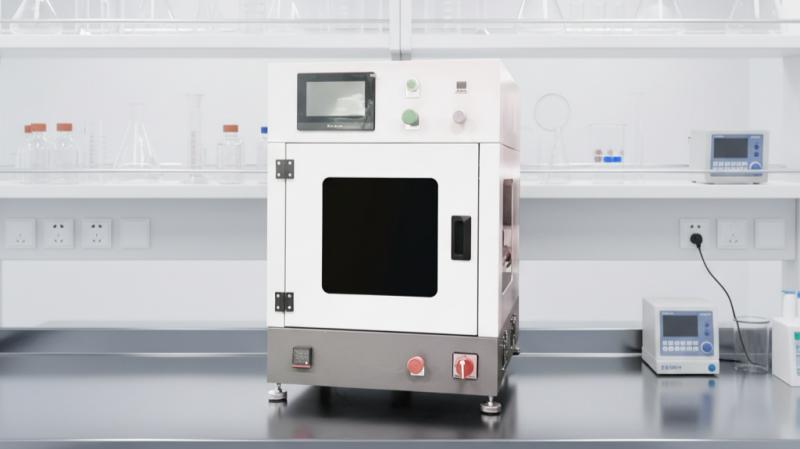
A complete ultrasonic spraying process involves much more than a simple spraying action. It begins with the precise preparation of the slurry and continuous circulation and stirring to ensure stable particle suspension and prevent sedimentation. Before spraying, the substrate requires rigorous cleaning and surface treatment to optimize its wettability and adhesion.
During the spraying process, multiple process parameters need to be precisely controlled in conjunction: the slurry supply rate determines the amount of material deposited per unit time; the ultrasonic amplitude directly affects the droplet size and distribution; and the spraying height and moving speed jointly determine the wet film thickness and uniformity of the coating. Furthermore, ambient temperature and humidity, as well as the substrate temperature, may be incorporated into the control system to ensure that the solvent evaporates in a controlled manner after the slurry impacts the substrate, forming a dense and crack-free dry film. The entire process is typically carried out on a highly automated platform, ensuring high batch-to-batch repeatability.
Application Prospects and Technological Outlook
With the increasing global demand for clean and efficient energy solutions, the manufacturing processes for related devices are evolving towards greater efficiency, precision, and environmental friendliness. Ultrasonic spraying technology, with its unique advantages in preparing high-performance, low-cost catalytic layers, has become one of the leading manufacturing technologies in this field.
Future development will focus more on further improving coating efficiency to adapt to large-scale production, while exploring novel nanomaterial catalysts, the preparation of ultrathin layers with lower loading requirements, and composite processes with other deposition technologies (such as reactive jet deposition). Through deeper process digitization and intelligence, achieving “precise design” and “perfect printing” of the coating’s microstructure, ultrasonic spraying technology will undoubtedly play a more central role in the manufacturing of next-generation energy devices.
About Cheersonic
Cheersonic is the leading developer and manufacturer of ultrasonic coating systems for applying precise, thin film coatings to protect, strengthen or smooth surfaces on parts and components for the microelectronics/electronics, alternative energy, medical and industrial markets, including specialized glass applications in construction and automotive.
Our coating solutions are environmentally-friendly, efficient and highly reliable, and enable dramatic reductions in overspray, savings in raw material, water and energy usage and provide improved process repeatability, transfer efficiency, high uniformity and reduced emissions.
If you have any technical questions, customization demands, or procurement inquiries about ultrasonic atomization nozzles, feel free to contact our professional sales and technical team for detailed parameters, customized solutions, and industry application support.
Email: market2@cheersonic.com