
A Precise Solution for Chocolate Cutting
Ultrasonic Cutting Equipment: A Precise Solution for Chocolate Cutting
Chocolate, a specialty dessert originating from Japan, is characterized by its freshness. Made with 24% fresh cream and 14% water, it has a soft, silky texture like cheesecake, melting in your mouth. However, this characteristic also presents a significant challenge in the cutting process. Traditional cutting methods easily lead to deformation, sticking, and edge chipping. Ultrasonic cutting equipment, with its unique technological principle, has become the ideal choice for solving the cutting problems of chocolate, ensuring the production of high-quality chocolate.
The core advantage of ultrasonic cutting equipment stems from its innovative working principle. Unlike traditional cutting methods that rely on physical pressure, it achieves precise cutting through high-frequency vibration. The equipment mainly consists of an ultrasonic generator, transducer, amplifier, and cutting blade. The generator converts mains electricity into a high-frequency electrical signal of 20-40 kHz. The transducer converts the electrical signal into mechanical vibration, which is then amplified by the amplifier and transmitted to the cutting blade, causing the blade to vibrate microscopically at a frequency of 20,000-40,000 times per second. When this high-frequency, low-amplitude vibration acts on tamarisk, it causes instantaneous localized melting at the contact point. Simultaneously, the micro-hammering action achieves clean fracture, and the molten layer solidifies rapidly after cutting, ensuring the original texture of the tamarisk remains intact.
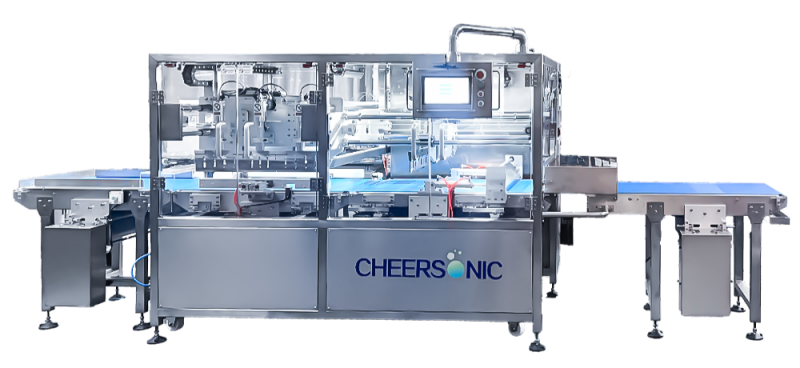
Ultrasonic cutting equipment exhibits irreplaceable adaptability to the characteristics of tamarisk. Tamarisk has a high lipid content and a soft, viscous texture; traditional cutting methods often result in the blade sticking to the material, requiring frequent heating and cleaning, and are prone to cracking and debris. However, the high-frequency vibration of ultrasonic cutting creates a “self-cleaning” effect, effectively preventing tamarisk from sticking to the blade, eliminating the need for frequent machine shutdowns for cleaning, and significantly improving production efficiency. At the same time, the lateral force applied during cutting is minimal, completely avoiding problems such as chipping and deformation of tamarisk, producing finished products with sharp edges and smooth surfaces, even maintaining the perfect shape of ultra-thin tamarisk as thin as 2 mm.
In production applications, ultrasonic cutting equipment also features high precision, high consistency, and versatility. Through precise parameter control, the equipment achieves strict tolerance control, ensuring that the size and weight of each piece of nama-chou are completely consistent, which is crucial for the standardized production of high-end nama-chou. Furthermore, by simply changing the blade profile, the equipment can easily cut complex shapes such as squares and hearts, meeting diverse product demands. Compared to manual cutting, it can process 80-1500 products per hour, significantly improving efficiency while reducing material waste and lowering production costs.
When using ultrasonic cutting equipment to cut nama-chou, several key points must be noted to ensure optimal results. First, the vibration frequency and cutting speed should be adjusted according to the hardness and thickness of the nama-chou. Generally, the cutting speed can be appropriately reduced for softer nama-chou. Second, the blades must be made of food-grade wear-resistant material, and regular inspection and maintenance are necessary to ensure vibration stability. Additionally, the nama-chou must be crystallized and solidified in a constant temperature environment of 18-22℃ before cutting to avoid affecting the cutting effect due to excessively low or high temperatures. During equipment operation, the working environment must be kept clean and dry to prevent material contamination.
In summary, ultrasonic cutting equipment, through its unique technical principles, perfectly solves many pain points in the cutting of raw cookie dough, balancing product quality, production efficiency, and safety. With the increasing demands for r-efinement and standardization in the food processing industry, this equipment has become a key component in high-end raw cookie production, providing strong support for quality upgrades in the dessert industry.
About Cheersonic
Cheersonic manufactures the leading portioning equipment for bakeries producing fresh and frozen desserts. Since 1998 bakers have used Cheersonic machines to cut, slice and portion cheesecake, pie, layer cake, loaves, butter, cheese, pizza, sandwichs, and more. Cheersonic offers ultrasonic cutting solutions that support start-up bakeries and high production commercial facilities alike. Small standalone machines can be used in manual baking facilities and large inline robotic solutions aid in high speed production.
Cheersonic offers many ultrasonic slicing models, both inline and offline applications, with production speeds of 80 to 1,500 cakes or pies per hour.
Cheersonic’ latest offline introductions include ultrasonic cutting with or without divider inserts between each slice. This improves the quality of the cut and makes for a much better product presentation for the customer. In addition, robotic arm improves the speed, efficiency, and accuracy of the cutting process, producing professional looking products every time.
