
Application of Ultrasonic Spraying Technology in SOFC Fabrication
Ultrasonic spraying technology, as a novel thin-film fabrication process, has demonstrated significant advantages in the fabrication of electrolyte and electrode layers in SOFCs, providing a new technical pathway for SOFC thin film preparation. This technology utilizes the atomization effect of ultrasound to transform the prepared slurry into tiny, uniform droplets. These droplets are then precisely delivered to the substrate surface via a carrier gas, followed by drying and sintering to form a dense and uniform thin film.
1. Core Working Principle of Ultrasonic Spraying
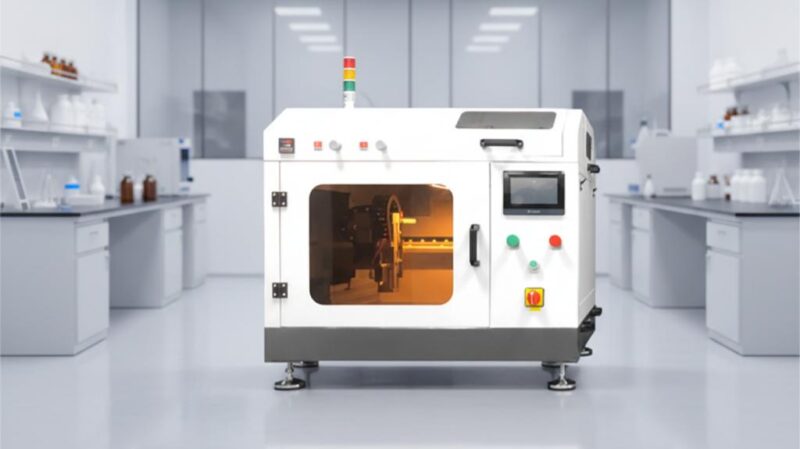
The ultrasonic spraying system mainly consists of an ultrasonic atomizer, a liquid delivery device, a carrier gas system, and a substrate heating device. During operation, the ultrasonic generator produces high-frequency vibrations, which are transmitted to the slurry in the atomizing head via a transducer, causing tiny droplet atomization clusters to form on the slurry surface. Simultaneously, the liquid delivery device precisely controls the slurry supply rate, while the carrier gas directionally blows the atomized droplets onto the preheated substrate surface. The droplets rapidly spread on the substrate and complete solvent evaporation, ultimately forming a continuous thin-film coating. Subsequent desizing and sintering yield a stable SOFC functional layer.

2. Technical Advantages of Ultrasonic Spraying in SOFC Fabrication
Compared to traditional casting processes, ultrasonic spraying technology offers several unique advantages in SOFC fabrication: First, it provides higher precision in film thickness control. By adjusting parameters such as ultrasonic power, liquid delivery rate, carrier gas flow rate, and spraying distance, the film thickness can be precisely controlled at the nanometer to micrometer level, better meeting the requirements for ultra-thin SOFC electrolyte layers. Second, it offers excellent coating uniformity. The uniform droplet size formed by ultrasonic atomization, combined with uniform carrier gas delivery, effectively avoids defects such as thicker edges and thinner centers that are common in casting, making it particularly suitable for the fabrication of large-area SOFC modules. Third, it offers high process flexibility. It can fabricate not only planar films but also substrates with complex shapes such as curved surfaces and tubular structures, meeting the fabrication needs of SOFCs with different structures. Furthermore, it enables continuous spraying of multilayer films, simplifying the electrode-electrolyte interface fabrication process. Fourth, it offers high material utilization. The directional deposition of atomized droplets reduces slurry waste, lowers fabrication costs, and makes solvent evaporation during the process easier to control, making it more environmentally friendly.
3. Main Application Scenarios of Ultrasonic Spraying in SOFCs
Currently, ultrasonic spraying technology has been applied in the preparation of multiple functional layers in SOFCs: In electrolyte layer preparation, this technology can be used to prepare ultrathin YSZ electrolyte films, whose density and ionic conductivity meet the requirements for SOFC use, and effectively reduce ohmic polarization losses; in electrode layer preparation, ultrasonic spraying can achieve precise composite of electrode and electrolyte materials, improve the bonding strength of the electrode-electrolyte interface, reduce interfacial impedance, and thus improve the battery’s output performance; in addition, this technology can also be used for the preparation of functionally graded layers in SOFCs, achieving a smooth transition between different functional layers by gradually adjusting the slurry composition, further optimizing the battery’s structural stability and electrochemical performance.
4. Existing Challenges and Development Directions of Ultrasonic Spraying Technology
Despite the significant advantages of ultrasonic spraying technology, some challenges remain in the large-scale preparation of SOFCs: such as the difficulty in atomizing high-solids-content slurries, which easily leads to atomization head clogging; and the high requirements for parameter stability control during long-term continuous spraying, necessitating the establishment of a precise process control system. The future development of this technology will focus on three main aspects: First, developing a dedicated atomization device adapted to high-solids-content and high-viscosity SOFC slurries to improve process applicability; second, combining with an automated control system to achieve real-time monitoring and precise control of spraying parameters to ensure product consistency in large-scale production; and third, exploring the combined application of ultrasonic spraying and casting processes to fully leverage the advantages of each process and further optimize the preparation process and performance of SOFC.
About Cheersonic
Cheersonic is the leading developer and manufacturer of ultrasonic coating systems for applying precise, thin film coatings to protect, strengthen or smooth surfaces on parts and components for the microelectronics/electronics, alternative energy, medical and industrial markets, including specialized glass applications in construction and automotive.
Our coating solutions are environmentally-friendly, efficient and highly reliable, and enable dramatic reductions in overspray, savings in raw material, water and energy usage and provide improved process repeatability, transfer efficiency, high uniformity and reduced emissions.
Chinese Website: Cheersonic Provides Professional Coating Solutions
