
Ultrasonic Spraying for Prism Coating
The Value of Ultrasonic Spraying Systems in Prism Coating Applications
In the field of optical component manufacturing, prisms serve as core optical elements widely used in optical instruments, imaging systems, and laser equipment; their optical performance directly determines the operational quality of the entire system. Surface reflection loss is a critical bottleneck limiting prism performance. Ultrasonic spraying systems, with their unique advantages, offer an ideal solution to this issue. They enable the precise application of anti-reflective and reflective coatings, effectively reducing surface reflection loss and significantly enhancing light transmission efficiency or reflectivity, thereby providing essential support for optimizing the performance of high-end optical systems.
Technologically, ultrasonic spraying systems utilize ultrasonic vibrational energy to atomize and apply coating materials. Compared to traditional spraying techniques, their core advantages lie in the production of finer, more uniform atomized particles and the absence of airflow turbulence during the process, allowing for precise control over coating thickness and coverage. For optical components like prisms—which feature complex geometries and require high surface precision—traditional spraying methods often result in issues such as uneven coatings, edge accumulation, and film delamination. In contrast, ultrasonic spraying systems use high-frequency vibration to convert coating materials into micron- or even nano-scale droplets. These droplets deposit uniformly onto the prism surface under pressure, forming a dense, smooth film structure that ensures excellent adhesion between the film and the prism surface, laying the foundation for superior optical performance.
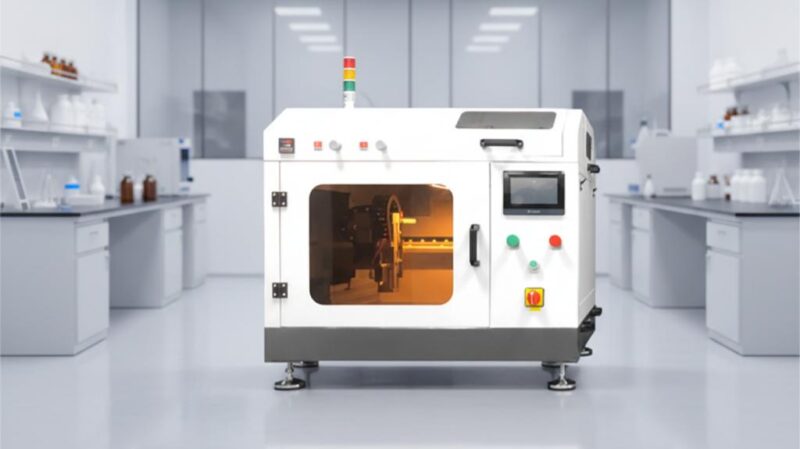
In the application of anti-reflective coatings, the value of ultrasonic spraying systems is demonstrated by their ability to precisely enhance light transmission efficiency. Prisms primarily function to refract or redirect light within optical systems; without anti-reflective treatment, surface reflection losses can range from 4% to 10%. This not only causes a loss of light energy but can also lead to stray light interference, compromising imaging clarity or the stability of laser transmission. Ultrasonic spraying systems enable the uniform application of low-refractive-index optical materials—such as silicon dioxide or magnesium fluoride—onto prism surfaces to create anti-reflective coatings of specific thicknesses. This film layer utilizes optical interference to cause reflected light waves to cancel each other out, thereby significantly reducing surface reflectivity. In visible light applications, anti-reflective coatings applied via ultrasonic sprayers can reduce reflection losses on prism surfaces to below 1% and boost light transmission efficiency to over 99%. Meanwhile, for specialized spectral ranges such as infrared or ultraviolet, precise control over coating material composition and film thickness enables high transmission tailored to specific wavelengths, meeting the unique requirements of diverse optical systems.
Ultrasonic sprayers also demonstrate excellent suitability for applying reflective coatings, effectively enhancing prism reflectivity. Applications such as laser resonant cavities and reflective optical systems demand high reflectivity from prisms to ensure efficient light reflection and energy focusing. Ultrasonic sprayers can utilize metallic coating materials—such as aluminum, silver, or gold—or multilayer dielectric materials; by precisely controlling spraying parameters, they form uniform, dense reflective layers on prism surfaces. Compared to traditional vacuum evaporation processes, reflective coatings applied via ultrasonic sprayers offer superior adhesion, resisting detachment caused by factors like temperature fluctuations or vibration, while also providing greater reflectivity stability. Optimized spraying processes can achieve reflectivity exceeding 95% for metallic reflective coatings. Furthermore, precise application of multilayer dielectric coatings can yield high reflectivity within specific spectral ranges—even approaching total reflection (over 99.5%)—thereby ensuring reliable performance for high-end laser equipment, astronomical instruments, and other applications with stringent reflectivity requirements.
In addition, ultrasonic sprayers offer significant process advantages during prism coating, further expanding their scope of application. On one hand, the gentle spraying process avoids mechanical damage to the prism surface, making it compatible with various prism substrates such as glass and crystals. On the other hand, the process ensures high material utilization; compared to traditional spraying techniques, material waste is reduced by over 30%, effectively lowering production costs. Moreover, ultrasonic spraying machines support automated control and integrate seamlessly with prism production lines; through precise parameter settings and in-line monitoring, they achieve consistent coating across batches of prisms, thereby ensuring stable product quality. In high-end sectors such as precision optical instrument manufacturing, photovoltaic optical components, and automotive LiDAR, these advantages have established the ultrasonic spraying machine as core equipment for prism coating, driving technological upgrades within the optical component manufacturing industry.
As optical technology continues to advance and requirements for prism optical performance become increasingly stringent, the value of ultrasonic spraying machines in the application of anti-reflective and reflective coatings will become even more pronounced. By continuously optimizing spraying processes and expanding the range of compatible coating materials, this equipment will further enhance prism optical performance, facilitate the evolution of high-end optical systems toward greater precision, stability, and miniaturization, and inject strong momentum into the high-quality development of the optical manufacturing industry.
About Cheersonic
Cheersonic is the leading developer and manufacturer of ultrasonic coating systems for applying precise, thin film coatings to protect, strengthen or smooth surfaces on parts and components for the microelectronics/electronics, alternative energy, medical and industrial markets, including specialized glass applications in construction and automotive.
Our coating solutions are environmentally-friendly, efficient and highly reliable, and enable dramatic reductions in overspray, savings in raw material, water and energy usage and provide improved process repeatability, transfer efficiency, high uniformity and reduced emissions.
Chinese Website: Cheersonic Provides Professional Coating Solutions
