
Ultrasonic Spraying of CNT-Modified Materials on Carbon Cloth
In the research and development of advanced materials and functional devices, carbon cloth, with its excellent flexibility, high conductivity, outstanding mechanical strength, and stable chemical inertness, has become one of the most favored substrates, widely used in energy storage, flexible electronics, and sensors. However, the surface chemical properties and specific surface area of virgin carbon cloth sometimes fail to meet the demands for higher performance. Therefore, surface modification to introduce new functional properties is crucial. Among these methods, loading carbon nanotubes, which possess excellent conductivity, mechanical strength, and a unique one-dimensional nanostructure, onto the surface of carbon cloth using precise and controllable processes is an effective way to improve its overall performance. Ultrasonic spraying technology stands out as a promising deposition method in this field.
I. Core Technology Principle: Precision Atomization and Controlled Deposition in Ultrasonic Spraying
Ultrasonic spraying technology differs from traditional pressure spraying; its core mechanism lies in utilizing high-frequency ultrasonic vibration energy. Specifically, the high-frequency electrical signal generated by the ultrasonic generator is converted into mechanical vibration of the same frequency by a transducer. This vibration is transmitted to the nozzle tip, causing the carbon nanotube dispersion (typically a solvent system containing carbon nanotube powder, possibly with necessary dispersants to maintain stability) flowing through it to be efficiently broken up at the liquid-gas interface under tremendous acceleration, forming an extremely fine, uniform, and low-flow-rate atomized droplet layer.
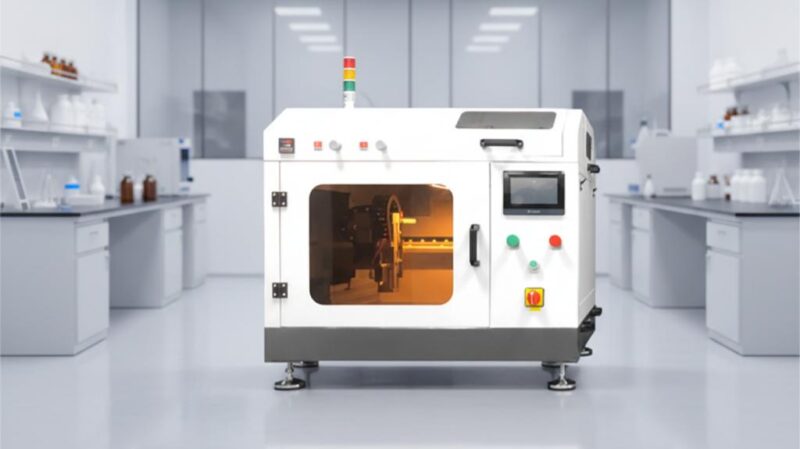
This unique atomization method offers several advantages:
1. Atomization uniformity: Because it does not rely on high pressure, it avoids the problem of inconsistent droplet size caused by hydrodynamic instability, thus ensuring an extremely narrow size distribution range for the generated aerosol droplets.
2. Low flow rate and high utilization rate: This technology is suitable for low-flow-rate conditions and can precisely control the amount of slurry deposited per unit area. For expensive functional materials such as carbon nanotubes, this significantly improves material utilization and reduces preparation costs.
3. Gentle Processing: Ultrasonic energy is primarily used to overcome liquid surface tension for atomization, rather than applying high shear stress to the material itself. This helps maintain the aspect ratio and structural integrity of the carbon nanotubes, avoiding nanotube breakage or performance damage due to excessive shearing.
II. Materials System and Interface Engineering: Synergistic Effects of Carbon Nanotube-Modified Carbon Cloth
Loading carbon nanotubes onto the surface of carbon cloth via ultrasonic spraying essentially constructs a multi-scale composite structure. The carbon cloth itself is a porous, three-dimensional network woven from countless carbon fibers, providing a broad substrate and abundant anchoring points for carbon nanotube attachment.
The modified carbon nanotube dispersion is a key raw material in this process. To achieve stable and uniform spraying, the carbon nanotubes need to be highly dispersed in a suitable solvent to avoid agglomeration. Successful dispersion ensures that each atomized droplet contains an appropriate amount of discrete carbon nanotubes during subsequent spraying. When these microdroplets are precisely delivered and deposited onto the surface of carbon fiber under ultrasonic guidance, they penetrate into the micropores and grooves of the carbon fiber network. Through van der Waals forces, physical entanglement, and potentially stronger bonding forces formed by subsequent heat treatment, they firmly adhere to individual carbon fibers.
This process ultimately forms a continuous, uniform microscopic conductive network composed of carbon nanotubes on the carbon fiber substrate. This network not only significantly increases the effective specific surface area of the material, providing more active sites for electrochemical reactions, but also significantly enhances the electron transport capability of the carbon fiber substrate. Simultaneously, the superior mechanical properties of the carbon nanotubes further strengthen the overall toughness and durability of the composite material. This combination of the macroscopic carbon fiber framework and the microscopic carbon nanotube network achieves a synergistic enhancement effect of “1+1>2”.
III. In-depth Analysis of Process Advantages: Why Choose Ultrasonic Spraying?
Compared to other film-forming techniques (such as blade coating, spin coating, or dip coating), ultrasonic spraying exhibits irreplaceable advantages in the preparation of such nanocomposites:
1. Unparalleled uniformity and consistency: For substrates with complex three-dimensional structures like carbon cloth, traditional spraying easily leads to uneven coating, edge buildup, or inconsistent penetration depth. The microdroplets generated by ultrasonic spraying, due to their uniform size and low kinetic energy, can cover and penetrate the carbon cloth more gently, ensuring a coating with controllable thickness and consistent distribution on complex morphological surfaces. This is crucial for ensuring the consistency of performance in mass-produced products.
2. Excellent controllability of thickness and morphology: By precisely adjusting the ultrasonic power, nozzle movement speed, dispersion supply rate, and deposition repetition count, coatings with thicknesses ranging from submicron to tens of micrometers can be easily prepared. This precise control allows researchers to systematically study the impact of coating thickness on the final properties of the composite material (such as conductivity, capacitance, and sensing sensitivity). 3. Broad Adaptability to Substrates and Materials: The gentle nature of ultrasonic spraying makes it suitable for various sensitive substrates, avoiding potential damage to the carbon cloth fiber structure or pre-loaded sensitive materials caused by high-pressure impact. Simultaneously, it can handle various slurry systems ranging from low to high viscosity; as long as the slurry has good dispersion stability, it can be used for the deposition of carbon nanotubes and other nanomaterials.
4. Improved Production Efficiency and Scalability: This technology is easily integrated with automated platforms, enabling large-area, continuous production, providing a smooth technology transfer path from laboratory sample development to large-scale industrial manufacturing.
IV. Application Prospects
Carbon nanotube-modified carbon cloth composites prepared using ultrasonic spraying technology, with their excellent comprehensive performance, demonstrate enormous application potential in several cutting-edge technology fields. For example, in flexible supercapacitors and lithium-sulfur batteries, it can serve as a high-performance electrode material, providing both rapid electron conduction pathways and abundant ion diffusion channels; in flexible strain/pressure sensors, the reversible change of its conductive network under external force enables sensitive signal response; furthermore, it plays a crucial role in catalytic support and electromagnetic shielding. Conclusion
In summary, ultrasonic spraying technology, as an advanced material deposition method, demonstrates its core value in the precise loading of carbon nanotube-modified materials onto carbon cloth substrates, exhibiting advantages in high uniformity, high controllability, high material utilization, and excellent process repeatability. It not only successfully combines the superior nanoscale properties of carbon nanotubes with the macroscopic structural advantages of carbon cloth to construct novel functional composite materials with outstanding performance, but also provides solid and reliable technical support for the development and industrialization of future high-performance, customized flexible devices and energy storage solutions due to its high process controllability and scalability.
About Cheersonic
Cheersonic is the leading developer and manufacturer of ultrasonic coating systems for applying precise, thin film coatings to protect, strengthen or smooth surfaces on parts and components for the microelectronics/electronics, alternative energy, medical and industrial markets, including specialized glass applications in construction and automotive.
Our coating solutions are environmentally-friendly, efficient and highly reliable, and enable dramatic reductions in overspray, savings in raw material, water and energy usage and provide improved process repeatability, transfer efficiency, high uniformity and reduced emissions.
Chinese Website: Cheersonic Provides Professional Coating Solutions