
Ultrasonic Cutter for Margarine Blocks Measuring
Ultrasonic cutting technology: an efficient solution for precise segmentation of margarine blocks
In the food processing industry, as a widely used oil product, the cutting process in the production of margarine is crucial. Traditional cutting methods for margarine blocks with specifications of 40 centimeters in length, 28 centimeters in width, and 24 centimeters in height often face challenges such as sticking to the blade, deformation, and uneven cutting surfaces. The introduction of ultrasonic cutters provides a breakthrough technical solution for processing butter blocks of this specific size.
The Challenge of Traditional Cutting
Margarine has unique physical properties – it is in a semi-solid state at room temperature, with a soft and viscous texture. When using a regular metal blade to cut block products with a size of 40 × 28 × 24 centimeters, the friction between the blade and the material generates heat, causing the butter to melt locally and adhere to the blade surface. This not only causes material waste, but also results in rough cutting surfaces and uneven edges, affecting the appearance of the product and subsequent packaging. In addition, frequent blade cleaning requirements can reduce production efficiency and increase labor costs.
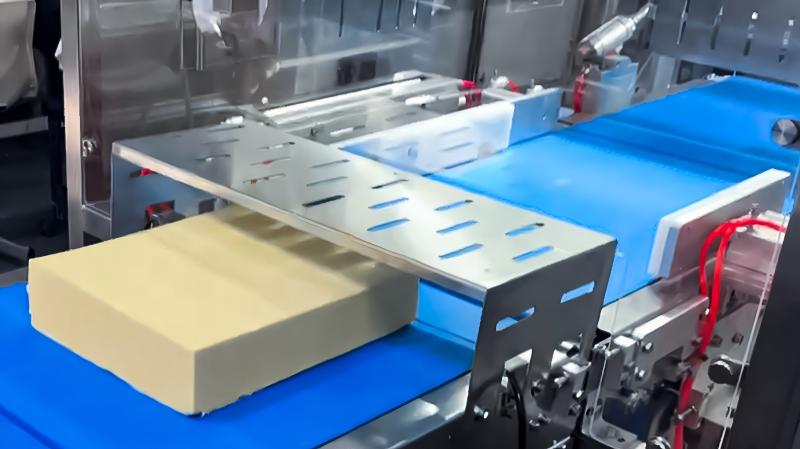
The working principle of ultrasonic cutting
Ultrasonic cutters use piezoelectric ceramic transducers to convert electrical energy into high-frequency mechanical vibrations, with vibration frequencies typically ranging from 20kHz to 40kHz. These tiny high-speed vibrations are transmitted to the cutting blade, causing it to perform micrometer level reciprocating motion at a frequency of tens of thousands of times per second. When the blade comes into contact with margarine, high-frequency vibration produces a local energy concentration effect on the surface of the material, effectively reducing cutting resistance.
Unlike static cutting, the vibration of ultrasonic blades causes micro level shear separation of margarine at the moment of contact, rather than being forcibly squeezed and broken. Due to the extremely small vibration amplitude and fast speed, the friction coefficient between the blade and the material is significantly reduced, and almost no frictional heat is generated, so it will not cause the phenomenon of butter melting and sticking to the blade.
Design considerations for adapting to 40 × 28 × 24 cm specifications
For this specific size of margarine block, the blade length and shape of the ultrasonic cutting system need to be accurately matched. The block length of 40 centimeters requires the effective cutting stroke of the blade to be greater than this value, usually designed to be 42 to 45 centimeters to ensure complete separation in one cut. Meanwhile, considering a width of 28 centimeters and a height of 24 centimeters, the cutting system often adopts two structures: downward pressure or horizontal propulsion.
In the downward pressure structure, the long strip ultrasonic blade cuts vertically from top to bottom, and can divide the entire piece of butter into two halves with one action. For scenes that require further segmentation into small pieces, a multi blade parallel design can be used, or a turntable can be used to achieve bidirectional cutting. The horizontal push type is suitable for continuous production lines, where butter blocks move on the conveyor belt and the ultrasonic blade cuts horizontally before retreating, achieving automated cyclic operations.
Improvement of cutting quality and efficiency
After ultrasonic cutting, the cut surface of margarine presents a smooth and flat characteristic, with no debris generated and no melting marks on the edges. Due to the non stick blade, the cleaning time between each cutting cycle is almost zero, greatly improving the continuous operation capability. For a block of 40 × 28 × 24 centimeters, the complete cutting time can be controlled within 0.5 to 1 second, which is 3 to 5 times faster than traditional cutting.
In addition, ultrasonic cutting can achieve precise dimensional tolerance control up to the millimeter level. When it is necessary to divide large blocks into commercial small blocks of standard weight (such as 500g or 1kg specifications), the cutting accuracy directly affects product compliance. The stable vibration characteristics of the ultrasonic system ensure the consistency of each cutting position and reduce weight fluctuations.
Health and maintenance advantages
The food processing environment has strict requirements for equipment hygiene. The surface of the ultrasonic blade is smooth, without complex groove structures, and the high-frequency vibration itself has a self-cleaning effect – the trace amount of butter adhered to the blade surface will be thrown off under the vibration. This significantly reduces the frequency of equipment cleaning. The blade material is usually made of titanium alloy or stainless steel, which has good corrosion resistance and can withstand regular high-temperature steam cleaning.
Compared with traditional rotating blades or wire cutting, ultrasonic systems do not have sharp edges that require frequent grinding, nor do they have complex transmission mechanisms that can easily accumulate materials. The maintenance work mainly focuses on the electrical connection inspection of the transducer and the confirmation of the blade fastening status, and the average maintenance time can be reduced by more than 70%.
Economic analysis
Although the initial investment of ultrasonic cutting equipment is higher than that of traditional mechanical cutting tools, from a long-term operational perspective, its comprehensive cost advantage is obvious. Firstly, material waste is reduced – traditional cutting causes losses of about 1% to 3% due to sticking knives, while ultrasonic cutting can reduce this proportion to below 0.2%. For large-scale production of margarine factories, saving material costs can be quite significant. Secondly, the improvement of production efficiency means an increase in output per unit time, and the payback period for equipment investment is usually within 6 to 12 months. Furthermore, reducing manual intervention lowers labor costs and safety risks.
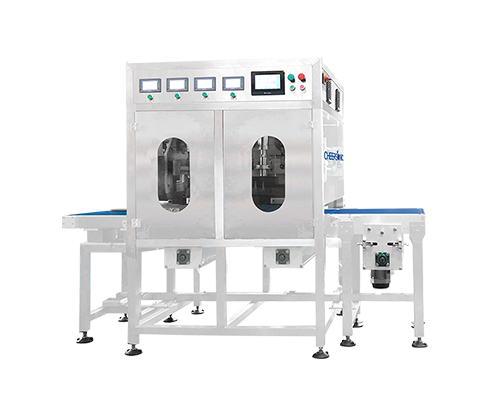
Extension of application scope
Although this article focuses on artificial butter blocks measuring 40 × 28 × 24 centimeters, the principle of ultrasonic cutting technology is also applicable to other oily products such as shortening, cream cheese, frozen dough, etc. For blocks of different sizes, simply adjust the blade length and vibration frequency parameters to adapt. This flexibility enables food processing enterprises to process multiple specifications of products with the same set of equipment, improving equipment utilization.
Conclusion
The ultrasonic cutter provides a precise, efficient, and clean technical solution for processing artificial butter blocks that are 40 centimeters long, 28 centimeters wide, and 24 centimeters high. It fundamentally overcomes the problems of sticking knives and cutting surface defects in traditional cutting, while improving production speed and yield. With the continuous improvement of product standardization and production line automation requirements in the food industry, ultrasonic cutting technology is gradually becoming a standard configuration for the processing of oil and fat products, creating tangible economic value for manufacturers.
About Cheersonic
Cheersonic manufactures the leading portioning equipment for bakeries producing fresh and frozen desserts. Since 1998 bakers have used Cheersonic machines to cut, slice and portion cheesecake, pie, layer cake, loaves, butter, cheese, pizza, sandwichs, and more. Cheersonic offers ultrasonic cutting solutions that support start-up bakeries and high production commercial facilities alike. Small standalone machines can be used in manual baking facilities and large inline robotic solutions aid in high speed production.
Cheersonic offers many ultrasonic slicing models, both inline and offline applications, with production speeds of 80 to 1,500 cakes or pies per hour.
Cheersonic’ latest offline introductions include ultrasonic cutting with or without divider inserts between each slice. This improves the quality of the cut and makes for a much better product presentation for the customer. In addition, robotic arm improves the speed, efficiency, and accuracy of the cutting process, producing professional looking products every time.
