Ultrasonic Homogenizers Optimize Suspension Performance
Ultrasonic Homogenizers Optimize Suspension Performance – Chemisonic
Suspensions, as heterogeneous systems formed by insoluble solid particles dispersed in a liquid medium, are widely used in biopharmaceuticals, food processing, and chemical industries. Their dispersion stability and bioavailability of active ingredients are core indicators for evaluating product quality. Traditional homogenization techniques often encounter problems such as particle agglomeration and uneven particle size distribution when processing high-viscosity, high-hardness particle suspensions, hindering product performance improvement. Ultrasonic homogenizers, with their unique physical mechanism, demonstrate significant advantages in improving suspension dispersibility and enhancing bioavailability, becoming a key technology for optimizing suspension processing.
The core working principle of ultrasonic homogenizers is based on the synergistic effect of cavitation, mechanical shearing, and turbulent disturbance. When high-frequency ultrasound (15kHz~1MHz) is transmitted into the suspension, the liquid medium rapidly forms a large number of tiny cavitation bubbles under the alternating compression and stretching effects of the sound waves. These cavitation bubbles expand continuously during acoustic vibration and then collapse instantaneously during the compression phase, generating localized extreme high temperatures (up to 5000K) and high pressures (up to 100MPa) within just a few microseconds, accompanied by intense microjets and shock waves with speeds exceeding 100m/s. Simultaneously, the propagation of ultrasound induces violent turbulence in the liquid, generating high-frequency mechanical shear forces. These intense microscopic effects work together on the solid particles in the suspension, breaking up particle agglomerates and achieving particle refinement and uniform dispersion.
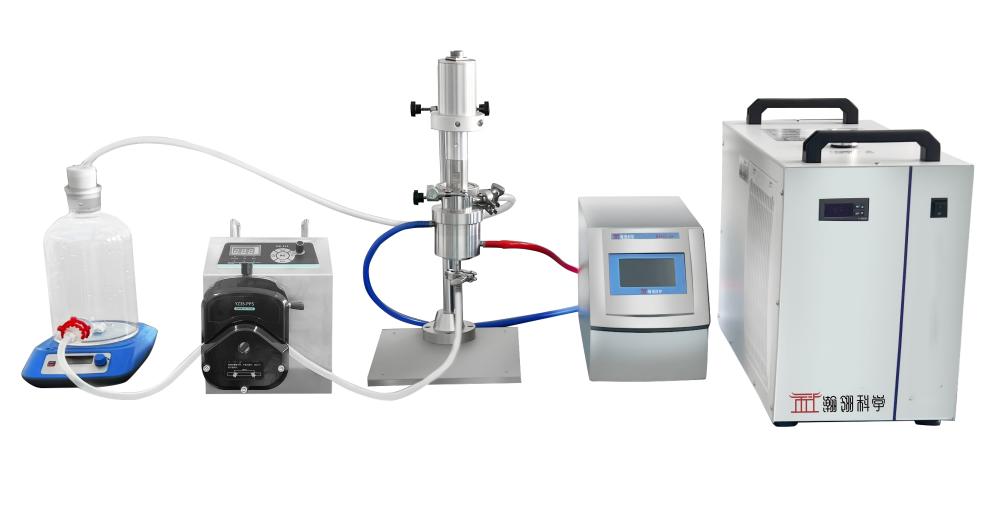
In improving the dispersibility of suspensions, ultrasonic homogenizers fundamentally solve the problem of particle agglomeration through precise microscopic effects. Solid particles in suspensions easily form agglomerates due to van der Waals forces, electrostatic forces, etc., leading to instability in the dispersion system and resulting in sedimentation and stratification. The microjets and shock waves generated by ultrasound can directly impact agglomerates, breaking them into fine particles; at the same time, the shear force can further refine the particle size, ensuring uniform particle distribution in the medium. Experimental data show that after ultrasonic homogenization, the particle size in the suspension can be reduced from the micrometer to the nanometer scale, with the particle size distribution range reduced by more than 40%, forming a stable dispersion system. This uniform dispersion not only prolongs the sedimentation time of the suspension but also improves the rheological properties of the system, avoiding performance fluctuations caused by particle aggregation during use.
The improved dispersibility directly promotes the enhanced bioavailability of the active ingredients in the suspension. Bioavailability depends on the dissolution rate and absorption efficiency of the active ingredients in vivo, and particle size and dispersion state are key factors affecting the dissolution rate. For oral suspensions in the biopharmaceutical field, particles prepared by traditional processes are relatively large, resulting in slow dissolution rates in the gastrointestinal tract and a tendency to aggregate, leading to uneven absorption. After ultrasonic homogenization, the specific surface area of the particles significantly increases, greatly enhancing the contact area with the gastrointestinal mucosa and accelerating the dissolution rate of the active ingredients. Simultaneously, uniformly dispersed microparticles more easily penetrate biological membrane barriers, promoting the absorption of the active ingredients. Studies show that ultrasonic homogenization can improve the bioavailability of poorly soluble drug suspensions by 30% to 50%, with some components even showing an increase of more than five times. In the field of traditional Chinese medicine preparations, this technology can also break down the cell wall barrier of medicinal materials, promoting the release of active ingredients while avoiding the degradation of heat-sensitive components caused by high-temperature heating, further ensuring bioavailability.
The advantages of ultrasonic homogenizers in suspension processing also lie in their wide applicability and flexible operation. Whether it’s high-hardness mineral particles, high-viscosity polymer suspensions, or suspensions of natural products containing fibrous materials, efficient homogenization can be achieved. By adjusting parameters such as ultrasonic power, frequency, and processing time, particle size and dispersion can be precisely controlled to adapt to the needs of different application scenarios. Furthermore, this technology eliminates the need for large amounts of chemical stabilizers, avoiding the impact of chemical reagents on product purity, making it particularly suitable for the biopharmaceutical and food industries where safety requirements are extremely high.
In summary, ultrasonic homogenizers, through the synergistic effects of cavitation, mechanical shearing, and turbulent disturbance, effectively break up particle agglomeration in suspensions, significantly improving dispersion stability. Simultaneously, by refining particle size and increasing specific surface area, they accelerate the dissolution and absorption of active ingredients, greatly enhancing bioavailability. With continuous technological optimization, this technology has become a core means of improving the quality of suspension products, showing broad application prospects in fields such as biomedicine and food processing, and providing reliable technical support for the performance upgrade of suspension products.
If you want to purchase equipment, please click here.