Ultrasonic Dispersion of Colloidal Silver Solution
Ultrasonic Dispersion of Colloidal Silver Solution – Chemisonic
Colloidal silver solution is widely used in antibacterial materials, biomedical, electronic devices and other fields due to the unique physicochemical properties of silver nanoparticles, and the uniformity of particle dispersion directly determines its performance. Ultrasonic dispersion technology, with its advantages of high efficiency and no pollution, has become the core process for preparing colloidal silver solutions, effectively solving the technical bottleneck of easy aggregation of silver particles.
The core mechanism of ultrasonic dispersion is the “cavitation effect”. When high-frequency ultrasound (usually 20kHz-100kHz) is applied to a silver particle suspension system, countless tiny cavitation bubbles will rapidly form in the liquid. These bubbles expand in the negative pressure phase of sound waves, and collapse instantly in the positive pressure phase, creating an extreme environment of local high temperature (up to 5000K) and high pressure (over 100MPa), while releasing strong shock waves and microjets. This mechanical force can directly break the van der Waals force and electrostatic attraction between silver particles, breaking the aggregates into monodisperse particles, while pushing the particles to move rapidly in the solution, avoiding secondary agglomeration.
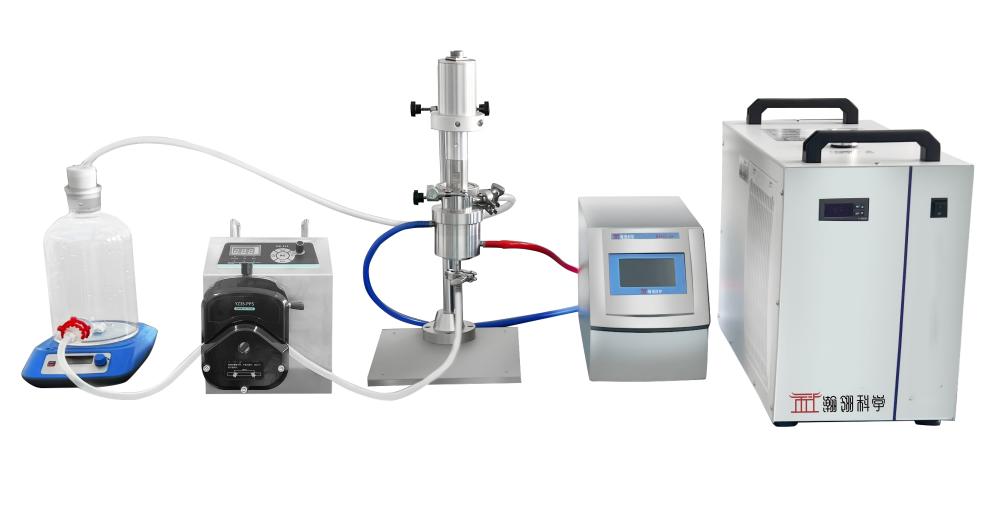
Compared to traditional dispersion methods such as mechanical stirring and high-speed shearing, ultrasonic dispersion exhibits significant advantages in the preparation of colloidal silver. Firstly, the dispersion uniformity is higher, which can control the silver particle size within the ideal range of 10-100nm, and the particle size distribution coefficient (PDI) is lower than 0.2, far superior to traditional methods; Secondly, there is no risk of chemical pollution, and stable dispersion can be achieved without adding dispersants, ensuring the biocompatibility of colloidal silver; Thirdly, the operation is convenient and controllable. By adjusting the ultrasonic parameters, the particle dispersion state can be precisely controlled to meet the needs of different application scenarios.
The effect of ultrasonic dispersion of colloidal silver solution is affected by parameters such as frequency, power, processing time, and solution environment. In terms of frequency, the low-frequency ultrasonic cavitation effect is stronger at 20-40kHz, which is suitable for dispersing coarse particles; High frequencies of 60-100kHz are suitable for fine particle refinement and stabilization. The power needs to be matched with the system volume, usually matching 50-100W power per liter of solution. Excessive power can easily lead to particle oxidation, while insufficient power can result in insufficient dispersion. The processing time is generally controlled between 20-60 minutes, and after 90 minutes, the dispersion effect slows down and increases energy consumption. In addition, adjusting the pH value of the solution to neutral or weakly alkaline can further enhance dispersion stability by enhancing the electrostatic repulsion on the particle surface.
In practical applications, this technology has been industrialized and implemented. Medical antibacterial colloidal silver solution is dispersed by ultrasonic waves to evenly distribute silver particles, enhancing the long-term antibacterial effect; After treatment, the conductivity of silver nano conductive paste in the electronic field is increased by more than 30%. With the intelligent development of ultrasonic equipment, it is expected to achieve automation and customization of the dispersion process of colloidal silver solution through precise control of sound field parameters in the future, laying the foundation for its application in more high-end fields.
If you want to purchase equipment, please click here.