Ultrasonic Dispersion of TiO2 Nanoparticles
The core value of ultrasonic dispersion technology in the application of TiO ₂ nanoparticles
TiO ₂ nanoparticles are widely used in fields such as environmental remediation and materials science due to their excellent photocatalytic activity, adsorption performance, and biocompatibility. However, due to its large specific surface area and high surface energy, it is prone to aggregation, resulting in the masking of active sites and seriously affecting the application effect. Ultrasonic dispersion technology, with its unique physical properties, has become a key means of solving the agglomeration problem of TiO ₂ nanoparticles, providing reliable guarantees for maximizing their functionality.
The mechanism and advantages of ultrasonic dispersion
Ultrasonic dispersion generates cavitation effect through the propagation of high-frequency sound waves (above 20kHz) in liquid media, achieving efficient dispersion of TiO ₂ nanoparticles. During the propagation of sound waves, alternating compression and sparsity regions are generated. In the sparsity stage, tiny bubbles are formed and continuously expand. In the compression stage, the bubbles instantly rupture, releasing enormous energy and producing local high temperature, high pressure, and strong shock waves. This mechanical effect can effectively break the van der Waals forces and hydrogen bonds between particles, and dissociate aggregates into monodisperse or small-sized aggregates.
Compared with traditional mechanical stirring, ultrasonic dispersion has significant advantages: more uniform dispersion, which can avoid local agglomeration residue; Small particle damage, able to preserve the crystal structure and surface activity of TiO ₂; High dispersion efficiency, achieving ideal results in a short period of time, and easy to control the degree of dispersion to meet the needs of different application scenarios.
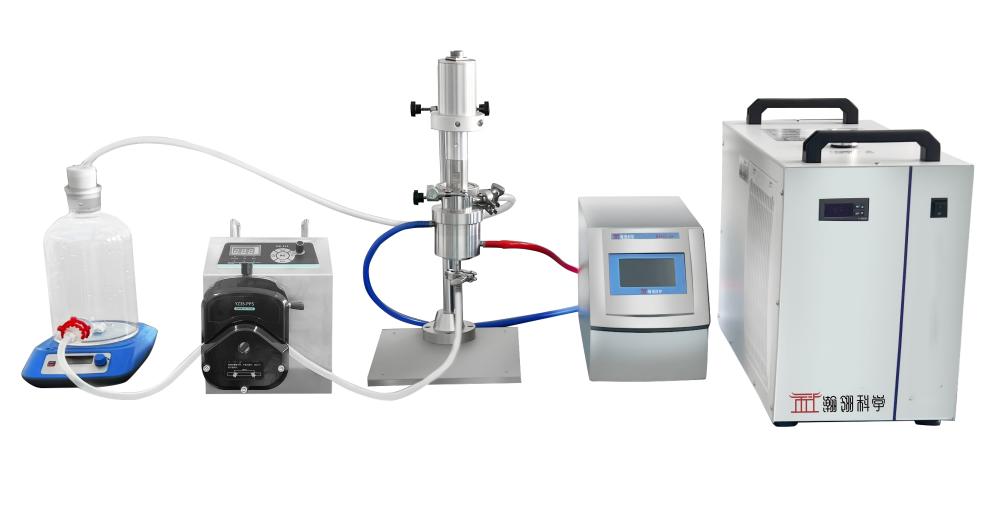
Enhancement of Application Performance of TiO ₂ Nanoparticles by Ultrasonic Dispersion
In the study of photocatalytic degradation of hexane vapor, TiO ₂ nanoparticles dispersed by ultrasound exhibited superior catalytic activity. Uniformly dispersed particles are more densely distributed in the reaction system, significantly increasing the contact area with hexane vapor and exposing more photocatalytic active sites. When excited by light, more electron hole pairs are generated and participate in the reaction, significantly improving the degradation rate and mineralization of hexane, solving the problem of low catalytic efficiency of agglomerated particles.
As an adsorbent for arsenic removal, the adsorption performance of TiO ₂ nanoparticles is directly related to their specific surface area. Ultrasonic dispersion can effectively suppress agglomeration and fully expose the adsorption sites on the particle surface. Experiments have shown that TiO ₂ nanoparticles treated with ultrasonic dispersion increase the adsorption capacity of arsenic by more than 30%, and shorten the adsorption equilibrium time. This improvement makes them more practical in arsenic containing wastewater treatment.
In the field of antibacterial component remediation in wastewater, ultrasonic dispersion optimized the photocatalytic effect of TiO ₂ nanoparticles. Well dispersed particles form a stable suspension system in wastewater, which can absorb light energy more evenly, generate a large amount of active substances such as hydroxyl radicals, and rapidly degrade antibacterial components. Meanwhile, uniform dispersion avoids the light shielding effect caused by excessive local concentration, ensuring efficient photocatalytic reactions in the system.
In the study of the adsorption of DNA oligonucleotides by TiO ₂ nanoparticles, the role of ultrasonic dispersion is also crucial. The dispersed particles have more uniform surface properties and can form stable interactions with DNA oligonucleotides, reducing the problem of uneven adsorption caused by aggregation. This provides more accurate experimental data for the study of adsorption mechanisms and helps in the development of related biomedical applications.
Conclusion
Ultrasonic dispersion technology fundamentally solves the agglomeration problem of TiO ₂ nanoparticles by accurately regulating their dispersion state, comprehensively improving their application performance in fields such as photocatalysis and adsorption. With the deep integration of ultrasound technology and nanomaterials research, optimizing ultrasound parameters (such as power, time, frequency) to adapt to different particle sizes of TiO ₂ nanoparticles will become a key direction for future research, promoting the efficient application of TiO ₂ nanoparticles in more fields.
If you want to purchase equipment, please click here.