
Ultrasonic Dispersed Liposomes
Liposomes are microscopic vesicles with a size range of 25 nanometers to 5000 nanometers, which are artificially prepared spherical carriers loaded with active molecules. They are widely used as drug carriers in the cosmetics and pharmaceutical industries, applied in fields such as gene therapy, immunization, and drug delivery. Ultrasonic technology is a mature tool that has been validated for the preparation of liposomes and the encapsulation of active ingredients.
The following is a detailed introduction to the application of ultrasound technology in this field:
The specific role of ultrasound in liposome preparation
Ultrasonic treatment is a core technology in liposome technology and development. The following is an in-depth discussion on “how” to achieve it and its “reasons”.

1. Main function: Reduce size and homogenize
The most common use of ultrasound is in the final stage of liposome preparation to control its size and size distribution (polydispersity).
*Process: Liposomes initially formed by other methods, such as thin film hydration, are usually large and multi-layered (multiple concentric lipid bilayers), resulting in an uneven mixture.
*The role of ultrasound: When this crude liposome suspension is subjected to high-intensity ultrasound (usually using a probe type ultrasonic instrument) treatment, strong shear forces and cavitation effects (formation, growth, and implosion collapse of bubbles in the liquid) break these large vesicles into smaller, mainly single-layer liposomes.
*Result: This process produces uniformly sized small single-layer vesicles with sizes ranging from 25-100 nanometers. This is crucial for many drug delivery applications, as consistent size affects cycle time and targeting.
2. Encapsulation mechanism
Ultrasonic waves mainly promote the encapsulation of active ingredients in two ways:
*Passive encapsulation: This is the most direct method. Active molecules (drugs, genes, etc.) exist in aqueous solutions during ultrasonic treatment. When liposomes are formed and recombined under the influence of ultrasound, they encapsulate a portion of the surrounding solution in their water nuclei. This method is effective for water-soluble drugs.
*For hydrophobic drugs: For lipophilic drugs, the active molecule first dissolves together with the lipid component in an organic solvent. After the solvent evaporates to form a lipid film, it is combined with buffer solution and water for ultrasonic treatment. Ultrasonic energy helps lipids assemble into vesicles, thereby directly embedding hydrophobic drugs into lipid bilayers.
The advantages of using ultrasound (why it has been “validated for a long time”)
*Efficient and fast: It is an effective method for rapidly mass producing SUVs.
*Controllability: By adjusting parameters such as ultrasound time, amplitude, and pulse period, the final size of liposomes can be highly controlled.
*Reproducibility: By carefully controlling parameters, this process has high repeatability across different batches.
*Reliability: This technology is mature, stable, and widely available in the laboratory.
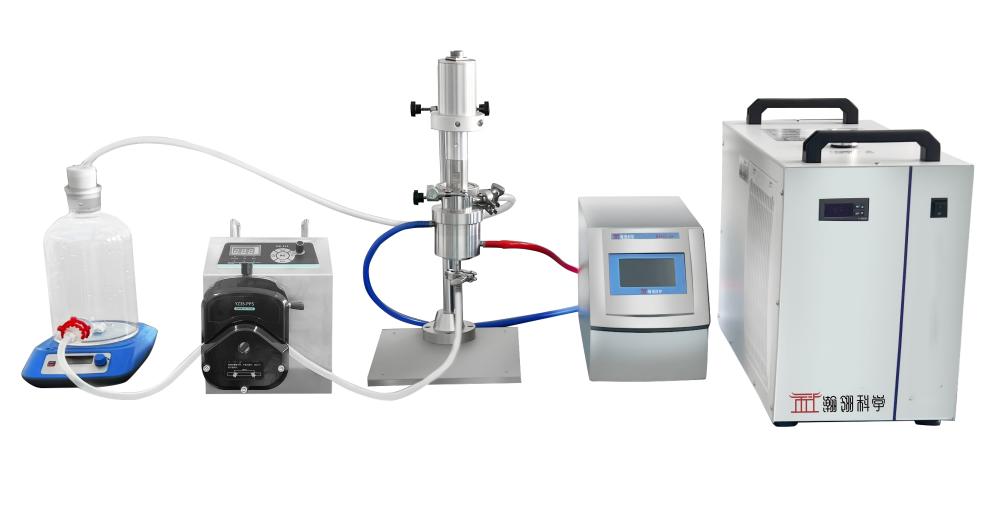
Challenges and Precautions
*Potential degradation risks: The high shear forces and local heat generated during the ultrasound process may degrade fragile active molecules (such as certain proteins or DNA fragments), and may even oxidize and damage the lipid components themselves.
*Heat generation: Ultrasonic treatment generates a large amount of heat and requires cooling of the sample in an ice bath.
*Batch processing: Traditional probe ultrasound is usually a batch process, which may be a limitation for large-scale industrial production.
Conclusion
Ultrasonic technology is indeed a fundamental tool that provides the necessary mechanical energy to manufacture clear, nanoscale liposomes, making advanced drug delivery and packaging applications possible in the cosmetics and pharmaceutical industries. Although new technologies such as microfluidics are emerging, ultrasound treatment remains a mainstay due to its effectiveness, simplicity, and reliability.
Chemisonic specializes in ultrasonic liquid processing technology. For decades, we have dedicated to designing, developing, and manufacturing ultrasonic liquid processors independently, from laboratory application to industrial level. Cutting-edge ultrasonic technology, high quality device and easy-to-use operating system are the fundamentals for our company to achieve continued business growth.