
Preparation of Liposomes and Ultrasonic Homogenization
Ultrasonic technology is indeed a fundamental tool that provides the necessary mechanical energy to manufacture clear, nanoscale liposomes, making advanced drug delivery and packaging applications possible in the cosmetics and pharmaceutical industries. Although new technologies such as microfluidics are emerging, ultrasound treatment remains a mainstay due to its effectiveness, simplicity, and reliability.

1. Core characteristics and application scenarios of liposomes
Liposomes, as artificially prepared microscopic vesicles, have the following key characteristics and application value:
- Structure and Size: Based on the lipid bilayer as the basic structure, the particle size range covers 25-5000 nm. This size flexibility allows it to adapt to different delivery needs (such as small particle size liposomes that can penetrate the capillary wall, while large particle size liposomes are suitable for local retention).
- Carrier function: The internal aqueous phase and bilayer gaps can respectively encapsulate water-soluble and lipid soluble active molecules, achieving protection (reducing degradation) and controlled release (prolonging action time) of active ingredients.
- Industry applications:
* In the pharmaceutical field, core applications include gene therapy (as a nucleic acid carrier to prevent nucleic acid degradation by enzymes), immunization (as a vaccine adjuvant to enhance antigen immunogenicity), and targeted drug delivery (achieving precise targeting of lesion tissues through surface modification to reduce drug toxicity and side effects).
* In the field of cosmetics, it is used to package active ingredients such as vitamins and plant extracts, improve the penetration efficiency of ingredients in the stratum corneum of the skin, and reduce irritation to the skin.
2. The mechanism of ultrasound technology in liposome preparation
As a mature tool for preparing liposomes, ultrasound technology plays two key roles:
- The process of liposome formation: The mechanical vibration effect of ultrasound can disrupt the thermodynamic equilibrium of lipid membranes – when ultrasound is applied to lipid suspensions, the shear force generated by high-frequency vibration causes lipid molecules to reassemble and form uniformly dispersed vesicular structures. At the same time, the particle size distribution of liposomes can be controlled by adjusting the ultrasound power and time (the higher the power and the longer the time, the smaller and more uniform the particle size is usually).
- Enhanced encapsulation of active ingredients: The cavitation effect generated by ultrasound (formation, oscillation, and rupture of small bubbles in the liquid) can increase the permeability of lipid membranes, promote the entry of active molecules into the internal aqueous phase or bilayer gaps of liposomes. Compared with traditional thin film hydration methods, it can significantly improve the encapsulation efficiency of active ingredients (especially for insoluble ingredients).
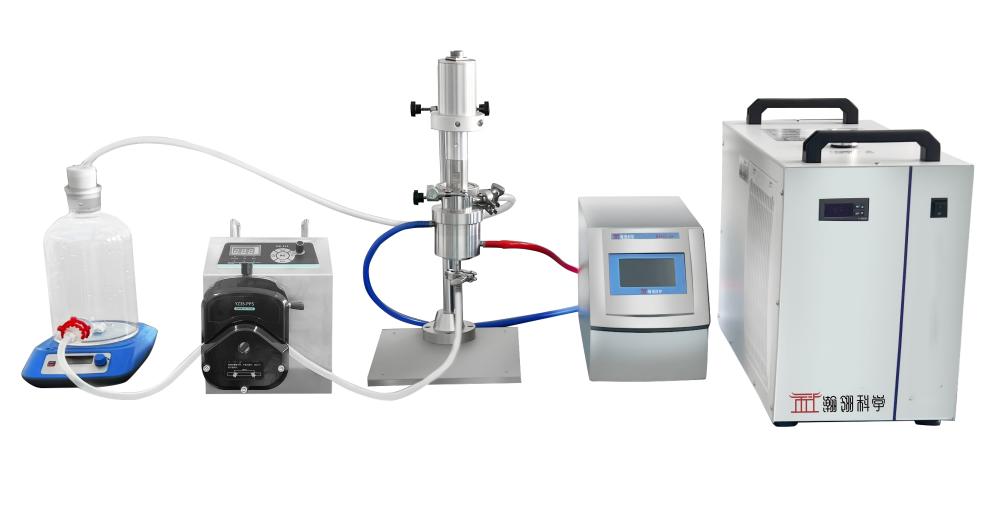
3. Advantages and characteristics of ultrasound technology
Compared to other lipid preparation methods such as extrusion and emulsification, ultrasound technology has three core advantages:
- Easy to operate: No complex molds or equipment are required, and preparation can be achieved through ultrasound probes or slots, making it suitable for flexible switching between small-scale laboratory research and industrial large-scale production.
- Process controllability: By adjusting ultrasound parameters (frequency, power, processing time), the particle size, dispersibility, and encapsulation efficiency of liposomes can be precisely controlled to meet the customized needs of different application scenarios.
- Stability guarantee: The ultrasonic process is mild, does not introduce additional impurities, and the formed liposome dispersion system has higher stability, making it less prone to aggregation or sedimentation.
Chemisonic specializes in ultrasonic liquid processing technology. For decades, we have dedicated to designing, developing, and manufacturing ultrasonic liquid processors independently, from laboratory application to industrial level. Cutting-edge ultrasonic technology, high quality device and easy-to-use operating system are the fundamentals for our company to achieve continued business growth.
