Ultrasonic Soldering Machine Used for FPC Soldering
Ultrasonic soldering machine for FPC (flexible circuit board) soldering is a very professional and efficient application. Below, I will provide you with a detailed analysis of its working principle, advantages, application scenarios, and key process points.
Overview
Traditional FPC soldering (especially hot press soldering) has problems such as large heating area, high temperature, easy damage to FPC and components, and the need for soldering flux. The ultrasonic soldering machine utilizes high-frequency vibration energy to achieve low-temperature and flux free soldering, making it particularly suitable for FPC components that are sensitive to heat and stress.
Working principle of ultrasonic soldering machine
The core of ultrasonic soldering is the application of ultrasonic energy between metal interfaces. The process is usually as follows:
1. Wire feeding and preloading: The solder wire is fed onto the solder pad through the wire feeding mechanism, and the soldering head (soldering iron tip) descends, slightly pressing against the solder wire and FPC solder pad.
2. Excitation of ultrasonic waves: The high-frequency transducer inside the welding head is activated, generating mechanical vibrations perpendicular to the welding direction (usually 20kHz -60kHz).
3. Energy transfer and removal of oxide layer:
*Ultrasonic vibration is transmitted through solder wires to the interface between FPC pads (usually copper foil) and component pins (if any).
*This high-frequency micro vibration will instantly break through the oxide layer and pollutants on the metal surface, exposing pure metal atoms.
4. Friction induced heat generation and diffusion:
*Vibration friction will generate local heat at the interface, causing the solder to melt rapidly.
*Due to the removal of the oxide layer, the molten pure solder can instantly undergo atomic diffusion with the pure base metal (Cu, Sn, etc.), forming a strong intermetallic compound (IMC) layer.
5. Cooling molding: Ultrasonic waves stop, vibration disappears, and the solder cools and solidifies under pressure, forming a reliable, oxidation free solder joint.
Significant advantages for FPC soldering
Compared with conventional welding methods, ultrasonic soldering has overwhelming advantages in FPC applications:
1. Low temperature welding:
*The heat mainly comes from interface friction, and the overall heating temperature is much lower than the melting point of the solder (for example, the melting point of SnAgCu solder is 217 ° C, and the welding temperature can be controlled at around 250 ° C, while hot press welding may require over 300 ° C). This greatly reduces the risk of thermal damage to FPC substrates (such as PI) and surrounding thermal sensitive components.
2. No need for soldering flux:
*Ultrasonic waves can effectively remove the oxide layer on their own, so there is no need to use soldering flux at all.
*Benefits:
*Avoiding the risks of corrosion and electromigration caused by residual flux, and improving product reliability.
*Eliminating the cleaning process reduces costs and environmental pressures.
*The appearance of the solder joints is clean and beautiful, suitable for products that require high cleanliness, such as sensors and precision medical equipment.
3. High welding strength and good reliability:
*Due to the metallurgical bonding formed in an unoxidized state, the mechanical strength and conductivity of the solder joints are excellent, with extremely low rates of virtual soldering and false soldering.
4. Widely applicable materials:
*Not only can it weld conventional tin plated and gold plated surfaces, but it also has good effects on difficult to weld metals such as aluminum, stainless steel, nickel, etc., which expands the application range of FPC.
5. Energy conservation and environmental protection:
*Low energy consumption, no chemical volatiles, in line with the green and environmentally friendly requirements of modern electronic manufacturing.
Typical FPC soldering application scenarios
Ultrasonic soldering is commonly used in the FPC process for the following steps:
1. FPC to PCB: Solder the flexible circuit board onto the main rigid circuit board.
2. FPC to Connector: Solder the connector on the FPC.
3. FPC to Component: Directly solder chips, sensors, LED chips, and other components onto the FPC.
4. FPC reinforcement steel sheet welding: In certain areas that require mechanical support, stainless steel reinforcement sheets are directly welded to the copper foil of the FPC, replacing traditional adhesive methods for a more secure connection.
5. Alignment welding of multi-layer FPC.
Key process points and challenges
To successfully apply ultrasonic soldering to FPC, the following points need to be noted:
1. Fixing and support of FPC:
*FPC is soft and prone to deformation, and must be perfectly fitted and fixed using specialized fixtures (jigs), ensuring that the solder joints are rigidly supported. Otherwise, the vibration energy will be lost, leading to welding failure.
2. Welding parameter optimization:
*Ultrasonic power/amplitude: Low power cannot effectively remove oxidation, while high power may damage the FPC copper foil.
*Welding time: usually very short (100ms-500ms), prolonged time can cause overheating.
*Welding pressure: Pressure affects the transmission of vibration energy and the final shape of the welding point.
*These parameters need to be optimized through DOE experiments based on pad size, coating material, etc.
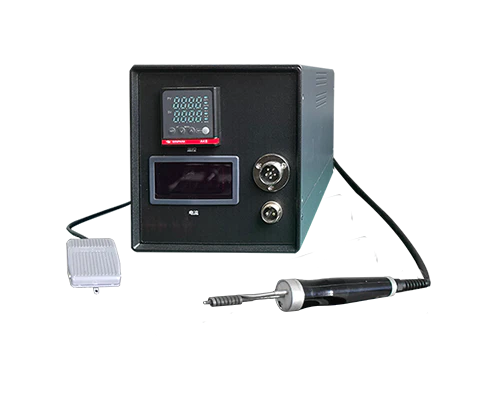
3. Horn design:
*The shape of the welding head must match the welding object. For fine solder pads on FPC, small dedicated solder heads need to be designed.
4. Pad design:
*The pad design of FPC needs to take into account the characteristics of ultrasonic welding, such as reserving suitable bonding areas.
5. Consistency control:
*Although the process is stable, key parameters still need to be monitored through SPC to ensure consistency in mass production.
Summary
Ultrasonic soldering machine provides a revolutionary solution for FPC soldering. It perfectly solves the core pain points faced by FPC in traditional soldering, such as thermal damage, flux contamination, and soldering reliability, through its unique low-temperature and flux free soldering mechanism. Ultrasonic FPC welding is becoming an indispensable key process in fields such as smartphones, wearable devices, automotive electronics, and high-definition displays that require high levels of lightness, thinness, and reliability.
About Sonic4Lab
Sonic4Lab was founded to ultrasonic instruments including ultrasonic soldering iron, ultrasonic impact treatment, ultrasonic knife and so on. Our customers are Research and Development laboratories and companies for production applications. We use state-of-the-art equipment and in-depth experience to develop accessible solutions for emerging applications.