
Ultrasonic Dispersion Prevents Pigment Particles from Settling in Ink
Using ultrasonic dispersion equipment to prevent pigment particle settling in ink is a feasible and efficient solution, which can fundamentally solve the problem of particle aggregation and significantly improve ink stability.
This problem is well grasped. The core of pigment sedimentation is particle agglomeration, which causes gravity to be greater than dispersion force, and ultrasound can precisely solve this pain point.
Core working principle: cavitation effect
Ultrasonic dispersion equipment generates a “cavitation effect” in ink through high-frequency vibration (usually 20kHz-100kHz), and the specific process is as follows:
1. Generation and rupture of microbubbles: When ultrasound propagates in liquid, it alternately produces high-pressure and low-pressure zones. Small bubbles form in the low-pressure area, while bubbles instantly burst in the high-pressure area.
2. Strong impact dispersion: Bubble rupture will release huge shock waves and microjets, with impact forces reaching thousands of atmospheres, which can effectively break the aggregates of pigment particles.
3. Particle refinement and suspension: After the aggregates are dispersed, the particle size becomes more uniform and smaller, the surface area increases, and the binding force with resin and solvent is enhanced, thereby suppressing sedimentation.

Core advantages compared to traditional methods
Compared with traditional dispersion methods such as mechanical stirring and high-speed shearing, ultrasonic dispersion has significant advantages in preventing settlement:
– More thorough dispersion: can break down hard agglomerates at the micrometer or even nanometer level, while traditional methods have limited effect on small agglomerates.
– More durable stability: The particle size distribution is narrower, the suspension system is more uniform, which can significantly extend the storage period of ink and reduce delamination and sedimentation.
– No mechanical damage: Mechanical components that do not require high-speed rotation, do not generate local high temperatures or shear dead corners, and avoid damaging other functional components in the ink (such as additives).
– More flexible operation: The equipment size can be large or small, which can be used for laboratory small-scale research and development, as well as integrated into production lines for continuous operations.
Key points for practical implementation
To achieve the best anti settlement effect, attention should be paid to the following three key operational steps:
1. Equipment selection
– Power: Depending on the viscosity of the ink, low viscosity ink (such as solvent based) can be selected from 500-1000W, while high viscosity ink (such as UV ink) requires 1000-2000W.
– Frequency: Priority should be given to 20-40kHz. If the frequency is too high, it may cause local overheating, while if it is too low, the cavitation effect will be insufficient.
2. Parameter settings
– Ultrasonic time: A single treatment of 5-15 minutes is sufficient, without the need for too long, to avoid ink temperature exceeding 60 ℃ (high temperature may cause resin denaturation).
– Amplitude: Initially use 50% -70% amplitude, and after the particles are initially dispersed, the amplitude can be reduced to 30% -50% to maintain stability.
3. Preprocessing coordination
– Before ultrasonic treatment, the pigment should be pre stirred with resin and solvent (at a speed of 300-500rpm) to ensure that the particles are initially moist and avoid “dry particles” clumping during ultrasonic treatment.
– Control the solid content of ink. If the solid content is too high (over 60%), it will affect the ultrasonic propagation efficiency and needs to be adjusted appropriately before treatment.
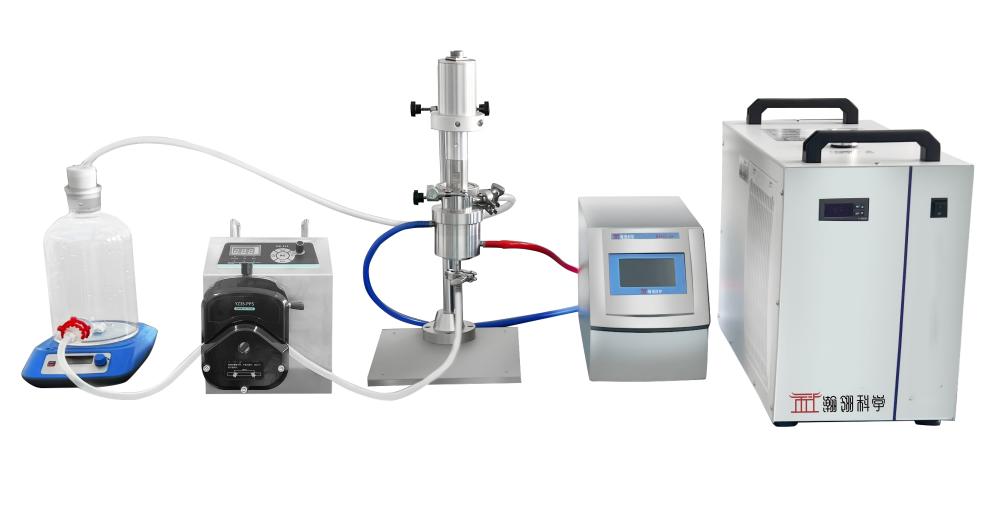
Precautions
Regularly check the wear of the ultrasound probe, as surface wear can reduce energy transfer efficiency. It is recommended to calibrate it every 3 months.
Some defoamers and leveling agents in ink may be sensitive to ultrasonic waves, and small batch testing is required before first use to confirm that there is no component damage.
Wear ear protection equipment during operation to avoid hearing damage caused by high-frequency noise.
Chemisonic specializes in ultrasonic liquid processing technology. For decades, we have dedicated to designing, developing, and manufacturing ultrasonic liquid processors independently, from laboratory application to industrial level. Cutting-edge ultrasonic technology, high quality device and easy-to-use operating system are the fundamentals for our company to achieve continued business growth.
