
Welding and Tin Plating Using Ultrasonic Soldering Iron Equipment
Welding and Tin Plating Using Ultrasonic Soldering Iron Equipment – Sonic4Lab
In modern manufacturing, welding is an ubiquitous process. However, when faced with glass, ceramics, composite materials, and certain special metals, traditional welding methods often fall short. These materials are often difficult to achieve reliable connections through conventional methods due to their inherent characteristics (such as susceptibility to oxidation) or structural sensitivity (such as lack of high temperature resistance). A technology called ultrasonic soldering is breaking through these limitations in a unique way and showing broad application prospects in fields such as photovoltaics, healthcare, and precision electronics.
What is ultrasonic soldering?
Ultrasonic soldering is essentially a soldering process that requires almost no flux. Its core mystery lies in using high-frequency ultrasonic energy (usually between 20-60 kHz) to replace the chemical flux relied upon in traditional soldering.
Unlike the ordinary soldering iron we are familiar with, ordinary soldering mainly melts the solder (filler metal) through external heating, and relies on the chemical action of the flux to remove the oxide film on the metal surface, thus achieving connection. Ultrasonic soldering, on the other hand, takes a different approach: while heating, it directly transmits ultrasonic vibrations to the melted solder material. This high-frequency vibration generates a powerful “cavitation effect”, forming countless tiny vacuum bubbles that instantly rupture, mechanically “tearing apart” the oxide layer on the surface of the material to be connected, exposing the pure metal surface. Subsequently, the melted solder can be smoothly wetted and firmly attached, forming high-quality solder joints.
Implementation method: Two main devices
Ultrasonic soldering is mainly achieved through two types of equipment:
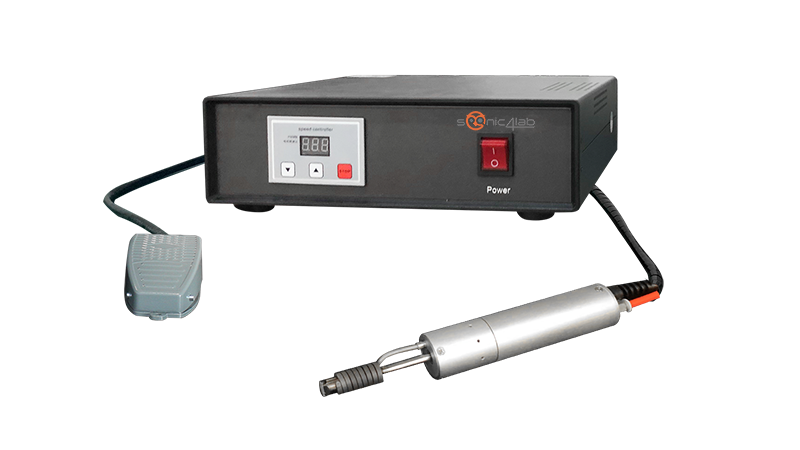
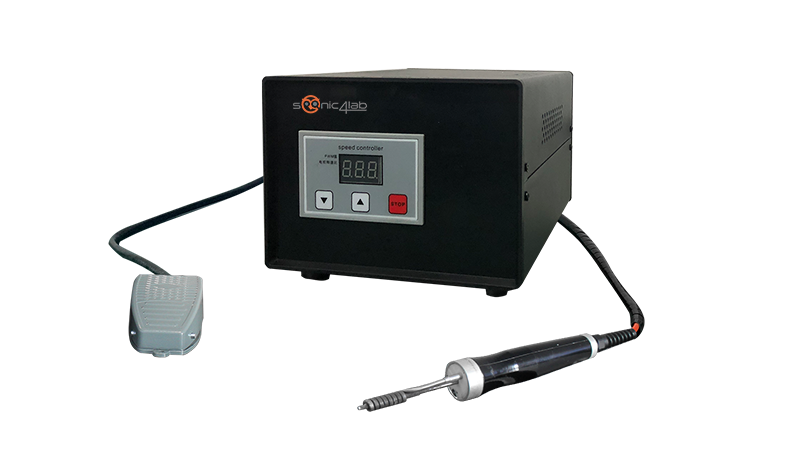
1. Ultrasonic soldering iron: It looks like a handgun, and its soldering iron tip can not only heat but also perform high-frequency mechanical vibration. When the soldering iron tip contacts the solder, the vibration directly acts on the molten solder, instantly cleaning the surface to be soldered and completing the soldering process. This method is very flexible and suitable for precision spot welding, maintenance, and automated production.
2. Ultrasonic immersion welding equipment: This type of equipment has a tin pot that holds molten solder, and an ultrasonic oscillator is integrated at the bottom or side of the pot. During welding, immerse the workpiece into a tin pot, and ultrasonic waves will generate cavitation effects throughout the entire solder pool. At the same time, clean the surface of the workpiece and complete tinning or welding. This is suitable for batch processing of small parts.
Breaking through boundaries: the secret to connecting glass and ceramics
The cavitation effect generated by ultrasonic immersion welding is extremely effective in removing oxides from metal surfaces. But when the welding object itself is an oxide (such as glass, ceramic), the situation is completely different – you cannot “remove” the material itself.
At this point, it is necessary for “active solder” to appear. By adding highly oxygen friendly active elements such as indium (In), titanium (Ti), and zirconium (Zr) to the solder, combined with the energy of ultrasound, welding with glass and ceramics can be achieved. The ultrasonic cavitation effect not only releases energy at the moment of collapse, but also absorbs oxygen, which greatly promotes the reaction between active elements and glass/ceramic surfaces, forming strong chemical bonds. The connection strength formed by this method is not inferior to traditional welding in terms of geometry and chemical properties.
Technical advantages and applicable scenarios
The application of ultrasonic soldering is increasingly expanding, mainly due to its significant advantages:
– Green cleaning: No need for soldering flux, avoiding corrosion and pollution caused by chemical residues, especially suitable for sensitive fields such as medical, optical, and high cleanliness electronics.
– Connecting dissimilar materials: Provides a reliable connection solution for dissimilar materials such as metals, ceramics, and glass.
– Precision machining: For precision applications with small solder joint areas (1-10 mm ²), ultrasound can efficiently stir small volumes of solder to ensure welding quality.
Summary
In summary, ultrasonic soldering technology solves the problems of chemical dependence and material limitations in traditional welding through clever physical methods. It is not only a clean and environmentally friendly process, but also a key to opening the door to new material connections. With the continuous development of manufacturing towards green and precision direction, the application stage of this technology will be even broader.
If you want to purchase equipment, please click here

