
Ultrasonic Technology for Cracking Copper-aluminum Transition
Ultrasonic Technology for Cracking Copper-aluminum Transition – Sonic4Lab
In the power electronics field, copper and aluminum are key conductive materials of choice due to their respective excellent electrical conductivity and cost advantages. However, the physical properties of the two metals differ significantly—copper has a melting point of 1083°C, while aluminum only melts at 660°C. Furthermore, their coefficients of thermal expansion differ by nearly 40%. Traditional welding processes struggle to achieve stable connections, and are prone to problems such as cold joints and interfacial oxidation, seriously impacting the reliability and service life of power equipment. The advent of ultrasonic technology has provided an efficient and reliable solution for copper-aluminum transition connections in power electronics, fundamentally overcoming the limitations of traditional joining techniques.
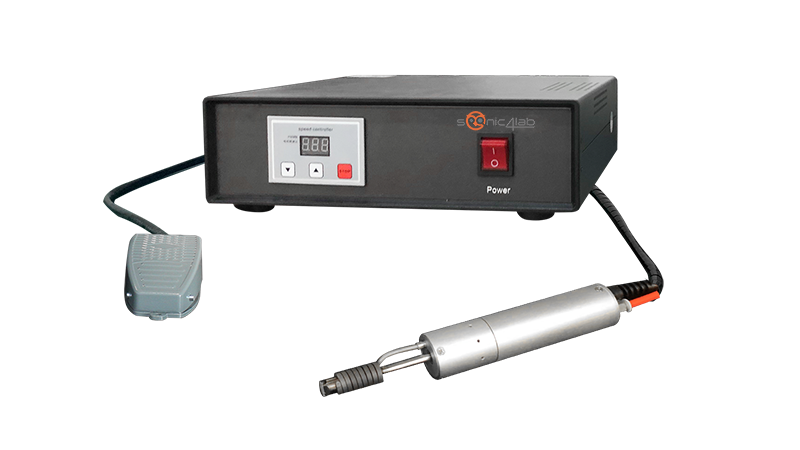
The core principle of ultrasonic copper-aluminum transition joining technology is to utilize the energy generated by high-frequency mechanical vibrations (typically 15kHz-70kHz) to induce plastic deformation of the copper-aluminum interface under pressure. This vibration breaks down the oxide film on the metal surfaces, allowing pure metal atoms to come into direct contact and form a metallurgical bond, completing the connection without the need for high-temperature heating. Compared to traditional brazing and welding processes, ultrasonic joining offers three significant advantages: First, it allows for low-temperature connection, with the maximum process temperature not exceeding 50% of the metal’s melting point. This avoids problems such as coarsening of metal grains and decreased mechanical properties caused by high temperatures, making it particularly suitable for connecting temperature-sensitive components in power electronics. Second, it requires no consumables, eliminating the need for solder or flux, reducing material costs and subsequent corrosion risks, while also improving the conductivity and corrosion resistance of the connection interface. Third, it is highly efficient and fast, with a single connection typically taking only 0.5 to 5 seconds, representing a 5-10 times improvement in production efficiency compared to traditional processes, meeting the needs of large-scale industrial production.
In practical power electronics applications, ultrasonic copper-aluminum transition joints are widely used in core equipment such as new energy vehicle inverters, photovoltaic inverters, and energy storage converters. For example, new energy vehicle inverters require numerous copper busbars connecting aluminum IGBT modules. Traditional brazing processes are prone to interfacial cracking due to thermal stress. Ultrasonic bonding, however, achieves joints with a tensile strength exceeding 120 MPa and conductivity approaching that of pure copper. After thermal cycling tests from -40°C to 125°C, the joint resistance change rate is less than 5%, significantly exceeding industry standards. Data from a photovoltaic equipment company shows that inverters using ultrasonic copper-aluminum bonding have an extended service life of 15 years, up from 10 years with traditional methods, and a 60% reduction in failure rate, significantly improving operational reliability and cost-effectiveness.

Industry trends indicate that as power electronics move toward higher power density and miniaturization, the requirements for precision and reliability in copper-aluminum transition connections will continue to rise. Ultrasonic technology is evolving towards intelligent and integrated advancements. By incorporating pressure and displacement sensors and AI algorithms, it can monitor key parameters during the connection process in real time, enabling online quality testing and automatic adjustment. Furthermore, the development of multi-station ultrasonic joining equipment will further improve production efficiency and meet the demands of mass production of high-power power electronics equipment. Furthermore, the expansion of ultrasonic technology into dissimilar metal joining will open up new possibilities for innovation in power electronics materials and drive technological evolution within the industry.
Driven by the “dual carbon” goals, the power electronics industry, including new energy and energy storage, is experiencing rapid growth. As a core process, copper-aluminum transition joining directly impacts the quality of the industry. Ultrasonic technology, with its unique advantages, not only addresses the pain points of traditional processes but also enhances the performance of power electronics equipment.
If you want to purchase equipment, please click here