Ultrasonic Active Brazing Technology for Aluminum/Graphite
Aluminum is lightweight and conductive, while graphite is stable and heat-resistant. Combining them together has the potential to create high-performance new materials. However, this “partner” is extremely difficult to connect – aluminum has a stubborn oxide film on its surface, while graphite (carbon) is a non-metal, and conventional methods are difficult to make the brazing material “favorable” to its surface. The traditional solution relies on vacuum brazing: in expensive vacuum furnaces, connections are achieved through special active brazing materials. But now, a new technology – ultrasonic vibration assisted brazing – has challenged this tradition and successfully achieved a strong connection between aluminum and graphite in ordinary air environments.
Experiment: The ‘Miracle of Sound Waves’ in Atmospheric Environment
Researchers have designed an exciting ‘comparative experiment’. They chose a tin silver alloy brazing material containing the active element titanium (Ti), which can effectively connect difficult to weld materials under vacuum.
*Control group: Vacuum brazing. Brazing in a vacuum environment is a recognized reliable benchmark.
*Experimental group: Ultrasonic atmospheric brazing. Apply high-frequency ultrasonic vibration to the brazing area in an open atmospheric environment.
The focus of the research is to observe how the “key” of ultrasonic action time can open the door to connection quality.
The Power of Time: Perfect Enhancement of Wetting and Strength
The experimental results clearly demonstrate a process that tends towards perfection with time optimization:
*2 seconds, conquer the aluminum surface: When ultrasound is only applied for 2 seconds, the liquid solder successfully breaks through the aluminum oxide “armor” on the aluminum surface, achieving complete wetting of the aluminum.
*6 seconds, conquer the graphite barrier: the action time is extended to 6 seconds, and the solder further demonstrates strong spreading ability, successfully completely wetting the inert graphite surface.
*10 seconds, intensity reaches its peak: As the action time increases from 0 seconds to 10 seconds, the area of the brazing material spreading on the two base materials becomes larger and the formed joint becomes more solid. When ultrasound is applied for 10 seconds, the shear strength of the joint reaches its maximum value of 16 MPa. This indicates that within a certain window period, longer ultrasound exposure time can lead to more complete interface reactions and stronger mechanical bite.
Microscopic Unveiling: How “Microfluidics” Create Miracles
Why can it achieve a vacuum like effect in air? The key lies in the micro jet effect generated by ultrasound.
By comparing the microstructure of two types of joints under an electron microscope, researchers have revealed a mystery: in vacuum brazing, the active elements (such as titanium) in the brazing material are mainly relied on to “capture” and react, thereby forming a connection.
In ultrasonic brazing, the situation is more active. High frequency vibration generates countless small, high-speed liquid jets inside and at the interface of liquid brazing materials. These microjets are like “high-pressure water guns” in the microscopic world, producing the following key functions:
1. Strong cleaning: Fierce impact on the surface of aluminum and graphite, instantly removing pollutants and oxide films, exposing the pure base material.
2. Promote mixing: Stir the brazing material vigorously to ensure that the active elements inside are transported more evenly and quickly to the interface.
3. Activation surface: The graphite surface is “activated” to increase its reactivity, making it easier for the solder to spread and bond.
It is precisely this powerful physical effect that simulates and even surpasses the interface cleanliness conditions that can only be provided by vacuum environments.
Conclusion: Exploring new paths for green manufacturing
This study strongly demonstrates that ultrasonic vibration assisted brazing technology can efficiently replace traditional vacuum processes in atmospheric environments, achieving reliable connections between difficult to weld materials such as aluminum and graphite. By precisely controlling the ultrasonic action time, excellent performance joints can be obtained.
This not only significantly reduces equipment costs and process complexity, but also opens up an efficient and economical new path for connecting various high-performance materials in an open environment in the future, which is of great significance for promoting the development of green and low-carbon advanced manufacturing industry.
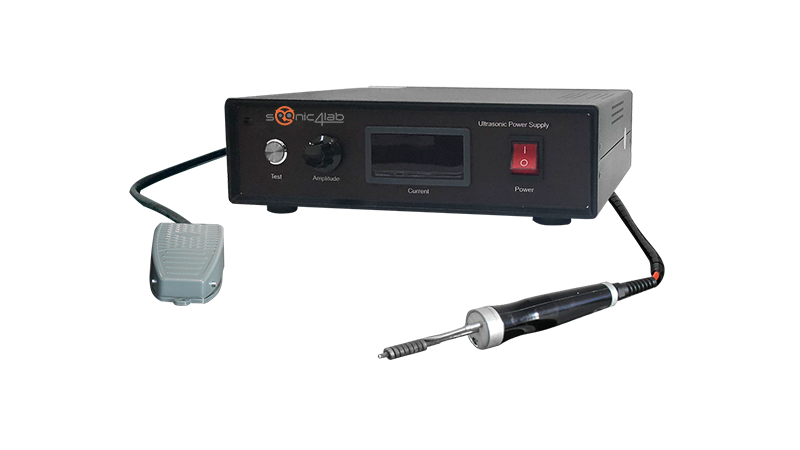
If you want to purchase equipment, please click here