
Ultrasonic Spraying Coating Optical Functional Layer
In the continuous breakthrough of optoelectronic device performance, the optical functional layer plays a crucial role. Anti reflective coatings (AR) and anti reflective films, as core representatives, have the mission of optimizing the efficiency of light manipulation – either significantly reducing interface reflection losses or maximizing the transmittance of light in specific wavelength bands. The quality of these micro – and even nano level coatings directly determines the energy capture efficiency of solar cells, the clarity of displays, the imaging quality of precision optical lenses, and the detection sensitivity of various sensors. Although traditional wet coating technology is widely used, its limitations are becoming increasingly prominent in the face of modern manufacturing demands for high precision, high efficiency, and low cost, and there is an urgent need to inject innovative processes.
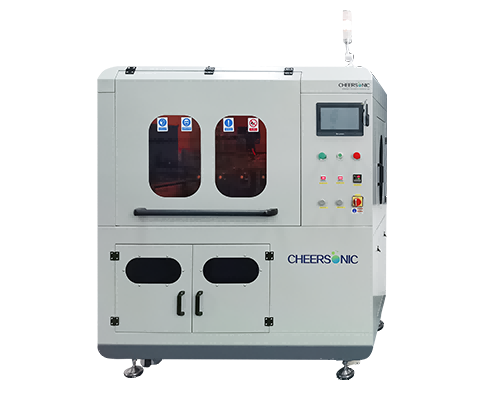
Precision atomization deposition: the core advantage of ultrasonic spraying
Ultrasonic spraying technology, with its unique precision atomization and low impact deposition characteristics, has opened up a new path for the manufacturing of high-quality optical functional layers. Its core lies in utilizing high-frequency vibration energy (usually far beyond the audible range of the human ear) to instantly tear and crush liquid coating materials into extremely fine and highly uniform micrometer sized droplets (usually in the range of 10-50 micrometers). This physical atomization process avoids high-pressure gas assistance, giving it significant advantages:
- Extraordinary uniformity and consistency: The generated ultrafine mist droplets have excellent flight stability and can gently cover the substrate with extremely low kinetic energy. Combined with precision motion control systems such as multi axis robotic arms and precision nozzle arrays, it is possible to achieve highly uniform coating thickness on complex surfaces or large-area substrates (with deviations controlled within ± 5%), which is crucial for anti reflective films that require precise control of optical phase.
- Extreme material utilization and cost-effectiveness: highly oriented spray mode and extremely low overspray loss (far lower than traditional air spraying) maximize the use of expensive functional coating materials (such as metal oxide sol with specific refractive index, nanocomposites). While reducing waste, it significantly lowers raw material costs, especially in large-scale production where efficiency doubles.
- Unparalleled film quality: The low impact deposition characteristics effectively prevent damage to the coating microstructure or substrate. By combining optimized formulations with drying/curing processes, the resulting coating surface is extremely smooth and dense, with low porosity, significantly reducing light scattering losses. For example, in AR coating applications, sub micron thickness control can be easily achieved to ensure reflectivity drops below 0.5%, and contact angle testing shows excellent surface smoothness.
- Excellent process adaptability: it has a wide tolerance range for solution viscosity and solid content (from low viscosity solvent to high solid content nano slurry), and can be compatible with a variety of functional material systems (such as SiO ₂, TiO ₂, Nb ₂ O ₂ sol gel, specific polymer, functional nano particle dispersion). The intelligent control system can accurately adjust the flow rate, atomization parameters, and deposition path to meet diverse needs from point coating, line coating to complex surface coating.
Empowering the forefront of optoelectronics: key application scenarios
Ultrasonic precision spraying technology is deeply integrated into the core manufacturing processes of multiple high growth optoelectronic fields:
- Enhancement of photovoltaic cell efficiency: Precise coating of broadband anti reflection layer on the surface of crystalline silicon and next-generation perovskite/stacked solar cells is the core means to improve the photoelectric conversion efficiency. Ultrasonic spraying can efficiently construct uniform nanoporous SiO ₂ or MgF ₂ film layers on large-sized (such as M10/G12 silicon wafers), textured structures, or flexible substrates, effectively reducing surface reflectivity (especially in the 300-1200nm spectral range), converting more photons into electrical energy, and assisting in the continuous improvement of component power.
- Advanced Display and Touch: In the manufacturing of flexible OLED, Micro LED display panels, and large-area touch sensors, this technology is used to deposit high-performance transparent conductive oxide (TCO) replacement layers (such as silver nanowires, carbon nanotubes, conductive polymer networks), high refractive index insulation layers, or flexible hard coatings. Its low-temperature and low stress characteristics perfectly match the flexible substrate (PI/PET), ensuring high transmittance (>90%) and low square resistance while endowing the device with excellent bending resistance.
- Upgrade of precision optical components: Coating high-performance multilayer anti reflective films or composite functional film layers (such as hydrophobic and anti fouling top films) for camera lenses, laser system optical components, and AR/VR lenses. Its non-contact spraying can avoid damaging the precision polished surface, achieve precise control of film thickness gradient on complex curvatures (such as non spherical surfaces), significantly improve imaging quality and system transmittance efficiency (for example, achieve the ultimate performance of visible light band average transmittance>99.5%).
- Intelligent sensing and optoelectronic integration: Ultrasonic spraying technology demonstrates its precise coating ability in micro areas on miniaturized devices such as fiber optic sensor end faces, photodetector windows, and optical filters, providing key functional interface layers for device integration.

Future oriented technology integration and evolution
The potential of ultrasonic spraying technology in the field of optical coating has not been fully explored. Its cutting-edge development is deeply integrated with materials science, automation, and artificial intelligence:
- Material innovation drive: facing higher performance requirements, new nanocomposites (such as high/low refractive index nano particle doping systems), smart response materials (photo/electrochromic), ultra-low refractive index aerogel coatings, etc. are using ultrasonic spraying to achieve controllable deposition and structural construction.
- Intelligent and integrated upgrade: deeply integrated with online film thickness monitoring (such as spectroscopic ellipsometry, interferometers), machine vision guided positioning, and AI driven closed-loop control algorithms to achieve real-time feedback and precise control of the coating process, moving towards “zero defect” manufacturing.
- Green manufacturing and sustainable development: Its high efficiency and low consumption naturally align with environmental trends. Combining water-based or low VOC environmentally friendly formulas, as well as efficient droplet collection and solvent recovery systems, further reduces the environmental footprint during the production process.
Ultrasonic spraying technology, with its core characteristics of precision, efficiency, and flexibility, is profoundly reshaping the manufacturing paradigm of optical functional films. It not only solves the pain points of traditional processes in uniformity, material utilization, and adaptability to complex substrates, but also provides a powerful and sustainable process engine for achieving the ultra-high performance, complex structure, and low-cost mass production required for the next generation of optoelectronic devices. With the continuous deepening of interdisciplinary integration, ultrasonic precision spraying will undoubtedly become one of the core enablers for the optoelectronic industry to break through performance boundaries and explore innovative applications.
About Cheersonic
Cheersonic is the leading developer and manufacturer of ultrasonic coating systems for applying precise, thin film coatings to protect, strengthen or smooth surfaces on parts and components for the microelectronics/electronics, alternative energy, medical and industrial markets, including specialized glass applications in construction and automotive.
Our coating solutions are environmentally-friendly, efficient and highly reliable, and enable dramatic reductions in overspray, savings in raw material, water and energy usage and provide improved process repeatability, transfer efficiency, high uniformity and reduced emissions.
Chinese Website: Cheersonic Provides Professional Coating Solutions
