Slurry Homogenization in Lithium-ion Battery Manufacturing Process
Why focus on “homogenization”?
If comparing lithium-ion battery manufacturing to baking a cake, slurrying is akin to “whisking egg yolks” – it appears to be a simple mixing process on the surface, but in reality, it determines the quality ceiling for subsequent coating and rolling processes, and even directly affects the battery’s cycle life. Industry data shows that defects in the electrode sheets caused by the slurrying process account for more than 35% of the reasons for subsequent scraping of electrode sheets. In other words, if there are oversights in this step, even if high-end equipment is used later, it will only be a struggle to compensate for the shortcomings.

What is the core of homogenization?
In brief: Homogenization is the process of mixing the main active powder, binder, conductive agent, and solvent into a uniform non-Newtonian fluid in a closed tank through specific process steps. In addition to traditional mechanical mixing methods, ultrasonic dispersion technology is gradually being applied to the homogenization process of lithium batteries due to its unique advantages in the dispersion of micro- and nano-scale materials.
Analysis of the four-step process: from “dry powder” to “coatable slurry”
① Pinch and knead
The core of kneading lies in ensuring sufficient wetting of the main powder, conductive agent, and binder, and achieving initial dispersion through friction between the materials. The key to this step is precise control of the solid content: if the solid content is too high, it can easily lead to uneven wetting, internal residual dry powder, and ultimately particles and uneven mixing in the slurry; if the solid content is too low, it can cause excessive wetting, slippage during kneading, and a significant reduction in dispersion effect. Within a reasonable range, as the solid content approaches the upper limit, the viscosity of the slurry can be reduced and the concentration can be increased, whereas if the solid content is too low, the viscosity will increase and the concentration will decrease. The end point of kneading is usually determined by the equipment current becoming stable and no longer decreasing.
② Wetting (solvent replenishment)
After kneading, more solvent needs to be added to fully wet the surface of each powder particle, reduce interfacial energy, and create favorable conditions for subsequent dispersion. For nano-sized active powders or conductive agents that are prone to agglomeration, a small amount of dispersant can be added in advance at this stage to enhance the subsequent ultrasonic dispersion.
③ Dispersion (high-speed shearing + ultrasonic assistance)
Common equipment used in the dispersion stage includes double planetary mixers, twin-screw dispersers, and continuous online dispersers. Currently, the mainstream equipment is the double planetary mixer, but twin-screw and continuous dispersing equipment have gradually become alternative choices. The core function of high-speed shearing is to achieve macroscopically uniform mixing of various components, while ultrasonic dispersion technology can be used as a key supplement or an independent dispersion method in this process.
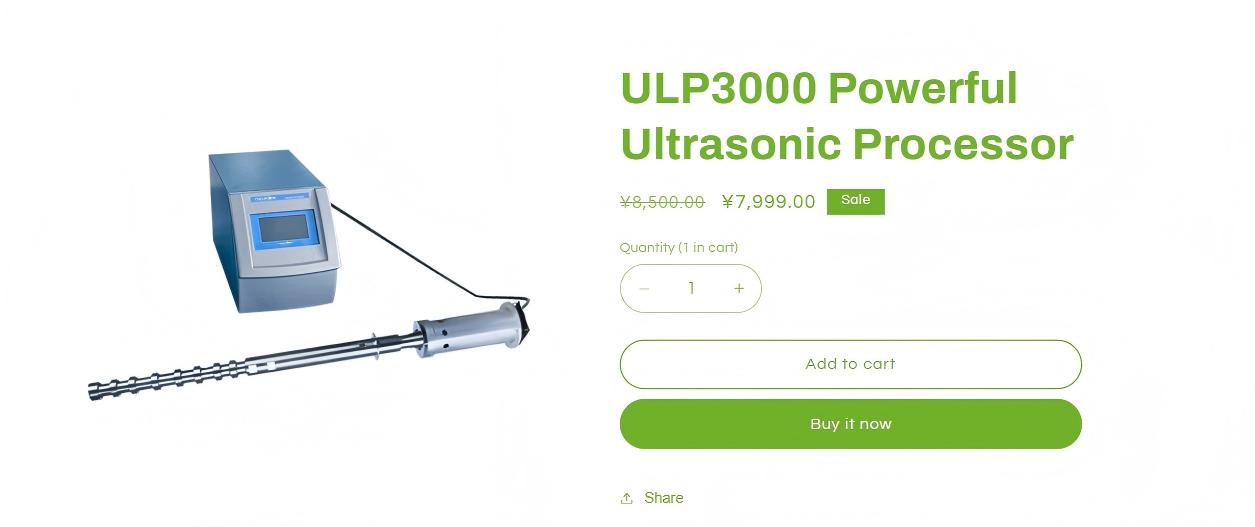
Principles and Applications of Ultrasonic Dispersion
Ultrasonic dispersion generates a “cavitation effect” in the slurry through high-frequency mechanical vibration (typically 20-50kHz) – that is, tiny bubbles rapidly form and collapse, generating local high temperature and pressure as well as intense microjets, directly breaking down powder agglomerates and achieving uniform dispersion at the microscopic level. Its advantages are reflected in three aspects: first, high dispersion efficiency, especially for conductive agents prone to agglomeration such as carbon nanotubes and graphene; second, good dispersion uniformity, which can reduce micron-sized particle residues in the slurry and minimize microdefects in the electrode sheet; third, minimal damage to the binder, making it easier to retain the binder network structure compared to excessive mechanical shear.
In practical applications, ultrasonic dispersion can adopt a combined process of “mechanical pre-dispersion followed by ultrasonic fine dispersion”, or perform online ultrasonic treatment on high-viscosity, high-solid content slurries. It is important to control the ultrasonic power and treatment time: too low a power can easily lead to incomplete dispersion, while too high a power may cause solvent evaporation or binder degradation due to local overheating; too long a treatment time may also cause abnormal fluctuations in slurry viscosity.
④ Viscosity adjustment & De-foaming
Adjusting viscosity is to adapt to the coating process. There are specific viscosity windows for positive and negative electrode slurries: positive electrode typically ranges from 8000–12000mPa·s, while negative electrode is between 4000–6000mPa·s. For slurries dispersed using ultrasonic waves, the viscosity may slightly decrease due to improved dispersion. During adjustment, it is necessary to fine-tune the solvent addition based on actual test results. Defoaming is often achieved through vacuum pumping by equipment, which can effectively avoid “volcano-like” defects caused by bubbles during coating.
Handling plan for abnormal viscosity
- Abnormal viscosity is mainly divided into two categories: high and low;
- Reasons for high viscosity: high solid content, excessive particle size variation in the main powder, uneven dispersion, abnormal binder, etc. If ultrasonic dispersion is used, insufficient ultrasonic power or too short treatment time may lead to insufficient dispersion, indirectly causing high viscosity;
- Reasons for low viscosity: too low solid content, excessive particle size variation in the main powder, abnormal binder, excessive dispersion, etc. If ultrasonic dispersion is used, be cautious of binder degradation caused by excessively high ultrasonic power or prolonged treatment time, which may lead to low viscosity;
- Handling of high viscosity: First, verify the solid content and fineness. If there are no abnormalities, proceed with viscosity adjustment – for the positive electrode, add approximately 1000–2000mPa·s for every 10kg of NMP added; for the negative electrode, add approximately 800–1500mPa·s for every 10kg of water added (during adjustment, pay attention to changes in solid content to avoid affecting the coating surface density due to concentration fluctuations). If insufficient dispersion is suspected, appropriately increase the ultrasonic power or extend the treatment time (while simultaneously monitoring the slurry temperature to avoid overheating);
- Low viscosity treatment: First, verify the solid content and fineness. If there are no abnormalities, the material can be discharged under concession. During the production of the next kettle, focus on checking whether the kneading state and ultrasonic parameters (such as reducing power and shortening treatment time) are abnormal.
Summary
The technical know-how of homogenization process goes far beyond this. The combination of traditional mechanical dispersion and new dispersion technologies such as ultrasonic waves is driving the development of homogenization quality towards higher precision. It’s difficult to elaborate on it in a short article. I hope today’s sharing can help you accurately say “I found the root of the problem” during the morning meeting, rather than just trying to “make another batch for trial and error”.