Guidelines for Lab Dispersed Photovoltaic Conductive Paste
Photovoltaic conductive paste (usually including silver paste, aluminum paste, etc.) is a key material for manufacturing solar cell electrodes. The conductive particles (such as silver powder and aluminum powder) are prone to agglomeration during storage and transportation, which affects the printing performance of the paste and the electrical performance of the battery cells. Ultrasonic dispersion is one of the most commonly used and effective methods for preparing and optimizing conductive slurries in the laboratory, which utilizes the high-frequency, high-energy vibration (“cavitation effect”) generated by ultrasound in liquids to break down aggregates and evenly disperse them in organic carriers.
Guidelines for Operating Laboratory Ultrasonic Dispersed Photovoltaic Conductive Slurry
Core principle: Cavitation effect
The ultrasonic generator (transducer) converts high-frequency electrical signals into mechanical vibrations and transmits them into the slurry through a probe (amplitude rod). This vibration generates countless tiny vacuum bubbles in liquid media and rapidly ruptures them, instantly producing extremely high local pressures (up to 1000 atm) and temperatures (up to 5000 K), forming strong shock waves and microjets. This tremendous force can effectively impact, peel off, and break the aggregates of conductive particles, thereby achieving uniform dispersion of nanometer or micrometer sized particles.

Main equipment and consumables
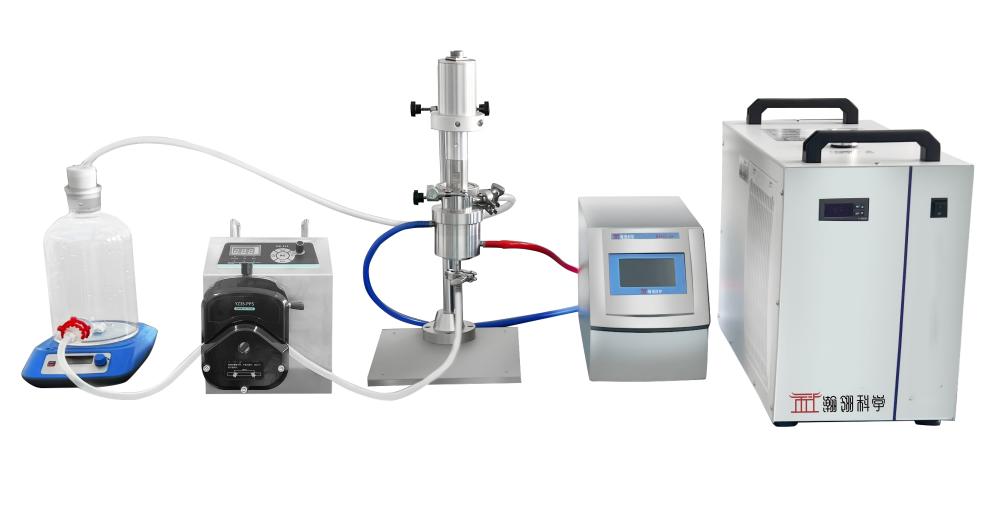
1. Ultrasonic cell grinder/ultrasonic processor: core equipment. Includes generator, transducer, and probe (amplitude rod). The commonly used power in the laboratory is 200W-1000W.
2. Ultrasonic probe (amplitude rod): made of titanium alloy material, directly inserted into the slurry. The appropriate model (such as Φ 6mm, Φ 10mm) should be selected based on the sample size and container.
3. Sample container: It is recommended to use a slender glass beaker (such as a 50ml or 100ml beaker). Avoid using plastic containers as ultrasound can corrode plastics and introduce pollutants.
4. Ice water bath device: crucial! Ultrasonic dispersion generates a large amount of heat, leading to a sharp increase in the temperature of the slurry, which may cause organic solvents to evaporate and resin to denature, thereby changing the rheological properties of the slurry. The sample beaker must be placed in an ice water bath for ultrasound.
5. Personal protective equipment (PPE): goggles, lab coats, gloves. Prevent the slurry (which may contain harmful solvents) from splashing during the ultrasonic process.
6. Other tools: electronic balance, pipette, scraper, etc.
Operation steps
1. Preparation work:
*Weigh an appropriate amount of conductive paste that needs to be dispersed (e.g. 20g).
*Transfer the slurry to a suitable glass beaker.
*Prepare a larger beaker and fill it with an ice water mixture. Place the beaker containing the slurry in an ice water bath, ensuring that the ice water level is slightly higher than the slurry level.
*Install and fix the ultrasonic probe, wipe and disinfect with alcohol, and air dry.
2. Set parameters:
*Power: usually set to 30% -60% of the total power. For example, a 600W instrument typically has a power range of 180W-360W. For high viscosity slurries, it is recommended to start with lower power and gradually increase it to avoid initial excessive heating and splashing.
*Working Time: Adopting “Pulse Mode” is a crucial step. Suggested settings: working time (ON) 2-5 seconds, intermittent time (OFF) 3-8 seconds. The total ultrasound time is usually within the range of 2-10 minutes and needs to be optimized through experiments.
*Probe position: Insert the probe vertically into the middle of the slurry, and the end of the probe should be 1-2 centimeters away from the bottom of the container, avoiding touching the bottom and wall of the cup to prevent damage to the probe and container.
3. Start ultrasound:
*Turn on the power and start the ultrasound program.
*During the ultrasound process, slowly and slightly move up and down (within a range of about 1-2cm) or translate the beaker to make the energy distribution more uniform and prevent the formation of “cavitation channels” below the probe, which may cause uneven dispersion.
*Closely observe the condition and temperature of the slurry, and replenish ice cubes in a timely manner.
4. Follow up processing:
*After the ultrasound is completed, immediately remove the probe and turn off the power.
*Let the slurry stand for a moment, allowing it to return to room temperature and eliminate internal bubbles.
*Characterize the properties of the dispersed slurry (see below).
Key considerations and optimization techniques
Temperature control is the top priority: always perform in an ice water bath! It is best to control the temperature of the slurry below 40 ° C.
Avoid introducing bubbles: Ultrasonic waves will vigorously stir the liquid, which can easily introduce a large number of bubbles. Intermittent mode and standing after ultrasound can effectively eliminate bubbles.
Prevent contamination: Ensure that the probe and container are clean. Titanium alloy probes may experience slight wear during ultrasonic processes, but their impact on slurry properties is usually negligible.
Parameter optimization: There is no ‘universal parameter’. The optimal power and time depend on:
*Slurry viscosity: The higher the viscosity, the greater the required power, but more attention should be paid to heat dissipation.
*Agglomeration intensity: The more severe the agglomeration, the longer the total time required.
*Particle material and size: The optimization conditions for silver powder and aluminum powder may be different.
*Suggest systematically optimizing power and time through design experiments (DOE) to find the optimal combination.
Safety first: Always wear goggles to prevent high-energy ultrasound from splashing the slurry.
Effect characterization
After ultrasonic dispersion, the effectiveness needs to be evaluated through the following methods:
*Fineness meter (scraper fineness meter): the most direct and rapid method. Observe the particle exposure after scraping to determine the degree of dispersion and maximum particle size.
*Viscosity testing: Good dispersion usually leads to a decrease in the viscosity of the slurry and tends to stabilize.
*Resistance/Square Resistance Test: After printing the slurry into a film and sintering it, measure its conductivity. The better the dispersion, the higher the conductivity is usually.
*Microscopic morphology observation (SEM): directly observe the density and uniformity of the sintered silver/aluminum film to determine the initial dispersion state of the slurry.
Summary: Laboratory ultrasonic dispersion is a key process for treating photovoltaic conductive paste. Strictly controlling temperature, using intermittent mode, optimizing power and time parameters are the core to achieve good dispersion effect and avoid deterioration of slurry performance. Providing feedback and guidance on the optimization of ultrasonic processes through systematic characterization is an important step in improving the performance of solar cell electrodes.