Lab Ultrasonic Dispersion Lithium-ion Battery Slurry
In the research and development experiments of lithium-ion batteries, ultrasonic dispersion technology is a key means to explore new slurry formulations and optimize dispersion processes, and its application mode is significantly different from industrial production.
The laboratory usually uses a probe type ultrasonic disperser (power range 50-300 W, frequency 20-40 kHz), which can be adapted to small batch slurry preparation of 10-500 mL by changing probes of different sizes (such as diameter 6 mm, 10 mm), suitable for formula screening and dispersion mechanism research needs. In practical operation, multiple parameters need to be precisely controlled: ultrasound power (usually set at 80-150 W for carbon nanotube slurry to prevent structural damage caused by excessive ultrasound), processing time (about 5-30 minutes, adjusted according to the solid content, such as 15-20 minutes for silicon carbon slurry with a solid content of 20%), and temperature control (maintaining the slurry temperature at 25-35 ℃ through water bath or ice bath to avoid adhesive denaturation caused by ultrasound thermal effect).
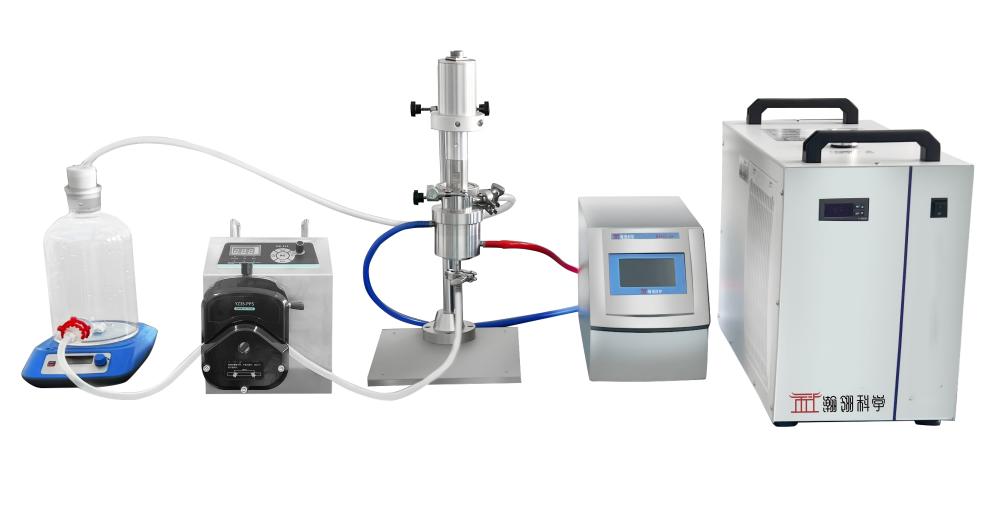
The core advantages of laboratory ultrasound dispersion include:
- Single variable control research can be achieved, such as fixing other conditions and only adjusting ultrasound power, and systematically analyzing the impact of dispersion on battery capacity, internal resistance, and other performance;
- For new materials such as two-dimensional material MXene and new conductive agents, their dispersion feasibility in slurry systems can be quickly evaluated, providing experimental basis for industrial applications;
- Without considering energy consumption and economic costs in large-scale production, we can focus on studying the correlation mechanism between dispersed quality and electrochemical performance. For example, transmission electron microscopy (TEM) can be used to observe the dispersion state of conductive agents and coupled with battery cycling performance testing to determine the optimal dispersion process parameters.
In addition, ultrasound dispersion is often combined with other mixing methods in experimental environments (such as “ultrasound+low-speed stirring”), which effectively depolymerizes nanoclusters through cavitation effect and achieves macroscopic uniform mixing through mechanical stirring, thus providing an effective technical path for the development of high-performance lithium-ion battery slurries.