Why do conductive agents need ultrasonic dispersion?
The use of ultrasonic dispersion technology to uniformly disperse conductive agents (such as carbon nanotubes, graphene, Ketchen black, acetylene black, etc.) is crucial for preparing high-performance electrodes, especially in the fields of lithium-ion batteries, capacitors, etc.
Conductive agents, especially nanoscale materials such as CNTs and graphene, have extremely high specific surface area and strong van der Waals forces, making them prone to agglomeration and forming difficult to open aggregates. Simple mechanical stirring cannot effectively disperse these aggregates, which can lead to:
1. Uneven conductive network: Agglomerated conductive agents cannot form a continuous and efficient conductive network, and some active substances become “dead zones”, leading to an increase in electrode internal resistance.
2. Poor stability of the slurry: unevenly dispersed slurry is prone to settling, causing uneven coating and affecting the consistency of the battery.
3. Performance degradation: Ultimately leading to poor rate performance, cycle life, and capacity utilization of the battery.
Ultrasonic dispersion is a key technology that utilizes the cavitation effect generated by ultrasonic waves in liquids to solve this problem.
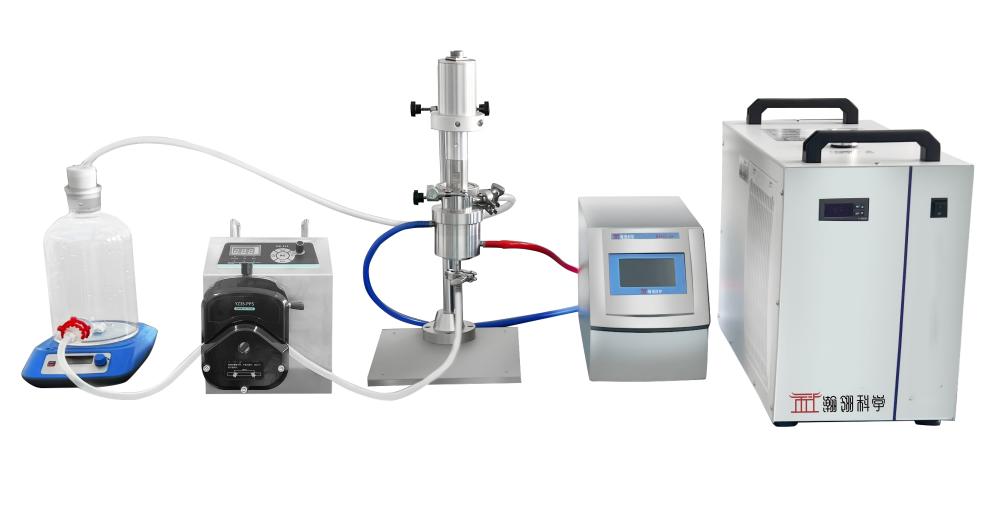
The working principle of ultrasonic dispersion: cavitation effect
1. Generate ultrasonic waves: The ultrasonic generator (transducer) converts electrical energy into high-frequency (usually 15-50kHz) mechanical vibrations.
2. Transmission to liquid: This vibration is transmitted into the liquid medium (such as NMP, water, etc.) through the probe (titanium alloy probe has the highest efficiency) or the cleaning tank wall.
3. Formation and rupture of cavitation bubbles: Ultrasonic waves form longitudinal waves with alternating density in the liquid, generating tiny vacuum bubbles (cavitation bubbles) in the negative pressure zone, which are rapidly crushed and ruptured in the positive pressure zone.
4. Release enormous energy: At the moment of cavitation bubble rupture, it will generate locally extreme high temperatures (about 5000K), high pressures (about 1000atm), and strong micro jets (shock waves).
5. Crushing aggregates: These enormous energies directly act on the aggregates of conductive agents, dispersing and separating them through strong shear and impact forces, thereby achieving uniform dispersion at the nanoscale.